


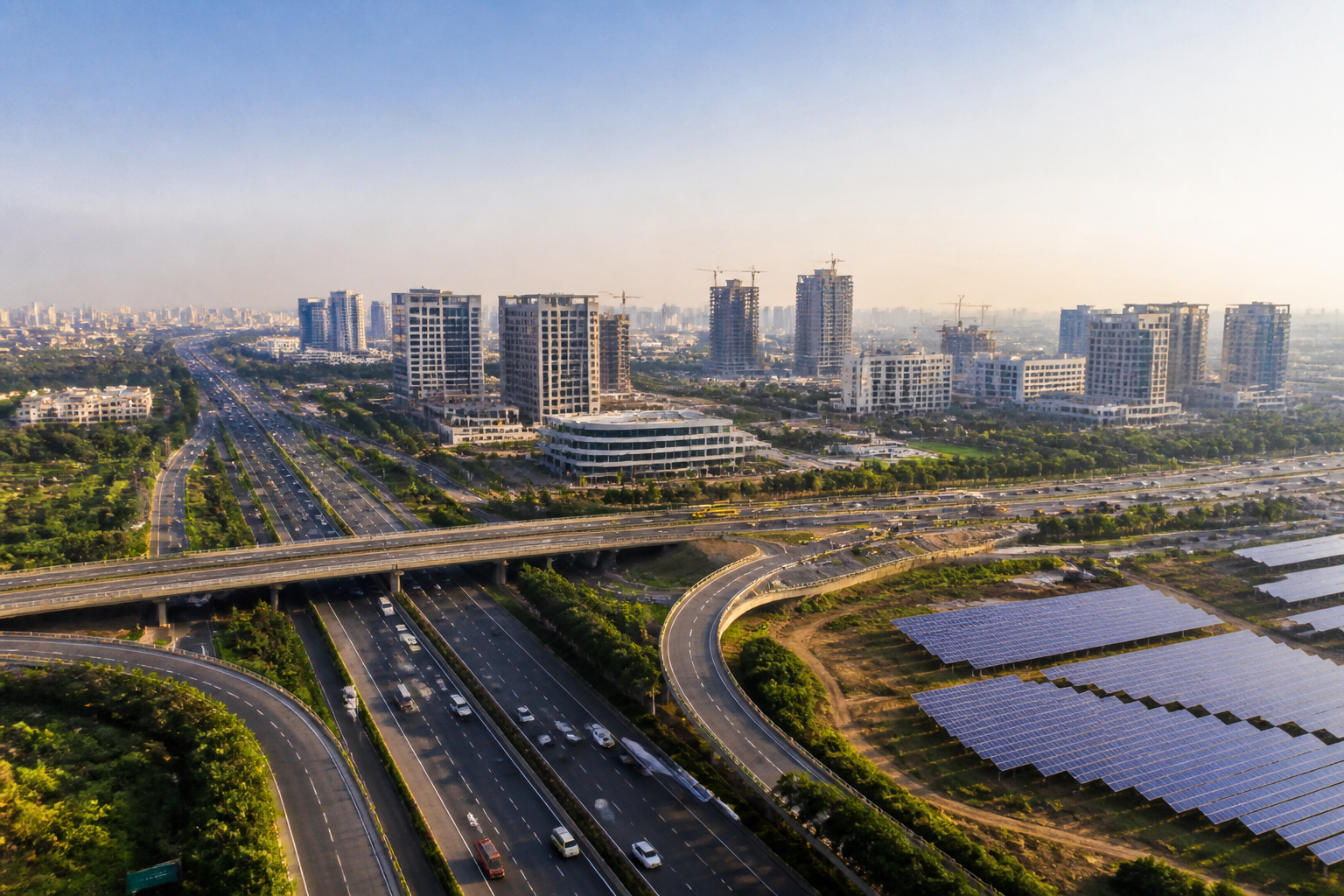
Telangana’s plan to build a $3 trillion economy by 2047 places Hyderabad’s next phase of growth on a much larger urban canvas. Unveiled by Chief Minister A Revanth Reddy at a state government event in Hyderabad, the roadmap combines the proposed Bharat Future City with transport infrastructure, industrial corridors, data centres, welfare, housing, skills and public-service commitments. Its central challenge will not be the ambition of the target, but whether the state can convert a broad economic vision into a coordinated, serviced and liveable urban system.
The announcement is significant because it treats urban expansion and economic growth as parts of the same policy project. The state says it wants to raise Telangana’s contribution to India’s GDP to 10% by 2047. At the centre of that strategy is a proposed 30,000-acre net-zero smart city, described as Bharat Future City, with specialised clusters for artificial intelligence, healthcare, education, life sciences and electric vehicles. The project is also expected to host the Young India Skills University.
The government’s stated model therefore extends beyond building a new business district. It seeks to connect investment-led growth with human capital, social welfare and infrastructure. That is a substantial shift in the scale of planning implied by the announcement: Future City is being positioned not as an isolated real estate development, but as an economic geography that could influence where jobs, institutions, housing and transport capacity are created across the Hyderabad region.
Yet the available details also show that the project is still at the roadmap stage. The master plan for Future City is expected to be unveiled at the Invest Telangana Global Summit-2026 in December. Until that plan is published, the announcement does not establish the city’s precise land-use structure, transport network, development phasing, utility systems, governance arrangement or financing framework. Those details will determine whether the project functions as an integrated city or as a collection of investment-led enclaves.
The infrastructure promise is extensive. The chief minister highlighted the Regional Ring Road, greenfield highways, dry ports and industrial corridors connecting Hyderabad with Nagpur, Bengaluru and Vijayawada. He also said road projects worth more than Rs 19,000 crore were being executed through the roads and buildings and panchayat raj departments. These commitments indicate that the government sees regional connectivity as essential to attracting industry and distributing economic activity beyond the existing urban core.
The institutional question is how these projects will fit together. Roads, ring roads, industrial corridors, dry ports and a new urban centre do not operate as separate investments. Their value depends on the connections between them, the availability of water and electricity, the movement of workers and goods, and the ability of public agencies to coordinate land development with infrastructure delivery. The source report identifies several departments involved in road execution, but it does not set out a single authority responsible for integrating the wider Future City programme.
That coordination issue is especially important because the proposed city is designed around several specialised hubs. An AI city, health city, education city, life sciences hub and electric vehicle park could generate demand for different types of buildings, utilities, transport and skills. They could also create different patterns of land use and employment. The announcement identifies the sectors, but not the mechanisms through which they will share infrastructure, services or public space.
The scale of proposed private investment adds urgency to the planning question. Revanth said Tata Consultancy Services had proposed a Rs 70,000-crore artificial intelligence data centre and Amazon had begun work on a Rs 1 lakh crore data centre. These projects, as described in the report, are intended to help establish Future City as a technology and investment destination. Data centres, however, are infrastructure-intensive facilities. Their integration into a new city will require clarity on power demand, water supply, land, connectivity and resilience, although the supplied material does not provide project-level details on these requirements.
The chief minister also referred to rising power demand and the need to ensure uninterrupted electricity and drinking water supply despite a rainfall deficit attributed to El Niño conditions. This places utilities at the centre of the economic roadmap. A growth strategy that depends on technology facilities, industrial corridors and a large new urban district will be judged not only by investment announcements, but by the reliability and reach of basic services.
The state’s development model is presented as a combination of growth and redistribution. The chief minister said crop loans of up to Rs 2 lakh had been waived for 25.35 lakh farming families at a cost of Rs 20,616 crore. He also cited more than Rs 36,000 crore transferred under the Rythu Bharosa scheme and a Rs 500-per-quintal bonus for fine-variety paddy. These measures are not urban infrastructure projects, but they are part of the political and economic framework within which the state is presenting its long-term transformation.
The same applies to the welfare measures outlined at the event: free bus travel for women, 200 units of free electricity for more than 53 lakh households and subsidised LPG cylinders for 43 lakh families. The government said 4.5 lakh houses had been sanctioned in the first phase of the Indiramma housing scheme and another 2.5 lakh had been approved in the second phase. For a rapidly expanding urban region, the housing figures raise a central planning issue: whether employment growth and new investment will be accompanied by sufficient affordable and accessible housing.
The announcement does not provide a housing plan for Future City or the proposed industrial corridors. It also does not specify how workers employed in data centres, manufacturing, healthcare, education and construction will be accommodated. Those omissions do not invalidate the roadmap, but they mark the difference between an investment strategy and a complete urban development strategy. The eventual master plan will need to clarify how residential areas, social infrastructure and transport are organised alongside specialised economic zones.
The government has also linked the roadmap to education and healthcare. It cited Young India Integrated Residential Schools, expanded scholarship coverage and efforts to attract international universities to Hyderabad. In healthcare, the state has increased Aarogyasri coverage to Rs 10 lakh and is constructing a new Osmania Hospital at an estimated cost of Rs 2,700 crore. These commitments suggest that the state is attempting to build a broader human-capital platform around its economic ambitions rather than relying only on private investment.
However, the evidence supplied does not establish how these education and healthcare initiatives will be distributed across the existing city, Future City and the wider regional network. Nor does it specify whether the proposed specialised hubs will be served by public institutions, private providers or a combination of both. The distinction matters because the presence of high-value sectors does not automatically ensure universal access to services or opportunities.
The proposed transport network is another test. The Regional Ring Road and greenfield highways could improve freight and passenger connectivity, while corridors towards Nagpur, Bengaluru and Vijayawada could strengthen Telangana’s regional economic links. But the announcement focuses on the existence and value of these projects rather than their detailed alignment, construction timelines, funding arrangements or integration with public transport. For residents, the practical measure of connectivity will be travel time, reliability and affordability, not only the length or cost of highways.
The data in the announcement is therefore strongest on ambition and expenditure commitments, and weaker on implementation sequencing. The state has supplied a $3 trillion economic target, a 10% intended contribution to India’s GDP, a 30,000-acre Future City, major proposed data-centre investments, more than Rs 19,000 crore in road projects and a Rs 2,700-crore new Osmania Hospital. It has also listed household, housing, farming and welfare figures. What remains unavailable in the supplied material is a consolidated timeline showing how these separate programmes will be delivered and evaluated.
This is where the December master plan becomes the next important milestone. Its significance will lie not simply in confirming the idea of Future City, but in establishing the rules of development. Readers and institutions will need to see how land, infrastructure, housing, mobility, utilities, environmental objectives and public services are connected. The government has described the project as a net-zero smart city, but the source report does not provide the performance standards, monitoring arrangements or implementation agency that would give that label operational meaning.
The roadmap also raises a question about the relationship between Hyderabad and the rest of Telangana. The government says the state is competing globally rather than only with neighbouring states, while the proposed corridors and dry ports point to a regional growth strategy. If the new infrastructure concentrates benefits around Hyderabad, it could reinforce the metropolitan area’s economic dominance. If it is paired with distributed industrial, educational and logistics activity, it could create a wider network of urban and regional opportunities. The supplied announcement does not yet establish which outcome is intended or how it will be measured.
For citizens, the meaning of the plan will ultimately be determined by everyday outcomes: access to housing, reliable power and water, affordable mobility, functioning public institutions and employment that is reachable without excessive travel. The government’s welfare and housing claims indicate awareness of these concerns, while the Future City proposal indicates a desire to attract globally significant investment. The unresolved issue is how these two priorities will be designed into the same urban system.
Telangana’s $3 trillion roadmap is therefore best understood as an opening framework rather than a completed development plan. The announcement confirms a large economic and infrastructure ambition centred on Future City, supported by regional connectivity, technology investment, welfare, housing, education and healthcare. It does not yet establish the institutional, financial and spatial arrangements required for delivery. The master plan expected in December, along with details on utilities, transport, housing, governance and implementation, will determine whether the proposal becomes a coordinated new urban district or remains a collection of sectoral promises.
