


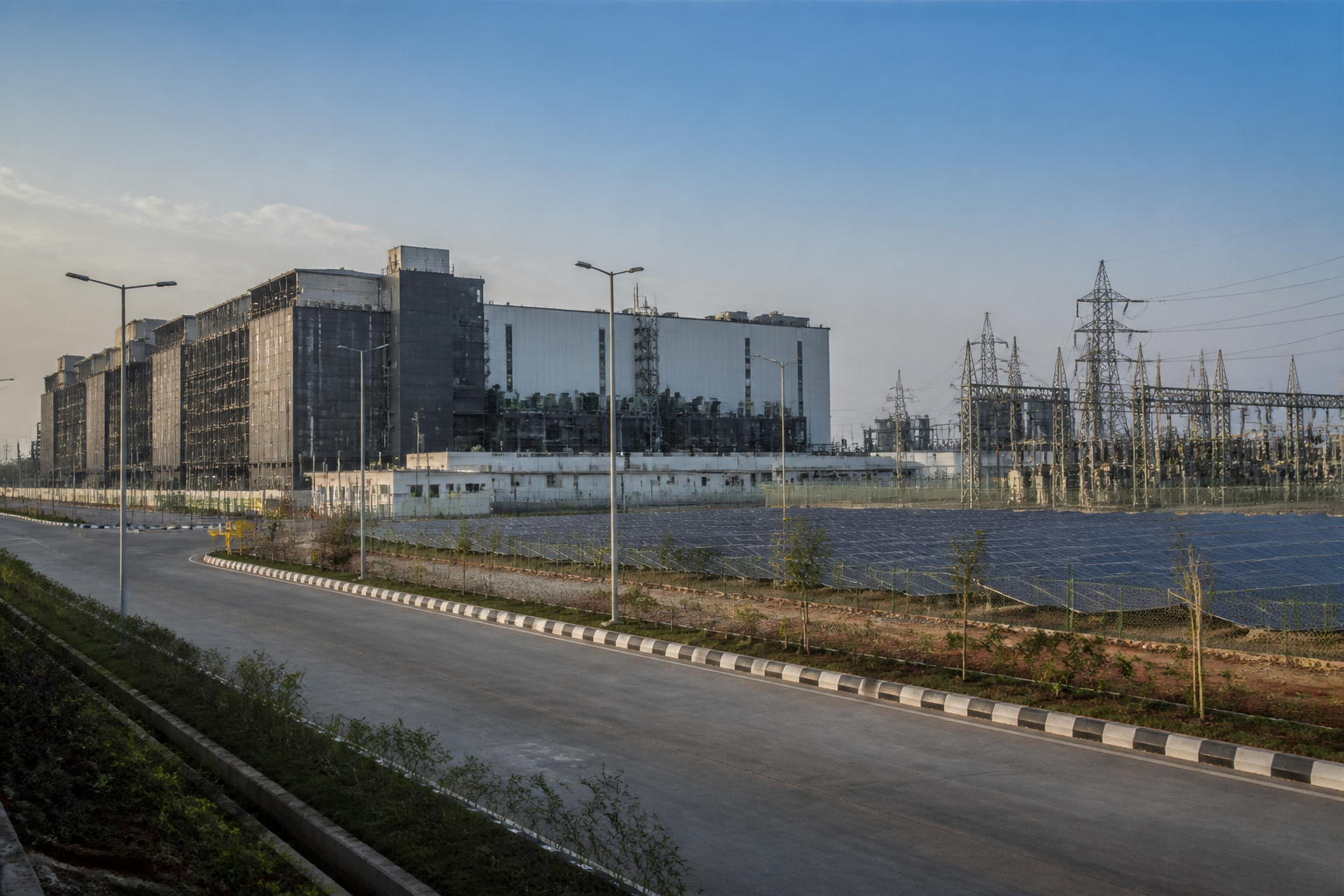
EQT’s plan to invest around $50 billion in India by 2030 is more than a large private-equity commitment. Its proposed allocation shows how the country’s urban and digital infrastructure agenda is increasingly being shaped by the computing capacity required for artificial intelligence, alongside the energy systems needed to support it.
The Swedish investment firm expects data centres to account for about $30 billion of the proposed investment. Around $5 billion is expected to go into solar and renewable energy, while $15-20 billion is earmarked for private-equity investments. The numbers indicate a strategy built around the physical infrastructure of the AI economy as well as the companies that will use and supply it.
Jean Eric Salata, chair of EQT Group, said at a media briefing in Mumbai that India had become one of the firm’s most important markets globally. EQT has invested $26 billion in the country since inception, according to the company. Its earlier investments were concentrated primarily in technology services, but the firm has since expanded into healthcare, pharmaceuticals, digital infrastructure and data centres.
That shift matters because data centres are no longer simply specialised technology facilities located on the edge of cities. They are becoming part of the infrastructure base on which cloud computing, enterprise software and AI services depend. Their expansion links investment decisions made by global funds to land, electricity, fibre connectivity, cooling systems and local planning decisions.
## From technology services to physical computing capacity
EQT has already invested about $10 billion in Indian data centres and expects to deploy another $20 billion by 2030. Much of the expansion will be carried out through EdgeConneX, EQT’s global data-centre platform, and its joint venture with the Adani Group, AdaniConneX.
The firm expects its data-centre capacity in India to rise from around one gigawatt currently to as much as five gigawatts. That is a fivefold increase in stated capacity. The investment plan therefore reflects not only a financial allocation but also an expected transformation in the scale of computing infrastructure available in the country.
The immediate driver identified by EQT is the growth of AI. Hyperscalers are leasing data-centre capacity to provide cloud and AI services, increasing demand for facilities capable of supporting large-scale computing. The source report does not establish how much electricity, water or land the proposed capacity will require, but the scale of the expansion places those questions at the centre of India’s infrastructure planning.
For cities and regions hosting these facilities, the consequences are likely to be administrative as much as technological. Data centres require reliable power, high-capacity network connections, secure sites and predictable approvals. Renewable-energy investments may help address part of the power requirement, but the supplied material does not specify whether EQT’s proposed $5 billion allocation will be directly linked to its data-centre portfolio or how the projects will be distributed geographically.
## The AI infrastructure chain is widening
The proposed allocation also shows that the AI economy is being treated as a chain rather than a single sector. At one end are the data centres and networks that provide computing capacity. At another are technology-services companies that help enterprises implement AI. Between them are energy projects, cloud platforms and companies at different stages of maturity.
Hari Gopalakrishnan, cohead of Private Capital Asia at EQT, said the firm expected technology-services companies to experience an AI wave similar to the earlier digital wave. For EQT’s portfolio, he said, every company was growing well. Salata described AI as both a disruptive force and a current source of growth for the technology-services industry.
The statements point to an important distinction. AI adoption does not remove the need for technology-services firms; it changes the work they are expected to perform. Enterprises still require engineers and technology partners to implement AI systems, according to Salata. Nicholas Macksey, cohead of Private Capital Asia and head of Mid-Market Asia at EQT, identified skills shortages in diffusing AI into enterprises as the biggest gap to adoption.
This places human capability alongside physical infrastructure as a constraint on AI expansion. A data centre can provide computing capacity, but enterprises still need organisations and workers able to integrate that capacity into business operations. EQT’s investment approach consequently covers both the facilities that host digital services and the companies that help customers use them.
## A longer investment lifecycle
EQT is also preparing an Early Stage Asia Strategy that is expected to expand into a regional programme including India. The strategy is expected to target Series-B and Series-C companies where product-market fit has already been established. The firm expects to write equity cheques of around $20-50 million for stakes of roughly 3-10 per cent, while also evaluating AI-first businesses.
This gives the investment plan a wider reach than a conventional infrastructure expansion. It would cover early-stage technology ventures, mid-market businesses and mature companies through EQT’s flagship buyout funds. The same strategy would also invest in the infrastructure supporting the AI economy.
The structure is significant for India’s urban economy because it connects different scales of activity. Data centres are capital-intensive facilities with large physical footprints and infrastructure requirements. Early-stage technology companies are more dispersed and dependent on talent, business networks and enterprise demand. Private-equity investments in mature companies can involve succession planning, ownership transitions and operational restructuring.
Gopalakrishnan said the total buyout market in India had grown seven times in the last 13 years, attributing the expansion partly to founders and founding families seeking succession solutions and suitable homes for their businesses. He said founders wanted investors who understood their businesses and could drive value creation.
The supplied report does not provide the base size of the buyout market or define the period over which the sevenfold growth was measured. The claim is therefore best understood as EQT’s description of market expansion rather than as a complete measure of India’s private-equity sector. Even so, it helps explain why the firm sees opportunities beyond new technology ventures and infrastructure assets.
## What the investment means for infrastructure planning
The most consequential part of the proposed allocation is the interaction between data centres and energy. EQT expects to increase its Indian data-centre capacity from around one gigawatt to as much as five gigawatts, while also planning about $5 billion in solar and renewable-energy investments. The numbers place digital infrastructure and energy infrastructure within the same capital strategy.
That relationship is central to the next phase of urban development. Data centres need continuous and reliable power rather than only high annual generation. Renewable projects can contribute to that system, but the source material does not say how power will be contracted, transmitted, stored or matched to data-centre demand. It also does not identify the states or cities that may receive the investment.
The absence of those details is important. A national investment announcement does not by itself establish where facilities will be built or how local authorities will manage their effects. Site selection will determine the pressure placed on electricity networks, fibre routes, roads, water systems and land. It will also shape the employment and economic benefits available to host regions.
For policymakers, the challenge is to treat data centres as infrastructure requiring coordinated planning rather than as isolated corporate buildings. The investment figures show the scale of private capital available, but they do not settle questions about approvals, grid capacity, environmental requirements or the distribution of benefits. Those issues will depend on project-level decisions that have not been disclosed in the supplied material.
## The institutional gap between capital and delivery
EQT’s announcement also highlights the difference between investment capacity and implementation capacity. Private capital can fund facilities, platforms and companies, but delivery depends on public and private institutions working across sectors. Data-centre expansion requires coordination among power providers, network operators, land and planning authorities, local administrations and the companies leasing capacity.
The same applies to renewable energy. A stated allocation does not automatically translate into operational projects. The eventual impact will depend on project approvals, construction schedules, transmission access and the commercial arrangements connecting generation to demand. None of those milestones has been specified by EQT in the supplied report.
This is where India’s AI infrastructure strategy becomes an urban governance question. The country’s ability to attract investment may depend not only on the availability of capital or technology talent, but also on whether infrastructure systems can expand at the same pace. A fivefold increase in stated data-centre capacity would require decisions about where demand is concentrated and how supporting systems are financed and governed.
The investment plan also raises a question about concentration. The report identifies EdgeConneX and AdaniConneX as the main platforms for much of the data-centre expansion, but it does not provide a project-by-project map or explain the competitive structure of the market. Without that information, it is not possible to assess how widely the benefits or infrastructure burdens will be distributed.
## A test of India’s AI readiness
EQT’s India strategy captures a broader transition in the built environment: digital infrastructure is becoming inseparable from physical infrastructure. Computing capacity requires buildings, electricity, connectivity, cooling and land. AI adoption then depends on companies, engineers and enterprise systems that can use that capacity.
The proposed $50 billion investment therefore has two distinct dimensions. One is financial: EQT is increasing its exposure to India across data centres, renewable energy, private equity and early-stage technology. The other is structural: the firm is positioning itself across the infrastructure and business ecosystem that supports AI adoption.
What the announcement confirms is the direction of capital. Data centres are expected to receive the largest share of EQT’s proposed investment, and India’s capacity in the segment could rise from around one gigawatt to as much as five gigawatts by 2030. What remains unclear is the delivery pathway: the locations, project schedules, energy arrangements, water requirements and public infrastructure implications have not been detailed.
Those details will determine whether the investment becomes only a measure of financial confidence or also a durable expansion of India’s urban and digital capacity. The next developments to monitor are the specific data-centre projects, renewable-energy investments, early-stage fund structure and implementation milestones announced by EQT and its operating platforms.
