


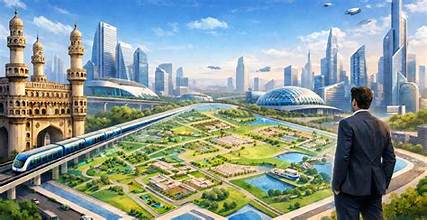
Telangana’s plan to build a $3 trillion economy by 2047 places Hyderabad’s next phase of growth around a proposed 30,000-acre Bharat Future City, a large infrastructure programme and a cluster of specialised economic hubs. Announced by Chief Minister A Revanth Reddy, the roadmap combines investment-led expansion with welfare, social justice and human-capital programmes. Its significance lies in the attempt to move the state’s development strategy beyond Hyderabad’s existing urban footprint and create a new economic geography around the city.
The government has presented the Future City as the centrepiece of its Telangana Rising Vision 2047. The proposed net-zero smart city is expected to include an AI city, health city, education city, life sciences hub, electric-vehicle park and the Young India Skills University. The master plan is scheduled to be unveiled at the Invest Telangana Global Summit-2026 in December, according to the chief minister’s remarks reported by the Times of India.
This sequencing is important. The government has already described the project through its intended sectors and scale, but the master plan will establish the details that determine whether it functions as a coherent city or as a collection of investment districts. The location, land-use structure, mobility network, water and power systems, housing strategy and relationship with existing settlements will shape the project’s actual urban consequences. Those details were not provided in the supplied report.
The proposed city is also being positioned as an investment platform. Revanth said Tata Consultancy Services had proposed a Rs 70,000-crore artificial-intelligence data centre and that Amazon had begun work on a Rs 1 lakh crore data centre. These projects, as described in the report, are intended to anchor the wider technology and services ecosystem. Their presence would give the Future City an economic identity beyond conventional real estate development, but the available material does not establish the projects’ construction schedules, land arrangements, employment numbers or infrastructure requirements.
That distinction matters because large technology facilities are not isolated buildings. They require dependable electricity, water, telecommunications, road access and, increasingly, specialised workforces. The chief minister referred to rising power demand and the government’s efforts to ensure uninterrupted electricity and drinking-water supply. The report does not specify how the proposed Future City or the data centres will be supplied, nor does it provide demand projections. Those will be central implementation questions when the master plan is released.
The roadmap’s infrastructure component extends well beyond the proposed city. Revanth highlighted the Regional Ring Road, greenfield highways, dry ports and industrial corridors connecting Hyderabad with Nagpur, Bengaluru and Vijayawada. He also said road projects worth more than Rs 19,000 crore were being executed through the roads and buildings and panchayat raj departments.
Together, these projects suggest an effort to create a wider regional network around Hyderabad rather than relying only on improvements within the core metropolitan area. A ring road can redistribute traffic and open new development locations, while highways and industrial corridors can connect production and logistics activity to markets beyond Telangana. Dry ports are intended to support freight movement without requiring every shipment to pass directly through a seaport-linked system. However, the supplied report does not establish how these projects are being coordinated, which authorities are responsible for each link or how their funding and construction timelines align.
The institutional challenge is therefore as significant as the physical construction challenge. The Future City, regional roads, industrial corridors, utilities and social infrastructure will involve different departments and levels of government. The chief minister referred to both the roads and buildings department and the panchayat raj department in relation to ongoing road works. That reference indicates that the infrastructure push extends across urban and rural administrative jurisdictions. It also means that coordination over land, permissions, local roads and service delivery will be necessary as the growth zone expands.
The government’s stated model is not limited to investment. Revanth said the development strategy would combine economic growth with welfare, social justice and skills. Telangana aims to raise its contribution to India’s gross domestic product to 10%, while the Future City is expected to bring together education, healthcare, life sciences, electric mobility and skills training. The proposed Young India Skills University is particularly relevant to the city’s economic design because the government is linking infrastructure and investment with workforce preparation.
The same approach appears in the state’s broader policy announcements. The chief minister said 4.5 lakh houses had been sanctioned under the first phase of the Indiramma housing scheme and another 2.5 lakh had been approved in the second phase. He also referred to free bus travel for women, 200 units of free electricity for more than 53 lakh households and subsidised LPG cylinders for 43 lakh families. These measures are not components of the Future City itself, but they show how the government is presenting economic expansion alongside household support.
Housing will be a critical test of that model. A new economic cluster can attract workers, students, service providers and industrial employees, but the supplied material does not state how many homes the Future City will require or whether the proposed master plan will include affordable housing. The number of houses sanctioned under the Indiramma scheme relates to the state’s welfare programme, but the report does not establish how those homes connect to the new urban growth areas. Without that link, employment-led expansion and housing provision could develop on separate tracks.
Mobility will pose a similar question. The roadmap identifies highways and the Regional Ring Road, but the report does not mention a public-transport system for the Future City. A city designed around specialised hubs, data centres, universities, hospitals and industrial facilities will generate daily movement between workplaces, homes and services. The available announcement establishes the road-led regional framework, but not the internal mobility structure or the planned relationship between private vehicles, public transport and freight.
The government has also connected the roadmap to energy, water and climate pressures. Revanth said Telangana faced a rainfall deficit attributed to El Niño conditions and rising power demand, while the government was taking steps to maintain electricity and drinking-water supplies. The Future City is described as a net-zero smart city, making its resource systems particularly important. Yet the report does not provide targets for renewable energy, water reuse, emissions, waste management or climate resilience. The net-zero designation is therefore an announced objective whose implementation framework remains to be set out.
The social and human-development elements add another layer to the proposed urban transformation. The government plans Young India Integrated Residential Schools, expanded scholarship coverage and efforts to attract international universities to Hyderabad. It has also increased Aarogyasri coverage to Rs 10 lakh and is constructing a new Osmania Hospital at an estimated cost of Rs 2,700 crore. These measures indicate that the state is treating education and healthcare as part of its development platform, rather than as separate welfare sectors.
The data in the announcement illustrates the scale of the wider programme. The government said crop-loan waivers of up to Rs 2 lakh had benefited 25.35 lakh farming families at a cost of Rs 20,616 crore, while more than Rs 36,000 crore had been transferred under the Rythu Bharosa scheme. It also said a Rs 500-per-quintal bonus for fine-variety paddy had increased farmers’ incomes. These figures concern agriculture and household support, but they are relevant to the state’s urbanisation strategy because Hyderabad’s expansion will occur within a wider rural-urban economic system.
The proposed $3 trillion target and the ambition to raise Telangana’s contribution to India’s GDP to 10% establish the scale of the political and economic promise. The 30,000-acre Future City, the reported data-centre proposals, road projects exceeding Rs 19,000 crore and planned regional links provide the physical outline of that promise. What is not yet established is how these elements will be sequenced, financed, governed and measured.
The next decisive document will be the Future City master plan, which the chief minister said would be unveiled in December at the Invest Telangana Global Summit-2026. That plan will need to clarify the city’s boundaries, land use, infrastructure capacity, mobility systems, housing provisions, environmental standards and institutional responsibilities. Until then, Telangana’s roadmap is best understood as a high-scale development framework: ambitious in its economic and spatial objectives, but still awaiting the planning detail that will determine how Hyderabad and its surrounding region actually change.
