


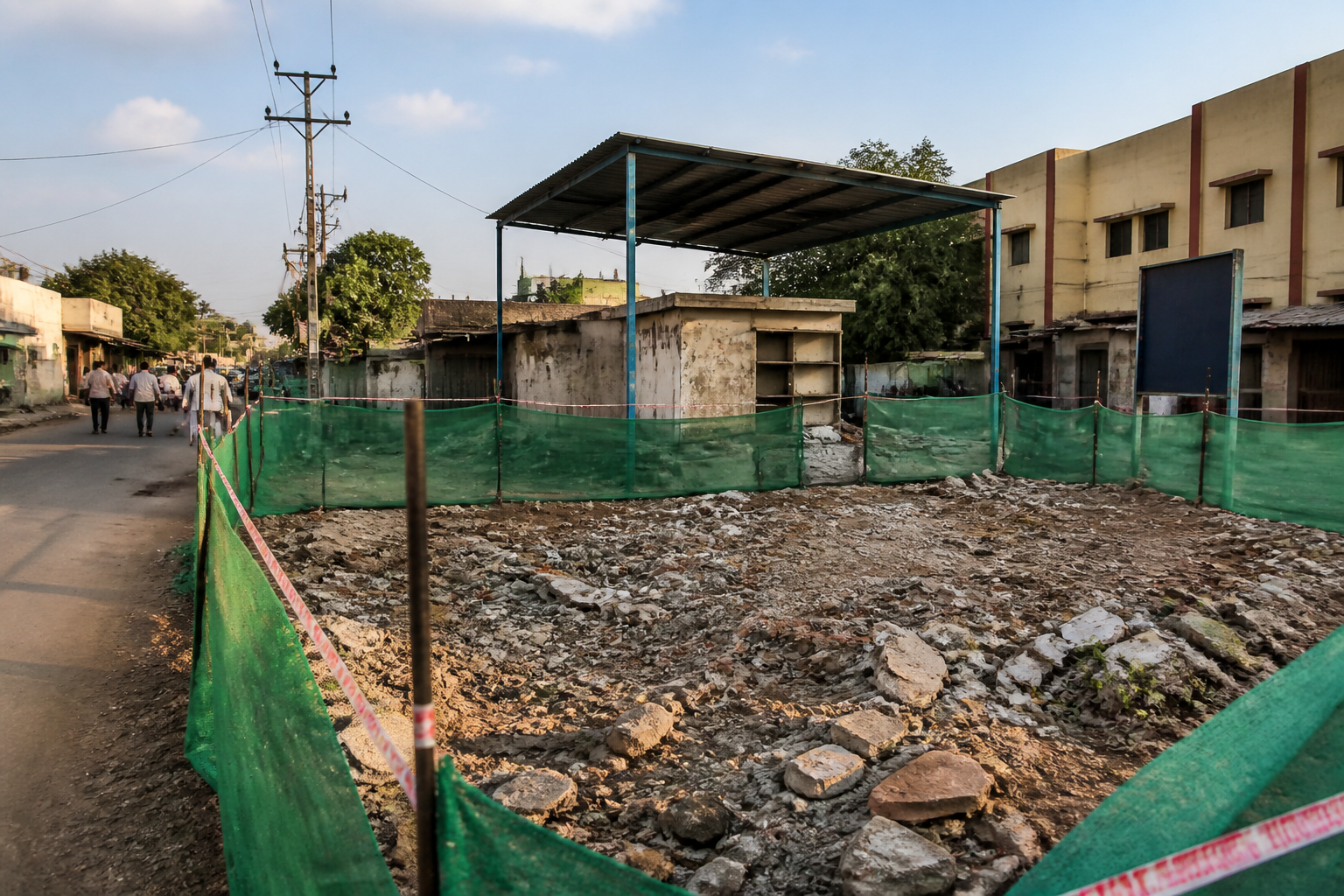
The Kosgi demolition case has placed a basic requirement of urban governance under judicial scrutiny: municipal officials must respect court orders even when they are enforcing local building or land regulations. The Telangana High Court sentenced Kosgi municipal commissioner C Shashidar to one month of simple imprisonment and imposed a ₹1,000 fine after finding that a private structure was demolished despite an interim order restraining such action.
The order, passed by Justice Laxmi Narayana Alishetty on September 15, is significant not only because it penalises an individual municipal official. It also exposes the institutional chain through which court directions are supposed to travel: from the court record to the concerned authority, from senior officers to field staff and finally to the officials carrying out an action at a site. In this case, the court rejected the commissioner’s claim that he was unaware of the 2019 order and held that the evidence showed deliberate disobedience.
According to the account reported by the Times of India, the contempt case was filed by R Muralidhar, who said he owned a 198.61 square yard property in Kosgi, in Telangana’s Narayanpet district. He purchased the land through a registered sale deed in 2018 and, after obtaining permission from the gram panchayat, constructed a tin shed. The structure housed an ice cream parlour, an online service centre and a storeroom.
The dispute moved to the High Court in 2019 after municipal authorities sought to demolish the structure. Muralidhar obtained interim protection restraining officials from taking such action. An interim order of this kind does not finally determine ownership or settle every dispute connected to a property. It does, however, place a temporary legal restraint on the action specified by the court. Municipal enforcement must then operate within that restraint until it is modified, vacated or replaced.
The case illustrates why the communication and tracking of judicial orders are as important to municipal administration as the power to issue notices or carry out demolitions. A demolition can be executed in hours, while a legal dispute over land, permissions or the validity of a structure may continue for years. If an authority acts despite an interim protection order, the physical consequences may be difficult to reverse even if the affected party eventually succeeds in court.
Muralidhar alleged that the authorities proceeded with the demolition in February 2024 despite being aware of the High Court’s directions. He further alleged that officials continued with the work even after a copy of the interim order was produced at the site. The report quoted his allegation that the officials said they were above the law. The court’s finding, as reported, was that the commissioner had been a party to the original writ petition and had been served copies of the interim order.
That finding was central to the contempt proceedings. The commissioner’s defence was that he did not know about the 2019 order. The court did not accept that explanation, noting his involvement in the original case and the service of the order. The issue was therefore not simply whether a structure was authorised or unauthorised. It was whether an official with knowledge of a judicial restraint could allow an action to continue in conflict with it.
This distinction matters in Indian cities and towns, where demolition powers are frequently connected to larger questions of land use, road widening, encroachment removal, building permissions and public projects. Municipal bodies may have statutory authority to regulate construction, but that authority is not separate from the judicial process. When a matter is before a court and an interim direction has been issued, enforcement must be adjusted to comply with the order.
The facts supplied in the case do not establish the full merits of the underlying property dispute. The High Court’s contempt order, as reported, does not amount to a final finding that every aspect of the construction was lawful. Nor does the punishment by itself decide the wider question of whether the structure complied with all applicable planning or municipal requirements. What it does establish is the court’s finding that its restraint on demolition was wilfully disobeyed.
The court also declined to accept an unconditional apology from the commissioner. It observed that an apology could not be used to avoid the consequences of deliberate disobedience, particularly when the demolition allegedly continued even after officials were shown a copy of the court order at the site. This reasoning places emphasis on conduct after the order became known, rather than on a later expression of regret.
For municipal institutions, the case highlights a compliance problem that is often less visible than the public-facing aspects of enforcement. Notices, inspections and demolition drives are visible actions. Less visible are the registers, legal cells, standing counsel, file movements and instructions that determine whether a court order is correctly identified and communicated to field personnel. The supplied report does not say how Kosgi municipality processed the 2019 order internally, but the punishment demonstrates the consequences when the court concludes that the administrative system failed to respect it.
The case also shows the asymmetry between an individual property holder and a public authority. A municipal body has officials, legal representation and administrative records. A property owner may have to approach the court to secure temporary protection and then return to court if that protection is allegedly violated. Once a structure is demolished, the dispute is no longer only about the legality of the proposed action; it also concerns the physical and economic consequences of an action that may have occurred before the legal process was completed.
The structure in question was described as serving three uses: an ice cream parlour, an online service centre and a storeroom. Those uses indicate that even a modest building can support livelihoods and local services. The case therefore carries a built-environment dimension beyond the size of the property. Decisions affecting small commercial premises can alter income, access to services and the functioning of a neighbourhood, particularly in smaller municipalities where formal commercial space may be limited.
At the same time, the case should not be read as a general restriction on municipal enforcement. The reported order does not say that municipal authorities are barred from acting against unsafe, unauthorised or non-compliant construction in all circumstances. It demonstrates a narrower but essential principle: enforcement must comply with a specific judicial direction when that direction is in force and known to the authority.
The High Court’s action also clarifies the personal accountability that can attach to municipal office. A court order addressed to an institution cannot be treated as a document that disappears into an administrative file. Where an officer is found to have knowledge of the order and to have participated in its violation, contempt proceedings can reach the individual responsible. The one-month sentence and ₹1,000 fine signal that disobedience may carry consequences beyond departmental criticism or a later administrative explanation.
The sentence has not immediately resulted in imprisonment. The High Court suspended it for four weeks to enable the commissioner to prefer an appeal. That step preserves the commissioner’s opportunity to challenge the order while keeping the contempt finding and sentence within the judicial process. The next formal milestone identified in the report is therefore the appeal opportunity during the four-week suspension period.
The Kosgi demolition case ultimately raises a question about how urban authority is exercised. Municipal power is necessary to regulate land and construction, but its legitimacy depends on procedure, notice, accountability and compliance with judicial oversight. The evidence reported in this matter confirms that the High Court regarded the restraint order as known to the commissioner and the subsequent demolition as deliberate disobedience. What remains to be established through the appeal process is whether that finding or sentence will be altered. Until then, the case stands as a warning that administrative enforcement cannot operate above the courts whose orders define its legal boundaries.
