


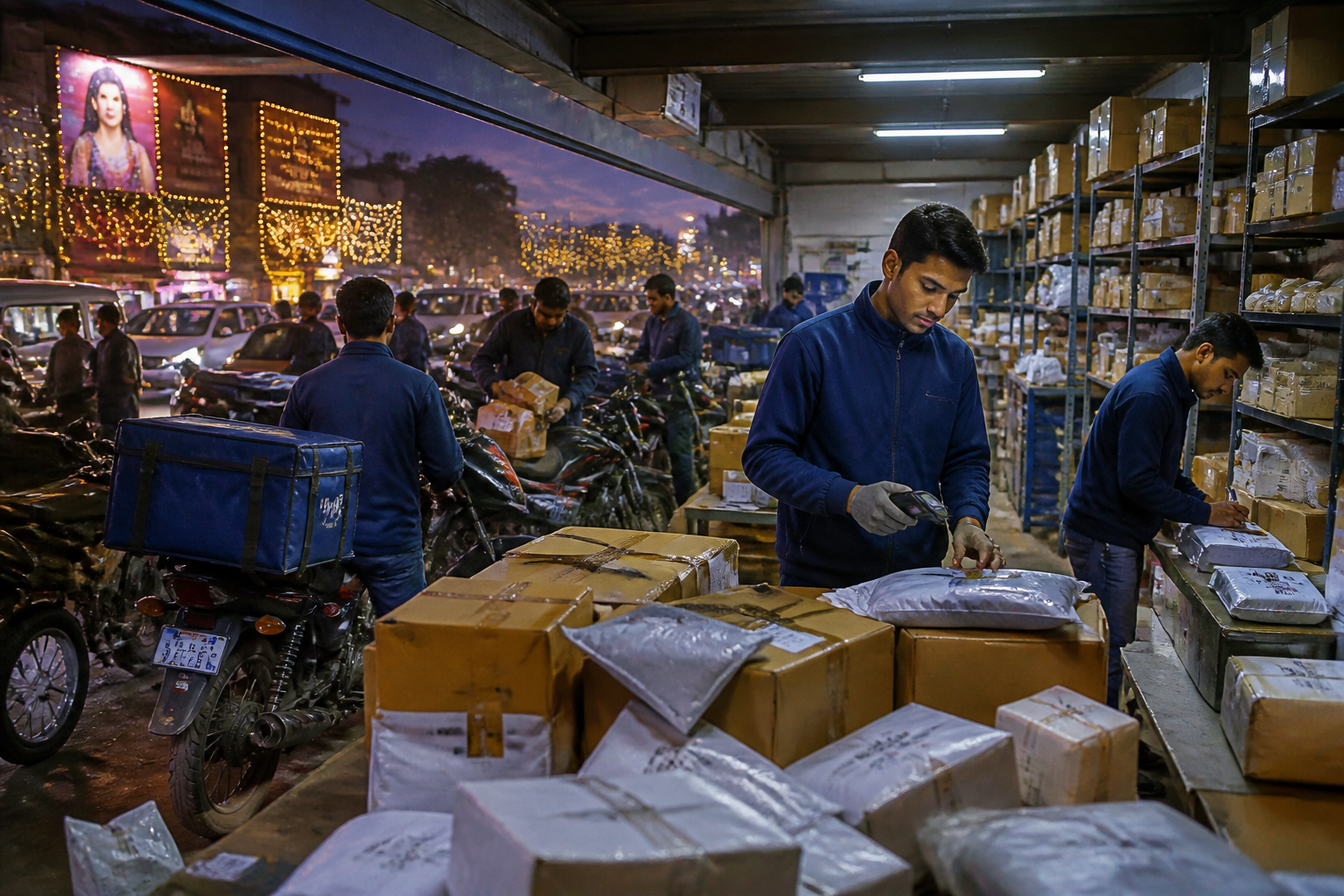
India’s expected festive online retail surge is doing more than raising order volumes. It is expanding the temporary workforce that keeps warehouses, dark stores, delivery hubs and neighbourhood streets connected to the digital-commerce economy. With online retail growth forecast to accelerate sharply in 2026, festive gig hiring is becoming a useful measure of how consumption is changing the organisation of urban work.
Redseer Strategy Consultants expects online retail to grow 25 per cent year-on-year during the 2026 festive period, compared with 16 per cent last year. The wider online retail market is expected to cross $90 billion in calendar year 2026, expanding 22-24 per cent from a year earlier. Those figures are translating into higher workforce requirements across fulfilment, warehousing, sorting and last-mile delivery.
According to Deepesh Gupta, Director and Head of Business, General Staffing, Adecco India, festive hiring across e-commerce and quick commerce is expected to rise 15-20 per cent this year. The temporary and gig workforce requirement could reach around 2.5-2.7 lakh workers, with the source report also giving an approximate figure of 2.16 lakh. The scale of the estimate indicates that festive demand is no longer being absorbed only through existing permanent teams. It is being managed through a flexible labour layer that expands and contracts with shopping peaks.
That labour layer is closely tied to the physical geography of cities. Delivery executives, warehouse associates, picker-packers, sortation staff, fleet coordinators and dark-store workers occupy different points in the same fulfilment chain. Their work depends on the location of warehouses, the density of neighbourhood demand, the availability of transport and the ability of platforms to move goods through increasingly compressed delivery windows.
Flipkart said it will create more than 2.5 lakh direct and indirect employment opportunities, including gig workers, during the festive season. Nearly 1.4 lakh of these opportunities will be in last-mile operations, while the company is adding more than 900 festive delivery hubs across its network. Nearly 75,000 opportunities are expected to go to first-time workforce entrants.
The numbers show that the seasonal workforce is not simply a back-end staffing issue. Adding more delivery hubs changes the pattern of movement through urban areas, even if the infrastructure is largely invisible to consumers. Goods must be received, stored, picked, sorted and transferred before a delivery worker reaches a customer’s door. Each additional hub creates a local operating node, linking commercial property, road access, workforce availability and neighbourhood-level demand.
Quick commerce is becoming the most important force in that expansion. Gupta estimates that the segment will account for 40-45 per cent of festive flexible workforce requirements, up from 30-35 per cent. That translates into roughly 1-1.25 lakh temporary workers. Redseer expects quick commerce to grow 110-120 per cent year-on-year during the festive period, compared with 16-18 per cent growth for the rest of e-commerce.
The difference is significant because quick commerce relies on a more distributed operating model. Its promise of rapid delivery depends on dark stores and local fulfilment capacity placed close to consumers. As the segment expands, demand for workers is distributed across more neighbourhoods rather than concentrated only in large warehouses or central logistics parks. The result is a labour market that is more closely embedded in the everyday geography of cities.
Quick commerce could account for nearly one-fifth of festive online retail this year, according to the source report. That share gives the sector influence not only over what consumers buy, but also over how goods are stored and moved. It also raises the importance of the frontline workforce whose productivity determines whether speed-based delivery models can operate at scale during periods of exceptional demand.
The expected rise in hiring is broad-based rather than limited to mobile phones and electronics. Redseer expects grocery to grow 48-50 per cent during the festive period, home and furniture 32-35 per cent, beauty and personal care 35-40 per cent and fashion 20-22 per cent. Mobiles are expected to grow 5-7 per cent, while electronics could expand 15-17 per cent.
This category mix matters for logistics. Grocery orders, furniture purchases, fashion shipments and electronic goods create different requirements for storage, handling, delivery vehicles and worker skills. A surge in grocery may require dense, frequent neighbourhood delivery, while furniture and large home products involve different handling and transport arrangements. The source material does not establish how individual platforms will redesign these systems, but the varied growth rates show why festive workforce planning cannot be treated as a single delivery requirement.
The hiring footprint is also spreading beyond the largest metropolitan markets. Around 45 per cent of workforce demand is expected to come from tier-2 and tier-3 cities, including Lucknow, Bhubaneswar, Jaipur and Coimbatore. This marks a wider geographic shift in digital commerce, with smaller cities becoming important locations for both online demand and the labour required to serve it.
For these cities, the expansion of fulfilment and delivery work connects consumption growth with local employment. It also places new demands on the urban systems that support commerce: roads, local warehousing, electricity, digital connectivity and access to transport. The available information does not quantify the infrastructure requirements in each city, but the distribution of hiring indicates that the operational footprint of online retail is becoming less concentrated in metros.
The employment itself remains seasonal and competitive. Staffing firms say e-commerce, quick-commerce and logistics companies are hiring at the same time, intensifying competition for frontline workers. Employers are relying more on referrals, existing talent pools and incentives to retain workers through the peak period.
Temporary wages are expected to rise 10-15 per cent year-on-year, according to Adecco. Companies are using attendance bonuses, retention payouts, productivity-linked incentives and referral bonuses. TeamLease Services expects frontline salaries to rise 8-10 per cent in the second half of 2026, with employers increasingly offering variable pay, surge multipliers, fuel and shift allowances and completion bonuses.
These arrangements reveal the operating tension inside the festive economy. Platforms need a workforce that can scale quickly, but workers are being recruited into a market where several employers compete for the same people at the same time. Higher incentives may help platforms secure labour during the peak period, but the source material does not establish whether these payments alter the longer-term stability or quality of the jobs being created.
The institutional structure is similarly fragmented. Platforms determine order volumes, delivery networks and incentive structures. Staffing firms help source and deploy workers. Warehousing and logistics operators provide physical capacity, while local urban systems absorb the resulting movement of people and goods. The workforce may appear flexible from the platform’s perspective, but the city must still provide the fixed systems on which that flexibility depends.
The most important shift may be the possibility that seasonal hiring is becoming a recruitment channel for permanent or longer-term work. Adecco estimates that nearly a quarter of seasonal associates could transition into longer-term assignments. If that estimate materialises, festive hiring would function not only as short-term capacity creation but also as a pipeline into India’s expanding digital-commerce workforce.
That transition remains an estimate rather than an established outcome. It also leaves open questions about the nature of the longer-term assignments, the terms offered to workers and the extent to which seasonal experience leads to stable employment. The supplied evidence confirms the scale of the projected hiring and the incentives being used, but it does not provide a detailed account of worker retention, benefits or employment conditions.
What it does establish is a clear relationship between consumption, urban logistics and employment. Online retail growth is increasing demand for workers across the fulfilment chain. Quick commerce is taking a larger share of flexible workforce requirements. Tier-2 and tier-3 cities are absorbing a substantial part of the hiring footprint. And companies are paying more to compete for workers during a concentrated period of demand.
The larger urban question is whether city systems and labour arrangements are evolving together. The festive season makes the change visible because demand rises quickly and platforms disclose hiring plans. But the underlying network of hubs, dark stores, warehouses and delivery workers operates beyond the festive calendar. The 2026 hiring cycle therefore offers a view of how India’s digital-commerce infrastructure is becoming part of the ordinary functioning of its cities, while leaving the longer-term employment consequences to be established by future evidence.
