


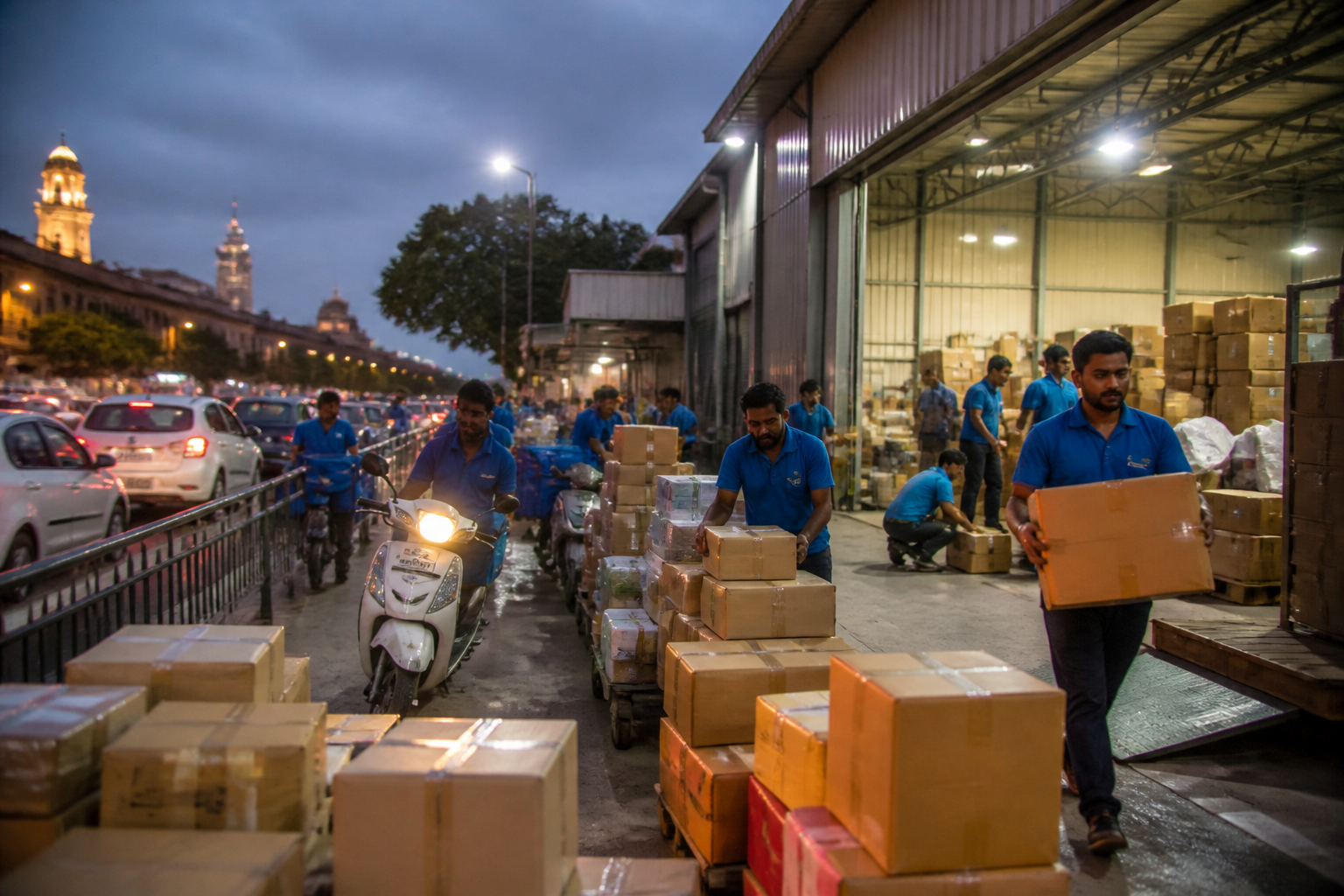
India’s expected five-year high in festive online retail is creating a parallel surge in temporary employment, fulfilment capacity and last-mile infrastructure. The immediate hiring numbers are significant, but the deeper change is that e-commerce and quick-commerce platforms are increasingly influencing how warehouses, delivery hubs, dark stores and frontline work are distributed across Indian cities.
Redseer Strategy Consultants expects online retail to grow 25 per cent year-on-year during the 2026 festive period, compared with 16 per cent last year. The online retail market is also expected to cross $90 billion in calendar year 2026, expanding 22-24 per cent from the previous year. That growth is translating into a short, intense demand for workers who can move products through increasingly compressed delivery networks.
According to Deepesh Gupta, Director and Head of Business, General Staffing, Adecco India, festive hiring across e-commerce and quick commerce is expected to rise 15-20 per cent this year. The report places the temporary and gig workforce requirement at around 2.5-2.7 lakh, while also referring to an approximately 2.16 lakh workforce figure; the supplied report does not explain the difference between the two estimates. The broader direction, however, is clear: platforms are preparing for a substantially larger seasonal workforce than last year.
Flipkart has said it will create more than 2.5 lakh direct and indirect employment opportunities for the festive season, including gig workers. Nearly 1.4 lakh of these opportunities will be in last-mile operations, while the company is adding more than 900 festive delivery hubs across its network. Nearly 75,000 opportunities are expected to be available to first-time workforce entrants.
These figures show that the festive economy is not operating only through large warehouses on the edges of cities. It requires a layered physical network that includes fulfilment centres, sorting facilities, delivery hubs, local storage locations and the roads connecting them. Every increase in order volume places pressure on the spaces and systems that allow goods to move from inventory to the customer’s doorstep.
The expansion of quick commerce is making that network denser and more local. Gupta estimates that quick commerce will account for 40-45 per cent of festive flexible workforce requirements, up from 30-35 per cent. That translates into around 1-1.25 lakh temporary workers. Redseer expects quick commerce to grow 110-120 per cent year-on-year during the festive period, compared with 16-18 per cent growth for the rest of e-commerce.
Quick commerce could account for nearly one-fifth of festive online retail this year. Its importance is therefore not limited to a new retail format. The model depends on geographically distributed dark stores, short delivery routes and a large number of delivery executives operating close to residential neighbourhoods. Its expansion is changing the location and intensity of urban commercial activity, even though the report does not provide city-level data on the number or size of these facilities.
The workforce required by this system is also more diverse than the conventional image of an online delivery worker. Delivery executives, warehouse associates, picker-packers, sortation staff, fleet coordinators and dark-store workers are expected to account for much of the additional demand. Adecco expects logistics and last-mile delivery hiring to increase 30-35 per cent, while organised retail and e-commerce hiring could rise 25-28 per cent.
This division of labour reflects the physical complexity of digital commerce. An order may pass through inventory storage, picking, packing, sorting, dispatch and last-mile delivery. The speed promised to customers depends on the performance of each stage. As quick commerce expands, more of those stages are being placed within or closer to urban neighbourhoods rather than being concentrated only in regional distribution centres.
The hiring geography is expanding as well. Around 45 per cent of workforce demand is expected to come from tier-2 and tier-3 cities, including Lucknow, Bhubaneswar, Jaipur and Coimbatore. This suggests that the logistics network supporting online retail is no longer a metropolitan phenomenon. Smaller cities are becoming both consumer markets and employment locations within the digital-commerce system.
That shift matters for urban planning because the workforce and infrastructure requirements of online retail are arriving through commercial decisions made by private platforms, while their consequences are experienced in public space. Delivery traffic, loading activity, worker commuting and the conversion of local premises into fulfilment or dark-store facilities can affect neighbourhood movement and land use. The supplied report does not quantify these effects, but its employment and hub figures indicate the scale at which the physical network is growing.
The seasonal nature of the demand creates another institutional challenge. E-commerce, quick commerce and logistics companies are hiring at the same time, intensifying competition for frontline workers. Staffing firms said employers are relying more on referrals, existing talent pools and incentives to retain workers through the peak period.
Temporary wages are expected to rise 10-15 per cent year-on-year, according to Adecco. Companies are using attendance bonuses, retention payouts, productivity-linked incentives and referral bonuses. TeamLease Services expects frontline salaries to rise 8-10 per cent in the second half of 2026, with employers increasingly using variable pay, surge multipliers, fuel and shift allowances and completion bonuses.
These payments reveal how the digital retail system absorbs demand spikes. Instead of maintaining a workforce sized for the busiest weeks throughout the year, platforms and staffing firms use flexible labour and targeted incentives to expand capacity when order volumes rise. The model can increase earning opportunities during the festive period, but it also makes the continuity of work dependent on seasonal demand and platform requirements.
The distribution of hiring across sectors provides a further indication of how consumption is changing. Redseer expects grocery to grow 48-50 per cent during the festive period, home and furniture 32-35 per cent, beauty and personal care 35-40 per cent, and fashion 20-22 per cent. Mobiles are expected to grow 5-7 per cent, while electronics could expand 15-17 per cent.
The figures point to a festive market that extends beyond high-value electronics. Grocery, home products, furniture, personal care and fashion require different storage, handling and delivery arrangements. Furniture may need larger fulfilment and transport capacity, while grocery and personal care support more frequent or localised orders. The result is a diversified demand for urban logistics spaces and workers rather than a single seasonal rush concentrated in one product category.
The policy landscape around this expansion is not detailed in the supplied report, which focuses on staffing and market forecasts. What is evident is that several institutional systems intersect in the delivery economy: private platforms organise orders and employment; staffing companies supply workers; logistics operators manage movement; and city authorities govern roads, commercial premises and public-space use. The report’s numbers show the scale of the private expansion, but they do not establish how municipal planning systems are responding to it.
The same gap applies to the employment status and protections of the temporary and gig workforce. The report identifies the scale of hiring, wage increases and incentives, but does not provide details on contracts, social security, insurance, working hours or accident coverage. Those questions are central to understanding the full urban impact of a workforce that operates on roads, in warehouses, at delivery hubs and inside dark stores.
The evidence does show that festive hiring is becoming more than a short-term staffing exercise. Adecco estimates that nearly a quarter of seasonal associates could transition into longer-term assignments. If that estimate materialises, seasonal recruitment will function as a pipeline into permanent or extended frontline employment within India’s digital-commerce ecosystem.
That possibility changes the meaning of the festive peak. It is not only a temporary response to higher consumer demand, but also a recurring recruitment cycle that can shape the composition of the urban workforce. First-time entrants, particularly the nearly 75,000 opportunities identified by Flipkart, may enter logistics and delivery work through a seasonal route before moving into longer-term assignments.
The larger urban question is whether Indian cities are prepared for an economy in which consumption growth and employment growth are increasingly mediated by delivery infrastructure. The expansion of more than 900 festive delivery hubs announced by Flipkart, the projected quick-commerce workforce of up to 1.25 lakh and the expected contribution of tier-2 and tier-3 cities all point to a network that is becoming broader and more embedded in everyday urban life.
The supplied evidence confirms a strong increase in festive online retail, a corresponding rise in flexible workforce demand and a growing role for quick commerce in shaping logistics employment. It also shows that the next phase of digital commerce will be distributed across different city sizes and product categories. What remains unclear is how cities will manage the resulting demand for space, roads, worker mobility and employment protections. Those institutional questions will determine whether the festive delivery economy remains a seasonal surge or becomes a lasting layer of India’s urban infrastructure.
