


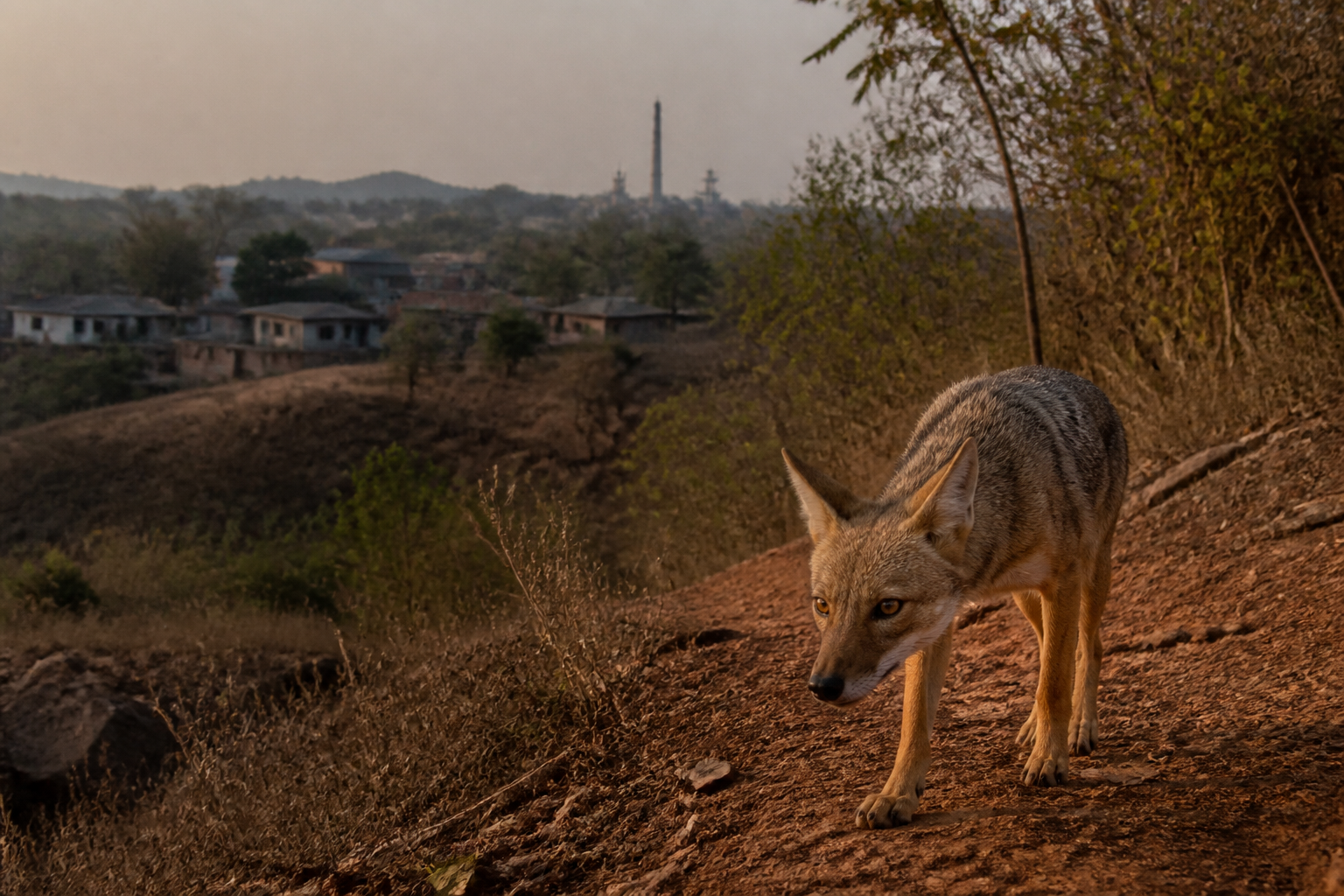
West Bengal’s decision to include the Bengal fox in its wildlife compensation registry is more than a new payment category. It is an administrative response to a changing relationship between protected wildlife and human settlements in Purulia, where rising fox and golden jackal populations have produced a growing number of encounters, injuries and fatalities.
The immediate trigger was the death of Pramila Rajak, a resident of Ichag village in Jhalda, who succumbed to injuries sustained in a Bengal fox attack within the Jhalda forest area. According to the report, the state forest department provided Rs 5 lakh in financial assistance to her family. Her son, Jitender Rajak, was also to be appointed as a forest volunteer in the Jhalda range with a monthly salary of Rs 12,000.
That response places the Bengal fox alongside elephants, tigers, leopards, crocodiles, bears and bisons in the state’s established framework for compensation and employment support following wildlife-related fatalities. The significance lies in the recognition of a species that has not traditionally occupied the same administrative category as the larger and more visibly dangerous animals covered by the scheme.
The policy shift also exposes a limitation in the way human-wildlife conflict is usually understood. Public discussion tends to focus on large mammals entering villages or damaging crops. The Purulia case suggests that conflict can also emerge through the spread of smaller nocturnal predators across inhabited landscapes, industrial belts, forest paths and rural movement corridors. The administrative challenge is not determined only by the size of an animal, but by the frequency and geography of encounters.
The reported pattern is concentrated across parts of Purulia, a district bordering Jharkhand. Fox activity has been reported in locations ranging from the Raghunathpur-Santaldihi industrial belt to the forested areas of Baghmundi and Jhalda. Other affected areas named in the report include Kotshila, Kangsabati North and Kashipur. These locations represent a broad landscape rather than a single isolated forest settlement, indicating that the conflict has implications for villages, workers, pedestrians and residents who move through areas where human habitation and wildlife habitat overlap.
According to data attributed to the state forest department, more than 100 people have suffered fox bites and scratches across these areas, with at least two recorded fatalities. The report identifies September 24, 2025, as the date on which Rajak died from her injuries. It also states that the increase in encounters followed a substantial rise in the local fox population recorded in the latest small and medium wildlife census.
The same census identified two primary canine species in the landscape: the Bengal fox and the golden jackal. The Bengal fox is described as a cat-sized mammal, while the golden jackal is larger and dog-sized. The distinction matters for administration because a rise in sightings or attacks cannot automatically be attributed to one species without field-level monitoring. The report’s identification of both species points to the need for the forest department to distinguish between them when recording incidents, assessing risk and planning mitigation.
The ecological dimension complicates the policy response. Forest officials have described the growth in the fox population as a positive development for local biodiversity. At the same time, the increase has been associated with panic and repeated encounters. This creates a familiar governance tension: conservation success can generate new public-safety obligations when wildlife populations expand into spaces used by people.
Compensation is the most visible part of the state’s response, but it addresses the consequences of conflict rather than its causes. The Rs 5 lakh payment to Rajak’s family provides immediate financial support after a death, while the forest volunteer appointment creates an employment benefit for the affected household. Both measures are important because a wildlife fatality can impose economic pressure on families already living close to forest boundaries or dependent on local and informal livelihoods.
However, compensation also reveals how the state defines responsibility. By adding the Bengal fox to the registry, the government is acknowledging that the risk associated with wildlife is not limited to a fixed list of iconic species. The registry becomes a working map of changing ecological and social conditions. When an animal previously treated as outside the main compensation framework begins to generate repeated injuries, the administrative category changes.
That change can improve access to support, but it also raises questions about how incidents are verified. A compensation system needs a reliable process for identifying the species involved, establishing the circumstances of an attack, recording injuries and determining whether a death is linked to the reported encounter. The supplied report does not set out those procedures. It does, however, indicate that the forest department has begun a more specialised response by deploying surveillance teams dedicated to monitoring fox activity and mitigating risks.
The move towards specialised surveillance is significant because the conflict described in Purulia is spatially dispersed. Monitoring only protected forest interiors would not be sufficient if encounters are occurring along industrial belts, village approaches and forested paths. The locations named in the report suggest that the department must track animal movement across a mixed landscape in which forests, settlements, roads and industrial activity sit close together.
This is also where the issue becomes relevant to the wider built environment. Human-wildlife conflict is shaped by the edges between land uses. A forest path may be a route for residents, a settlement may lie near animal habitat, and an industrial belt may attract regular movement at times when nocturnal species are active. The report does not provide land-use maps or infrastructure data, but its account of incidents across different parts of Purulia indicates that risk is being experienced across multiple types of space rather than within a single reserve.
The state’s established model combines ex-gratia assistance with employment opportunities for families affected by fatal wildlife attacks. Extending that model to the Bengal fox shows that compensation policy can adapt when ecological conditions change. It also demonstrates that wildlife governance is partly a question of social protection. A forest department dealing with conflict must not only protect animals and monitor habitats; it must also respond to injury, death, household income loss and public fear.
The reported employment appointment is particularly relevant to the institutional response. A forest volunteer based in the affected community could form part of a local information and monitoring network, although the report does not specify the duties, training or operating authority attached to the post. The appointment therefore signals a community-linked approach, but its effectiveness will depend on how the role is integrated with forest officials and surveillance teams.
The numbers in the report point to a problem that is larger than one compensation cheque. More than 100 injuries and at least two deaths over the reported period indicate repeated exposure. Yet the available information does not establish the full trend in incidents, the exact population increase, the distribution of attacks by species or the extent to which the two canine populations overlap. Nor does it provide details of medical response, preventive measures, public warnings or the number of households living in the affected areas.
Those gaps matter because a compensation registry can record harm without fully explaining risk. To plan an effective response, authorities would need consistent incident records covering location, time, species identification, injury type and the circumstances of each encounter. The report confirms that surveillance teams have been deployed, but it does not state whether the department has published a broader mitigation plan or a public protocol for residents.
Purulia’s experience illustrates a larger shift in the management of India’s human-wildlife interface. As biodiversity improves in some landscapes, the boundary between conservation areas and everyday settlement becomes more active. The policy question is no longer simply how to preserve wildlife or compensate people after an attack. It is how institutions can identify emerging conflict early, adapt administrative categories and make shared landscapes safer without treating wildlife recovery as a problem in itself.
The Bengal fox compensation decision confirms that West Bengal has recognised a new category of risk in Purulia and has linked financial assistance, employment support and surveillance to that recognition. What remains unclear from the available report is how the registry will be implemented in future cases, how species will be verified and whether monitoring will reduce encounters across Jhalda, Baghmundi, Raghunathpur and the other affected areas. Those details will determine whether the policy remains a post-incident relief measure or becomes part of a broader system for managing changing human-wildlife boundaries.
