


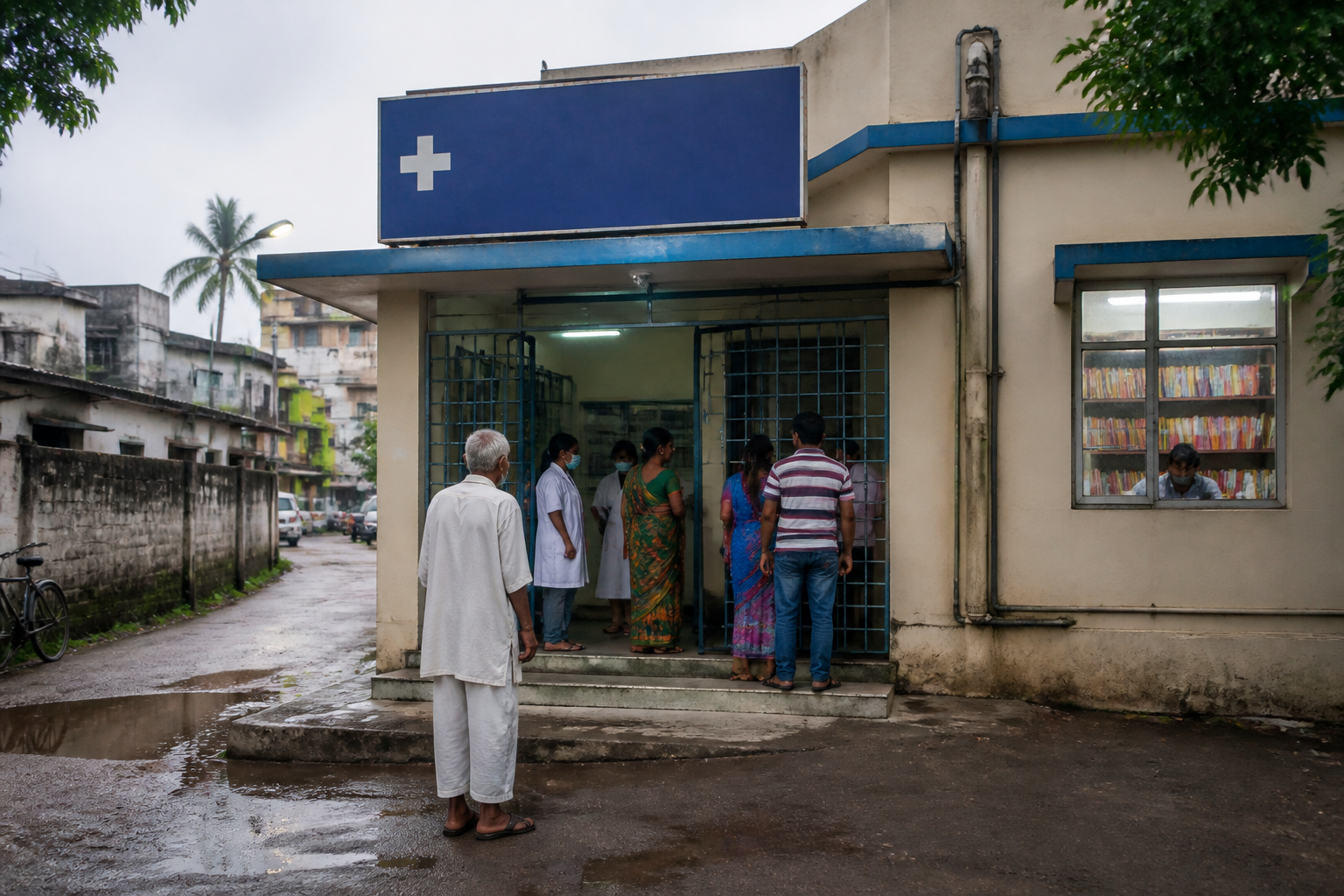
The alleged appointment of two fake doctors at health facilities linked to the Rajpur-Sonarpur municipality has exposed a gap in the way West Bengal’s public health system verifies medical credentials. The immediate action is disciplinary: the South 24 Parganas health department has begun the process of dismissing Uttam Maiti and Sheikh Yunus Hasan after they allegedly failed to respond to show-cause notices. The larger issue is how their applications passed through the state’s recruitment and registration filters in the first place.
According to the report by Anandabazar, both men received appointment letters around two years ago under the National Health Mission. They were working as doctors at government health centres associated with the Rajpur-Sonarpur municipality. Their cases came to light in the wider investigation into five alleged fake doctors. The report says both are currently unavailable, while the district health department has begun proceedings to terminate their employment.
The case matters because public healthcare recruitment is supposed to involve several points of scrutiny. Candidates are expected to establish their educational qualifications, professional registration and suitability for government employment. Yet the accounts provided by the district health administration and the West Bengal Medical Council indicate that the system may have relied too heavily on the presence of a name in a state registration database without completing the underlying verification.
South 24 Parganas chief medical officer of health Muktisadhan Maiti said recruitment under the National Health Mission was conducted at the district level. He said the registration numbers submitted by the two accused appeared in the records of the West Bengal Medical Council, and that the registrations were not from another state. On that basis, the district authorities permitted the appointments, according to the report.
West Bengal Medical Council president Sudipta Roy gave a different account. He said the two men had obtained registration in the state after showing that their names were registered with the Bihar Medical Council, similar to the other three accused doctors. That distinction is central to the institutional question. A registration appearing on a state portal may confirm that a record exists, but it does not necessarily establish that the original degree, registration or identity documents were authentic unless the source records have also been checked.
The report attributes further details to the health department. Uttam Maiti’s document reportedly carried a 2008 Bihar Medical Council registration, while Sheikh Yunus Hasan’s document referred to a 2019 registration. Roy said the state medical council was responsible for verifying whether the Bihar records were genuine. He also said he was not the council president at the time when the relevant decisions were taken.
That exchange reveals a chain of responsibility that is divided across institutions. District health authorities conduct or administer recruitment under the National Health Mission. The medical council controls professional registration. The recruitment process may also involve scrutiny of marksheets, police verification and other identity or qualification documents. If one institution assumes that another has completed the decisive check, an applicant can pass through the system even when the original record has not been independently authenticated.
The case therefore cannot be reduced to the question of whether two individuals allegedly submitted false documents. It also concerns the design of verification. The district health officer’s explanation suggests that the immediate recruitment check focused on whether the applicants’ registration numbers appeared on the state council’s portal. The council president’s response, as reported, shifts attention to the verification of records from the Bihar council. Neither account, on its own, establishes that a complete document trail was examined before the appointments were approved.
The consequences extend beyond administrative irregularity. Patients visiting a government health centre do so on the understanding that the person treating them has been authorised and professionally qualified. The report says medical organisations have questioned who bears responsibility for patients who relied on the two men over an extended period. The supplied material does not establish how many patients were treated, what treatment they received, or whether any injury resulted. Those facts remain important for the police and departmental investigations.
The episode has also exposed unresolved coordination within the state’s medical regulatory structure. Rajib Pandey, secretary of the Association of Public Health and Nursing, called for a Criminal Investigation Department inquiry. He alleged that complaints about suspected fake doctors had previously been sent to chief medical officers of health and forwarded to the state medical council without action. These are allegations attributed to a medical organisation and are not independently established in the supplied report.
Pandey further alleged that people working in roles such as operating-theatre or laboratory technicians were presenting themselves as doctors. The report does not provide the number of such cases or documentary evidence for the wider claim. Its significance lies in the possibility that the two South 24 Parganas appointments are not isolated failures, but the available material does not establish that broader pattern as fact.
The political and administrative response has added another layer to the dispute. Kalyanashis, a government-nominated executive committee member of the state medical council who is described as belonging to a group opposed to the council president, met state health secretary Narayan Swaroop Nigam. He alleged that the council president was acting unilaterally by not convening meetings. Roy rejected responsibility for decisions made before his presidency, while minister of state for health Sumana Sarkar said the government would investigate the matter and file a first information report after the health minister’s return.
These competing statements show why the next stage cannot depend only on public accusations. A credible investigation would need to establish when each document was submitted, which authority examined it, whether the Bihar Medical Council records were contacted directly, what checks were performed by the district recruitment committee, and whether police verification and educational certificates were reviewed. The supplied report does not say that these questions have been answered.
The institutional problem is one of verification ownership. When recruitment, professional registration and criminal or identity checks sit with different bodies, the system requires a clearly documented handover of responsibility. A portal entry can become a shortcut if officials treat it as conclusive proof rather than one step in a wider process. Conversely, a council may say it was responsible for verifying an outside registration while the recruiting authority assumes that the state registration itself has already settled the question.
The case also demonstrates why accountability in public health cannot end with dismissing an accused employee. Termination may address the immediate employment relationship, but it does not explain how the appointment was approved, whether warning signs were missed, or whether other appointments followed the same process. Those answers matter for protecting patients and for restoring confidence in government health centres.
At present, the confirmed administrative developments in the supplied report are the issuing of show-cause notices, the reported absence of replies, and the initiation of dismissal proceedings against the two accused doctors. The state government has also indicated that an FIR will be filed and that the matter will be investigated. The central questions—whether the credentials were forged, who failed to verify them, and whether other appointments are affected—remain for the police, health department and medical council to establish through documents and formal inquiry.
