


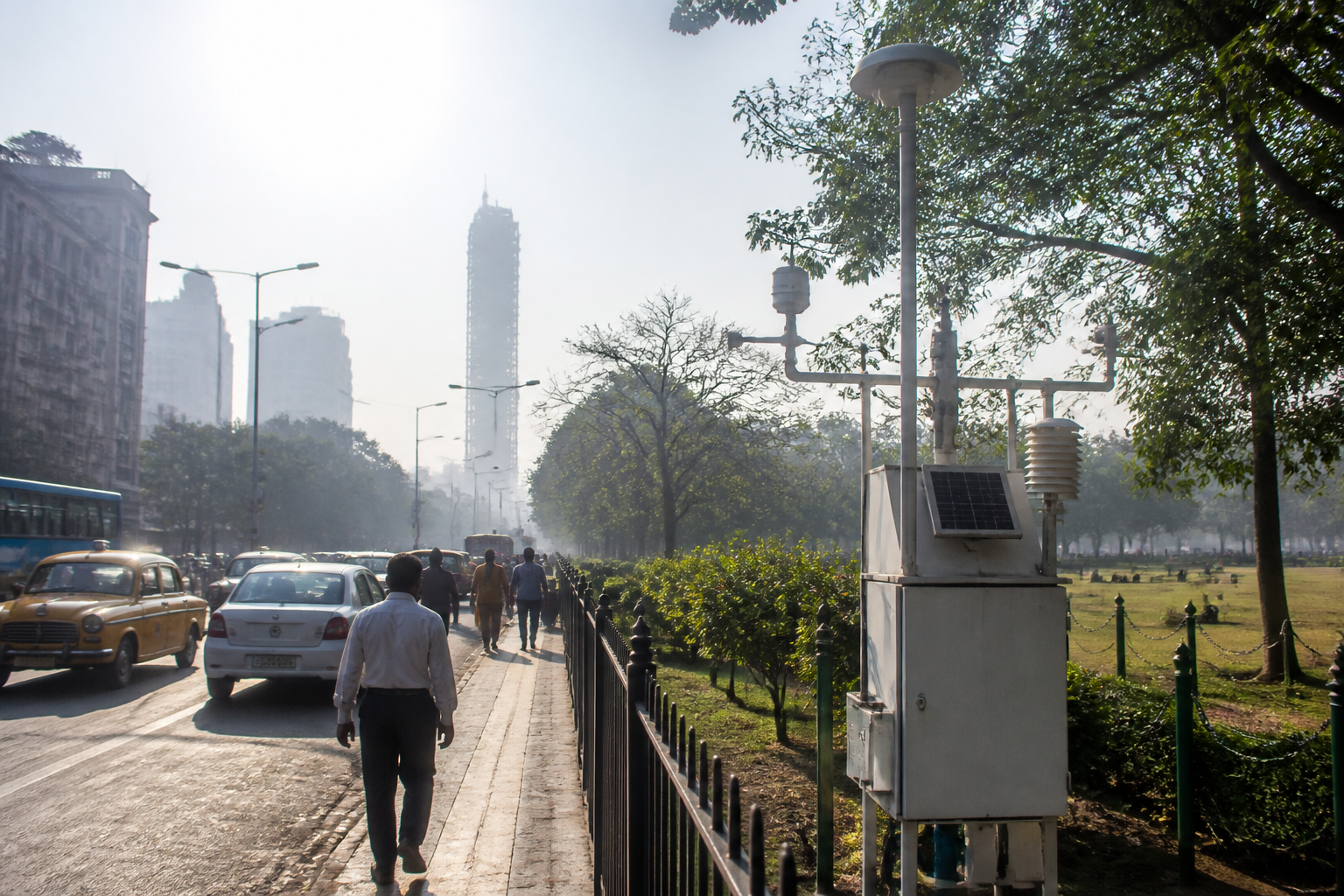
Kolkata’s ground-level ozone readings improved sharply during the summer of 2026, but the city’s air-quality picture remains more complicated than a zero-violation count suggests. Data cited from a Centre for Science and Environment analysis show that ozone exceeded the national eight-hour standard on 46 days in 2021, fell to 22 days in 2025 and was not recorded above the standard on any day during the 2026 summer. Yet ozone remained elevated in several green areas, crossed the standard during parts of the winter and was substantially more persistent in neighbouring Howrah.
That contrast matters because ozone is not a single environmental problem with a single location or source. The protective ozone layer high in the atmosphere and ground-level ozone near the surface are chemically identical, but their effects and policy implications are different. The upper layer shields the Earth from harmful ultraviolet radiation. Ground-level ozone is an air pollutant that forms when nitrogen oxides, volatile organic compounds and other pollutants react in sunlight.
The distinction is particularly important for cities because ground-level ozone is not emitted directly in the same way as exhaust smoke or industrial fumes. It is produced through atmospheric chemistry. Vehicles and industrial activity can supply precursor pollutants, but the final concentration depends on sunlight, temperature, rainfall, cloud cover, wind and the movement of polluted air across municipal boundaries. A reading at one monitoring station therefore reflects both local emissions and wider atmospheric conditions.
The CSE figures indicate a clear summer improvement in Kolkata. The number of days on which the eight-hour national ozone standard of 100 micrograms per cubic metre was exceeded declined from 46 in 2021 to 22 in 2025. During the summer of 2026, no such exceedance was reported in the city. That is a meaningful change in the monitoring record, but it does not establish that the underlying sources of ozone precursors have been eliminated or that the improvement will persist across seasons.
The seasonal pattern in the same report points to that limitation. Between November 2025 and January 2026, ozone exceeded the prescribed standard on 12 days. This suggests that a summer reading cannot by itself describe Kolkata’s annual exposure pattern. Ozone formation is shaped by a combination of emissions and atmospheric conditions, and the relationship between these variables can change across seasons.
The location of the exceedances also complicates the assumption that parks and tree-covered areas automatically provide protection from every form of air pollution. Between March and May 2025, Rabindra Sarovar recorded ozone above the standard on 17 days. Jadavpur recorded five such days, Rabindra Bharati University three and Victoria Memorial two. By contrast, no comparable exceedances were recorded at Ballygunge, Bidhannagar and Fort William during the period covered by the report.
These differences do not mean that green spaces cause ozone pollution. They show instead that ozone behaviour cannot be understood only through a simple distinction between polluted roads and clean parks. Ozone and its precursor pollutants can move through the urban atmosphere, and concentrations can be affected by local geography, sunlight, air circulation and the chemical reaction of pollutants over time. The supplied report does not establish why individual monitoring locations recorded different results, but the variation makes location-specific interpretation essential.
The comparison with Howrah is even more significant for understanding the wider metropolitan system. During the summer of 2025, ozone exceeded the standard on 58 of 92 monitored days in Howrah, compared with 22 days in Kolkata. Dasnagar alone recorded 57 days of exceedance. CSE also noted that the expansion of monitoring stations in Howrah may have influenced the observed trend. This qualification is important: an apparent increase can partly reflect better coverage rather than only a deterioration in air quality.
At the same time, the figures demonstrate why air pollution cannot be managed solely within Kolkata’s administrative boundary. Kolkata and Howrah form a connected urban region in which traffic, industrial activity, residential settlements and atmospheric movement do not stop at a municipal line. If precursor pollutants travel across that boundary, separate local responses may not fully explain or control the resulting ozone concentrations.
The health concern arises from the pollutant’s effect close to the ground. According to the report, experts have warned that ground-level ozone can affect the respiratory tract and lungs, with higher risks for children, older people and those who already have respiratory illnesses. The available material does not provide hospitalisation figures or a Kolkata-specific health assessment, so the data cannot be used to quantify the city’s health burden. It does, however, establish why exceedance days matter beyond an air-quality dashboard.
The policy challenge is therefore different from controlling a pollutant that can be traced directly to one visible source. Reducing ground-level ozone requires attention to nitrogen oxides, volatile organic compounds and other precursor pollutants, alongside monitoring of the weather and atmospheric conditions that help produce ozone. The supplied report does not identify a new government programme, enforcement action or emissions-reduction measure linked to the 2026 improvement. It also does not establish whether the reduction resulted mainly from lower emissions, favourable weather, rainfall, cloud cover, temperature changes or a combination of factors.
That uncertainty does not cancel the improvement, but it defines how it should be interpreted. A fall from 46 exceedance days in 2021 to none during the 2026 summer is a positive signal in Kolkata’s monitoring record. It is not yet evidence of a permanent reversal. To determine whether the trend represents structural improvement, authorities and researchers would need to examine longer time periods, seasonal variation, precursor emissions and the consistency of readings across monitoring locations. The report itself calls for closer study of weather, rainfall, cloud cover, temperature and atmospheric chemistry.
The monitoring network is central to that interpretation. Howrah’s experience shows how the number and location of stations can affect the picture available to the public. More stations can reveal pollution that earlier monitoring missed, but comparisons across years must account for changes in coverage. Without that context, a city may appear to have become more polluted simply because it has started measuring more intensively, or appear cleaner because problematic locations are not adequately represented.
Kolkata’s ozone paradox is therefore not that one part of the atmosphere is recovering while another is worsening. It is that two different ozone questions are being discussed at once, while the urban air-quality system is producing a mixed and geographically uneven record. The protective upper-atmosphere layer is a global environmental issue; ground-level ozone is a metropolitan governance and public-health issue shaped by emissions, weather, monitoring and regional movement of pollutants.
The evidence currently confirms three points: Kolkata recorded no ozone-standard exceedance during the 2026 summer; exceedances had already declined substantially from 2021 to 2025; and ozone remained a concern during the winter period, in selected green areas and across the Hooghly in parts of Howrah. What remains uncertain is whether the summer improvement reflects a durable change in emissions or a favourable combination of atmospheric conditions. That distinction will become clearer only through continued, seasonally consistent monitoring and analysis of the wider Kolkata–Howrah airshed.

