


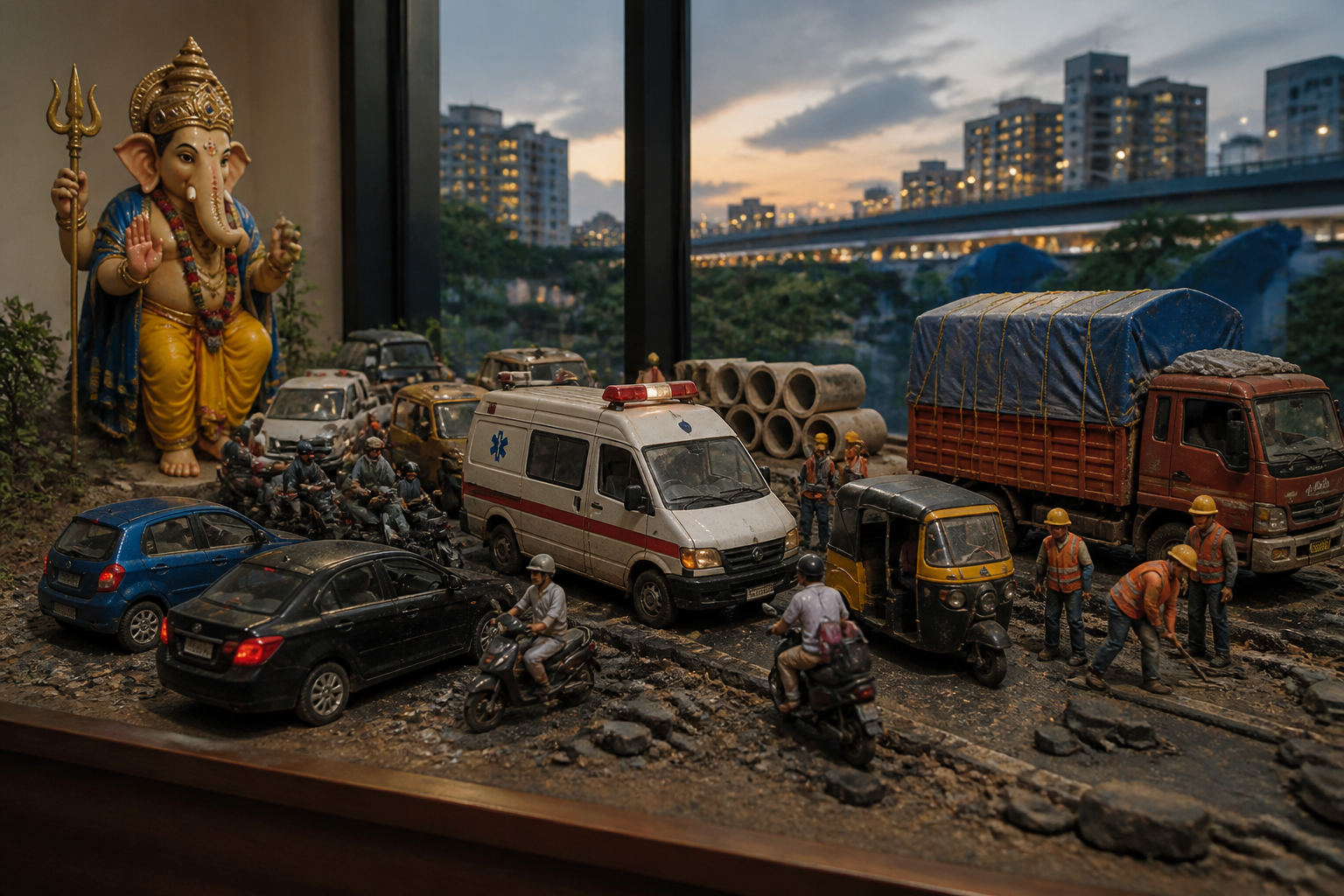
A Ganeshotsav installation in Pune is turning one family’s experience of a delayed ambulance into a wider examination of how traffic congestion, damaged roads, unsafe driving and weak civic responsibility can combine to make an emergency more dangerous. Created by IT professional and artist Ravi Chauhan at his home in Hinjewadi, the installation places an ambulance trapped in road chaos at the centre of its message.
Chauhan’s intervention is rooted in a personal tragedy. On New Year’s Day, he was travelling in an ambulance with his mother after she suffered a heart attack. The vehicle became stuck near Shri Chhatrapati Shivaji Maharaj Chowk in Punawale, an area described in the report as being known for severe congestion. Chauhan urged surrounding vehicles to move and make way, but traffic did not clear. His mother died in the ambulance seven minutes before it reached the hospital.
The event is not presented simply as a story of congestion. It exposes the chain of urban conditions that can determine whether an emergency vehicle moves or remains trapped: the design and maintenance of roads, the behaviour of individual road users, the management of junctions, the availability of clear lanes and the ability of authorities and contractors to complete infrastructure work safely and on time.
That chain is particularly important in Pune’s fast-growing western corridor. Hinjewadi and Punawale have developed as major residential and employment areas, bringing together office workers, construction activity, goods vehicles, two-wheelers, autorickshaws and private cars. Chauhan’s installation represents this mixed traffic through a crowded road scene featuring cars, trucks covered with blue tarpaulins, two-wheelers, construction workers and autorickshaws moving in different directions.
The physical setting matters. The installation is displayed at Chauhan’s home in Hinjewadi, an IT hub where rapid development has placed pressure on roads and junctions. The report does not provide traffic-volume data, emergency-response times or an official assessment of the junction. It does, however, show how residents experience the consequences of growth when transport infrastructure and road discipline do not keep pace with the number and variety of users.
At the centre of the display is an ambulance carrying a woman in pink on a stretcher. Two men, representing Chauhan and his father, watch helplessly. Above the scene, Ganesha observes a city that is unable to provide a clear route for an emergency vehicle. The choice of Ganeshotsav as the medium allows the message to reach people in a setting that is both familiar and public, rather than limiting the issue to a formal road-safety campaign.
Chauhan’s narrative gives the installation an institutional dimension. In his account, Ganesha arrives in the city expecting to bless devotees but instead encounters broken roads and traffic disorder. He asks who is responsible for the condition of the road, wrong-side driving and the failure to give way to an ambulance. The silence in the installation reflects a familiar governance problem: responsibility for a road is distributed across agencies, contractors, traffic managers, vehicle users and citizens, while accountability can become difficult to locate when the system fails.
The installation’s proposed response is deliberately symbolic. Ganesha’s Mushaks begin managing traffic, repairing potholes, clearing the road and helping a person who has fallen. The message is not that civic problems can be solved through individual goodwill alone. Rather, it asks residents to recognise that urban safety depends on both institutional performance and daily conduct.
Chauhan directs part of his appeal at the administration and contractors. He calls for roads to be completed on time and for construction quality and safety to be maintained. These demands point to a recurring problem in expanding urban areas: road construction is often experienced not as a finished public asset but as a prolonged condition of excavation, diversion, uneven surfaces and incomplete connections. For emergency vehicles, these conditions can turn a short journey into an uncertain one.
The report does not identify the agencies responsible for the road near Shri Chhatrapati Shivaji Maharaj Chowk, nor does it record a response from the municipal administration, traffic police or contractors. That limitation is important. A personal account can reveal a serious public problem, but establishing institutional responsibility requires information about road ownership, project contracts, maintenance schedules, traffic-management arrangements and emergency-response procedures.
Road safety also depends on behaviour at street level. Chauhan’s installation depicts vehicles moving in multiple directions and specifically raises the problem of wrong-side driving. He asks citizens to follow lane discipline and traffic rules and to immediately give way to ambulances. These are basic obligations, but their effectiveness depends on whether roads are legible, lanes are usable, junctions are managed and drivers can recognise where emergency vehicles should pass.
The ambulance message is especially significant because emergency access is a citywide issue, not only a concern for hospitals. An ambulance must pass through residential streets, arterial roads, construction zones, signalised junctions and congested commercial areas. A delay at any one point can affect the entire journey. The account of Chauhan’s mother illustrates the human consequences of a system in which every road user may be moving, yet no route remains available for the vehicle facing the greatest urgency.
Ganeshotsav itself provides an unusual civic platform for discussing that system. Public celebrations frequently transform streets, homes and neighbourhoods into places of gathering and expression. In Chauhan’s installation, the festival becomes a form of public communication about road design and responsibility. The display is open to the public until September 25, giving visitors an opportunity to engage with the issue outside the usual language of traffic notices, enforcement drives and infrastructure announcements.
The installation also challenges a narrow understanding of civic responsibility. Chauhan says he cannot change what happened to his mother, but hopes his artwork can make people think about road safety, ambulance access and responsible citizenship. His appeal asks residents not only who will solve an urban problem, but also what they can do themselves. That does not remove the administration’s obligation to build and maintain safe roads. It establishes that the system requires action at several levels simultaneously.
For authorities, the central questions are operational. Are emergency corridors identified and kept clear? Can traffic personnel rapidly manage congested junctions? Are road diversions communicated and maintained? Are potholes and unfinished works addressed through enforceable contracts? Are road designs and construction practices assessed for the safety of ambulances, pedestrians, two-wheeler riders and workers? The supplied report does not answer these questions, but the installation makes their absence visible.
For citizens, the immediate issues are more direct: not driving on the wrong side, maintaining lane discipline, obeying traffic rules and giving way to ambulances. These actions are often treated as individual matters, yet they collectively shape whether the street functions as a shared public system. When drivers block an emergency vehicle, the failure is personal and systemic at the same time.
The story ultimately shows how an urban issue can emerge from a single journey. Chauhan’s experience began as a medical emergency but became a test of the road network, traffic behaviour and public administration. His Ganeshotsav decoration does not provide data on the scale of Pune’s ambulance delays or establish responsibility for the specific junction. It does something else: it places the consequences of road failure before the public in a form that is difficult to ignore.
The installation will remain open to visitors until September 25. Its broader message is that road safety cannot be separated from infrastructure quality, traffic management or civic conduct, and that each of these elements must be examined when an emergency vehicle is unable to reach a hospital in time.
