


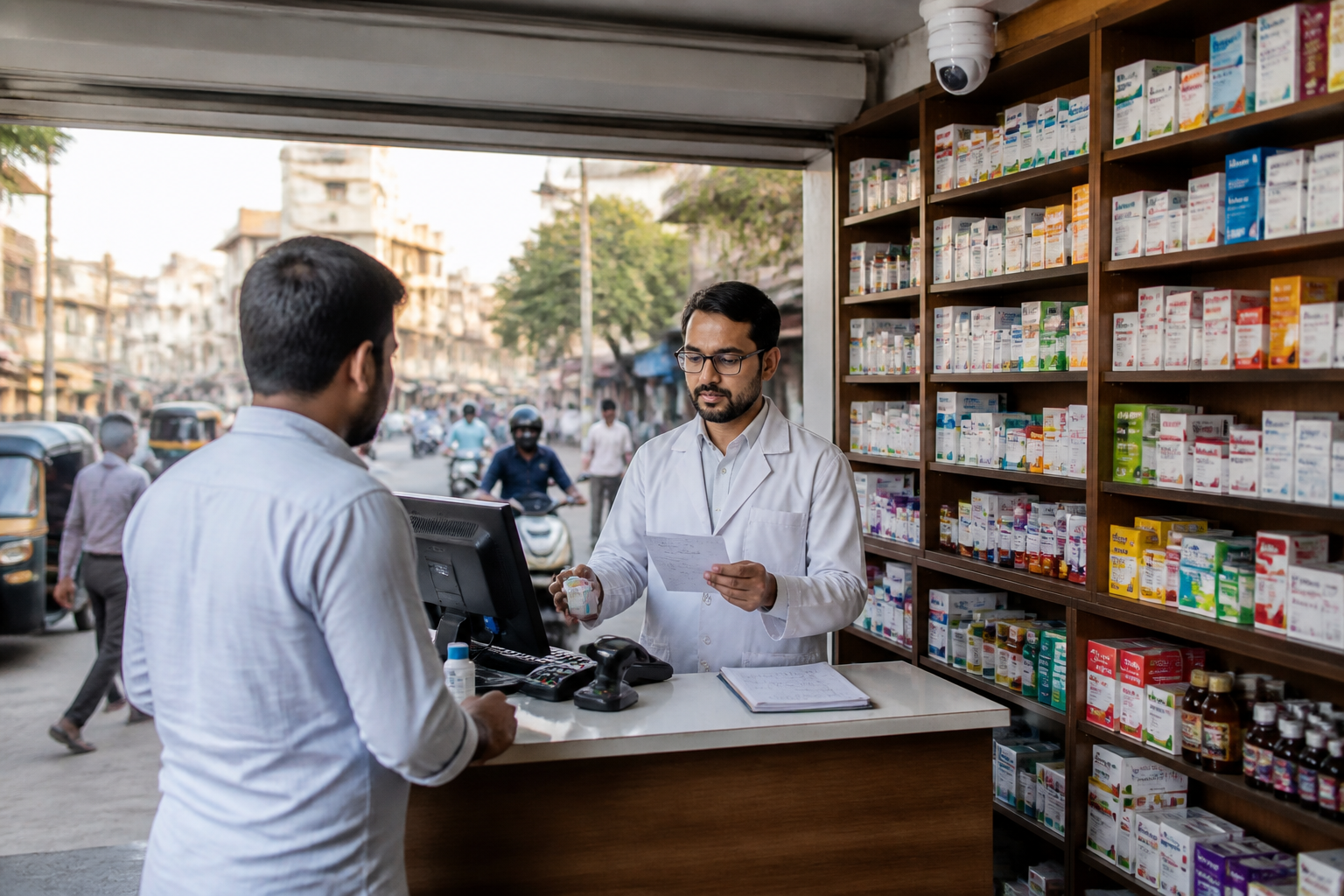
Prescription medicine sales in India are taking place through a retail system where consumers often cannot rely on a prescription check, qualified pharmacist assistance or even a proper bill, according to a nationwide LocalCircles survey. The findings have emerged as the Union Ministry of Health and Family Welfare proposes mandatory CCTV surveillance at medical stores that dispense prescription drugs, turning a routine neighbourhood transaction into a question of traceability and regulatory enforcement.
The survey, which received about 1.06 lakh responses from consumers across 327 districts, found that 64% of respondents said their chemist never or rarely asked for a doctor’s prescription before selling medicines during the previous 12 months. Only 15% said their chemist mostly or always refused to sell medicines without one. These figures do not establish the scale of unlawful sales across all pharmacies, but they indicate a widespread consumer experience of weak or inconsistent prescription checks.
That gap matters because neighbourhood medical stores are not a marginal part of the healthcare system. In the survey, 86% of respondents who answered the relevant question said they primarily purchased medicines from local chemists, compared with 14% who relied mainly on ePharmacy apps. The neighbourhood store therefore functions as an everyday access point for medicines, advice and repeat purchases, particularly for consumers who may not have immediate access to a doctor or a formal healthcare facility.
The proposed surveillance requirement seeks to address one part of this retail system: the absence of a reliable record of how prescription medicines are supplied. Under the draft notification, the supply, other than by wholesale, of any drug sold on the prescription of a Registered Medical Practitioner would have to take place under a CCTV surveillance system installed and maintained at the premises. The proposal would make the transaction more traceable, although the supplied report does not specify the proposed retention period, technical standards, access rules or enforcement mechanism for the footage.
That distinction is important. A camera can record a transaction, but it cannot by itself determine whether the person behind the counter is qualified, whether the prescription is genuine or whether the medicine supplied is appropriate. The survey found that only 31% of consumers were able to get assistance from a qualified pharmacist most of the time or always. At the other end, 13% said they were assisted by someone who was not a qualified pharmacist, while 27% said they never or very rarely received assistance from a qualified pharmacist.
The findings point to a layered compliance problem rather than a single failure. Prescription verification, professional supervision, billing and product traceability are separate safeguards. Weakness in any one of them can make it harder for consumers to establish what they purchased, from whom and under what conditions. When several safeguards fail together, enforcement becomes dependent on complaints or inspections after the transaction has already taken place.
The survey’s findings on home delivery show that the same issue extends beyond the physical shop. Among respondents who answered the question, 41% said a prescription was never or rarely asked for when medicines were delivered to their homes. This suggests that moving the transaction from a neighbourhood counter to a delivery channel does not automatically create stronger compliance. The method of purchase changes, but the need to establish prescription validity and seller accountability remains.
Billing is another part of the chain. Of 20,573 respondents, 26% said they were not provided a GST bill when buying medicines from local chemists. The survey described a bill as more than a tax document because it carries the batch number, expiry date and identity of the seller. Those details can provide an evidentiary trail if a medicine is expired, defective or counterfeit. Without a bill, consumers may find it more difficult to seek redress or help authorities identify the source of a product.
The survey also reported that 15% of 18,457 respondents said they had purchased medicines that later turned out to be fake or counterfeit. The supplied material does not establish whether these experiences were independently verified, nor does it identify the products, locations or sellers involved. The figure should therefore be read as a measure of reported consumer experience, not as a confirmed rate of counterfeit medicines in the market. Even so, it highlights the importance of maintaining a transaction record and preserving product information.
The proposed CCTV rule comes against a backdrop of intensified enforcement in multiple States against chemists selling prescription medicines without valid prescriptions, operating without registered pharmacists and failing to provide proper bills. The report identifies Telangana Standards Authority for Food and Essential Drugs officials inspecting a medical shop as part of a recent drive on the illegal sale of prescription drugs. It does not provide the number of inspections, violations, closures or prosecutions arising from that drive.
This is where the institutional challenge becomes visible. Retail drug regulation is not delivered through one intervention or one authority alone. A prescription requirement concerns the conduct of the sale; pharmacist registration concerns professional responsibility; billing creates a commercial record; inspections test compliance; and enforcement determines whether violations carry consequences. CCTV may strengthen evidence collection, but its effectiveness will depend on how these responsibilities are coordinated and whether authorities have the capacity to review and act on recorded violations.
The survey also needs to be read with care. Respondents were not evenly distributed across India’s urban hierarchy: 52% were from tier-1 districts, 29% from tier-2 districts and 29% from tier-3, 4 and 5 districts, according to the report. The different questions received different numbers of responses, ranging from 15,473 to 20,573, rather than the full survey total. The results describe what participating consumers reported and should not be treated as a direct audit of every medical store or district.
Still, the pattern is consistent across the different questions. Consumers reported limited prescription checks, uneven access to qualified pharmacists, weak verification during home delivery and missing bills. Each issue affects a different point in the medicine-supply chain, but together they show how an essential urban service can remain highly accessible while being insufficiently accountable. Convenience is present; consistent verification is not.
The policy question is therefore larger than whether medical stores should install cameras. It is whether surveillance will be used as part of a functioning compliance system or become another infrastructure requirement that exists without regular monitoring. The source material confirms the Union Ministry’s draft proposal but does not establish its final status, implementation timetable, cost-sharing arrangement or penalties for non-compliance. Those details will determine whether the proposal changes retail practice or simply records existing transactions more visibly.
For consumers, the immediate issue remains practical: the local chemist is often the most accessible medicine source, but access does not guarantee professional advice, prescription scrutiny or a usable purchase record. The evidence supplied by the survey supports a clear conclusion: improving medicine safety requires accountability at the point of sale, during delivery and after purchase. The next developments to watch are the final form of the draft notification and the enforcement response across States, including how authorities address pharmacist availability, billing and prescription verification alongside CCTV surveillance.
