


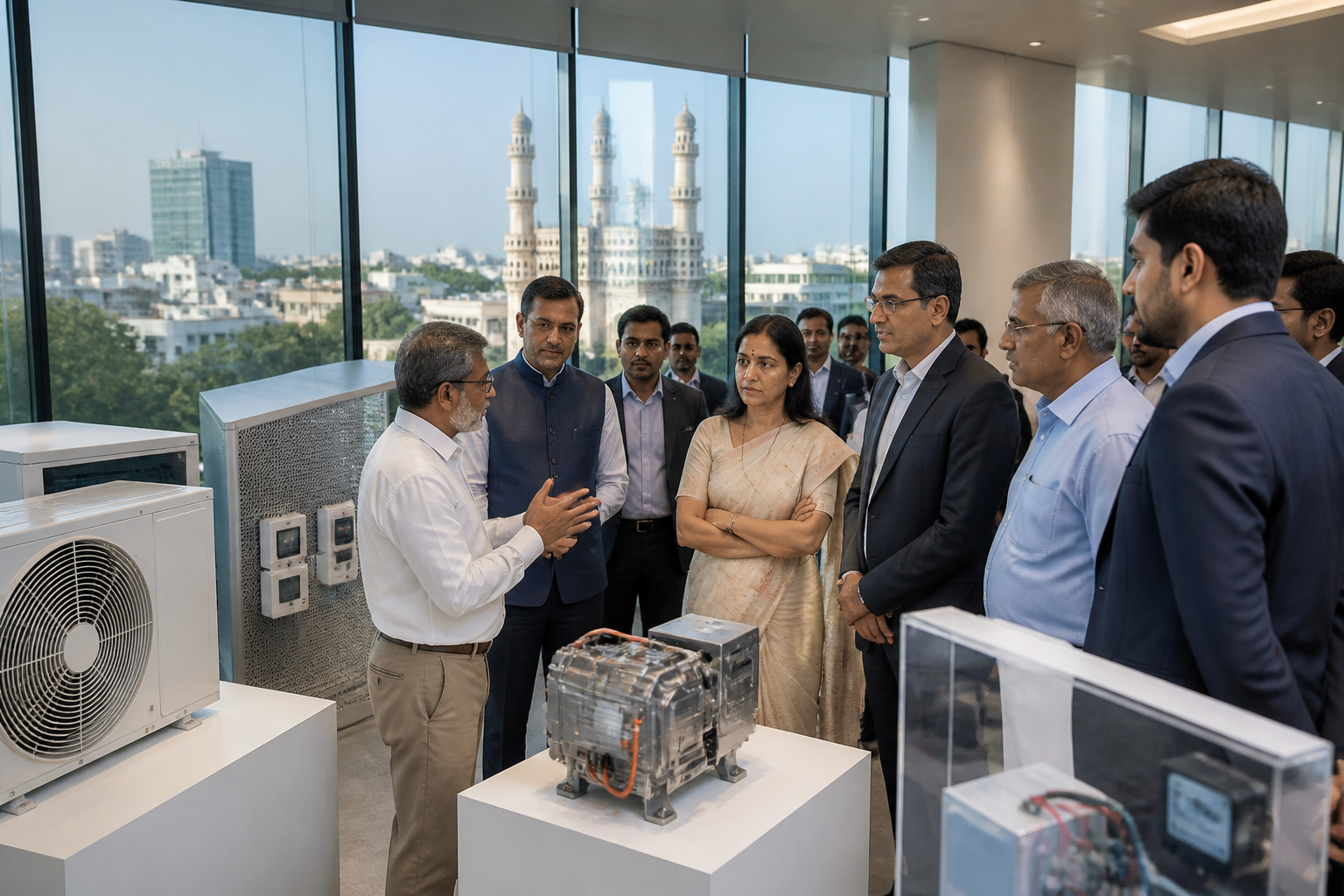
The 25th CII Energy Efficiency Summit 2026 placed a practical question at the centre of India’s net-zero transition: how can businesses reduce energy use and emissions while keeping power affordable and reliable? The discussion in Hyderabad brought together policymakers, industry leaders, technology providers, academics and sustainability experts, but its most consequential evidence came from the investments already being made by companies and the technologies being positioned for wider adoption.
The summit’s central message was that India’s next phase of energy transition will not be defined by a single intervention. The report identified four connected requirements: faster electrification, wider deployment of clean technologies, greater use of digital solutions and stronger collaboration between government, industry and institutions. Together, these point to an energy transition that is as much about changing industrial systems and operating practices as it is about adding new energy sources.
That distinction matters for cities and the built environment. Energy efficiency is often discussed as a technical issue inside factories, offices or commercial facilities. In practice, it affects the cost and reliability of the services that support urban life, from buildings and industrial supply chains to cooling and heat management. The summit did not announce a new public programme or regulatory mandate, but it offered a view of how companies and institutions are attempting to make energy performance an investment priority.
Krushna Chandra Panigrahy, Director General of the Bureau of Energy Efficiency, said the past 25 years had provided lessons as India entered a transformative phase of growth. He also said energy must remain affordable and reliable to support that growth. His remarks establish the principal institutional tension in the discussion: efficiency and decarbonisation cannot be separated from the everyday requirement that homes, businesses and industries receive dependable energy at a manageable cost.
The summit therefore framed efficiency as more than an environmental objective. It was presented as a way to reduce waste, improve processes and manage the energy intensity of growth. This is particularly relevant as urbanisation increases demand for buildings, manufacturing, transport-related systems and digital infrastructure. The supplied report does not provide sector-wise energy data or identify which industries account for the largest potential savings, but it does show that participating companies are treating efficiency as a capital investment rather than only as a compliance exercise.
The figures cited by CII provide the clearest evidence of this shift. P V Kiran Ananth, Executive Director for Energy Efficiency, Renewable Energy and Green Entrepreneurship at CII Godrej GBC, said 720 industry respondents had invested around Rs.5,700 crore over the previous three years and achieved savings of more than Rs.7,100 crore. On the figures reported, the savings exceeded the investment amount across the group, although the report does not specify whether the savings are annual, cumulative or calculated using a common accounting method. That limitation makes the figure a signal of investment activity rather than a basis for measuring the financial performance of every participating company.
The same statement said companies had committed another Rs.3,590 crore within a year towards electrification, process improvement, waste-heat recovery, digitalisation, the Internet of Things and artificial intelligence. The range of activities is significant because it shows that efficiency is being pursued through several layers of the industrial system. Electrification changes the energy source used by a process. Process improvement can reduce the energy required for the same output. Waste-heat recovery attempts to retain energy that would otherwise be lost, while digital tools are intended to identify opportunities and support operational decisions.
This combination also changes the institutional challenge. If efficiency depended only on replacing equipment, the task would primarily involve technology procurement and finance. The inclusion of process redesign, waste-heat recovery, IoT and AI suggests that implementation also depends on measurement, skilled operation and the ability to connect information with action. Tejpreet Singh Chopra, Chairman of the CII Energy Efficiency Summit 2026, said AI and digital tools were becoming a catalyst by compressing the time between identifying an efficiency opportunity and acting on it.
That claim describes a management function rather than a substitute for physical infrastructure. Digital systems can help identify an abnormal energy pattern or a process that is consuming more power than expected, but the reported material does not establish the accuracy, scale or outcomes of any specific AI deployment. The evidence does establish that industry leaders see digitalisation as part of the next stage of efficiency work. Whether those tools deliver lasting savings will depend on how they are integrated into industrial operations, a question the summit report leaves open.
The launch of the India Heat Pump Atlas adds a more specific dimension to this transition. The National Installation Insights Dashboard was developed under the CII Heat Pump Alliance, described as a collaborative platform intended to accelerate heat-pump adoption and innovation in India. The launch indicates an attempt to create a clearer picture of heat-pump installations and market activity. However, the supplied report does not provide the number of installations, their geographic distribution, the sectors using them or the energy savings achieved.
Even without those figures, the atlas is institutionally important because deployment data is a prerequisite for understanding where a technology is being used and where gaps may remain. A national dashboard can potentially help connect technology providers, policymakers and users, but the report does not state whether the platform is public, how frequently it will be updated or which organisation will maintain it. Those details will determine how useful it becomes for planning and investment decisions.
The summit’s policy landscape is therefore visible through the institutions represented rather than through a new policy announcement. The Bureau of Energy Efficiency provided the government-linked perspective on affordability and reliability. CII and CII Godrej GBC represented an industry platform that is tracking investment and savings. The CII Heat Pump Alliance provided the collaborative structure behind the atlas. Technology providers, academia and sustainability experts formed the wider group involved in the discussion. The report does not describe a new funding mechanism, statutory target or implementation timetable, so the event should not be read as the announcement of a new national scheme.
What it does reveal is a movement from broad transition language towards a portfolio of interventions. Electrification, heat recovery, digitalisation, IoT, AI and heat pumps operate at different points in the energy system. Their common thread is the attempt to reduce the amount of energy required for economic activity or to shift activity towards cleaner technologies. The reported investment commitments suggest that companies are preparing to combine these approaches, although the supplied evidence does not show how many projects have been completed or how results compare across sectors.
For urban India, the larger question is whether this approach can extend beyond large industrial respondents and reach the buildings, small enterprises and service systems that shape daily life. The summit report is focused on industry and does not provide evidence on residential energy use, municipal facilities or commercial buildings. That boundary is important. It means the reported numbers cannot be treated as a complete picture of urban energy efficiency. They instead show one part of the transition: organised industry’s investment in technologies and operational changes.
The evidence also suggests that affordability and decarbonisation will remain linked. Panigrahy’s emphasis on reliable and affordable energy places a practical limit on transition strategies that raise costs or reduce operational certainty. The CII figures, meanwhile, present efficiency investment as capable of generating savings, though the report does not define the calculation period or explain the distribution of results. The unresolved issue is not whether efficiency has value, but how consistently that value can be measured and reproduced across different companies and applications.
The summit consequently matters as an indicator of the implementation problem facing India’s net-zero transition. The broad direction is clear in the supplied material: accelerate electrification, deploy clean technologies, use digital tools and build collaboration. The less settled questions concern verification, scale and access. The next useful evidence will be detailed information on the projects behind the reported investments, the basis for the savings figures, the performance of the new heat-pump dashboard and the sectors in which these technologies are being adopted.
For now, the summit confirms that energy efficiency is being treated by participating industry stakeholders as a central investment and operating issue. It also shows that India’s transition is being discussed not only in terms of cleaner energy supply, but in terms of how companies use, monitor and recover energy. The performance of that model will depend on whether reported commitments translate into measurable, repeatable savings and whether the data systems being launched can make that progress visible.
