


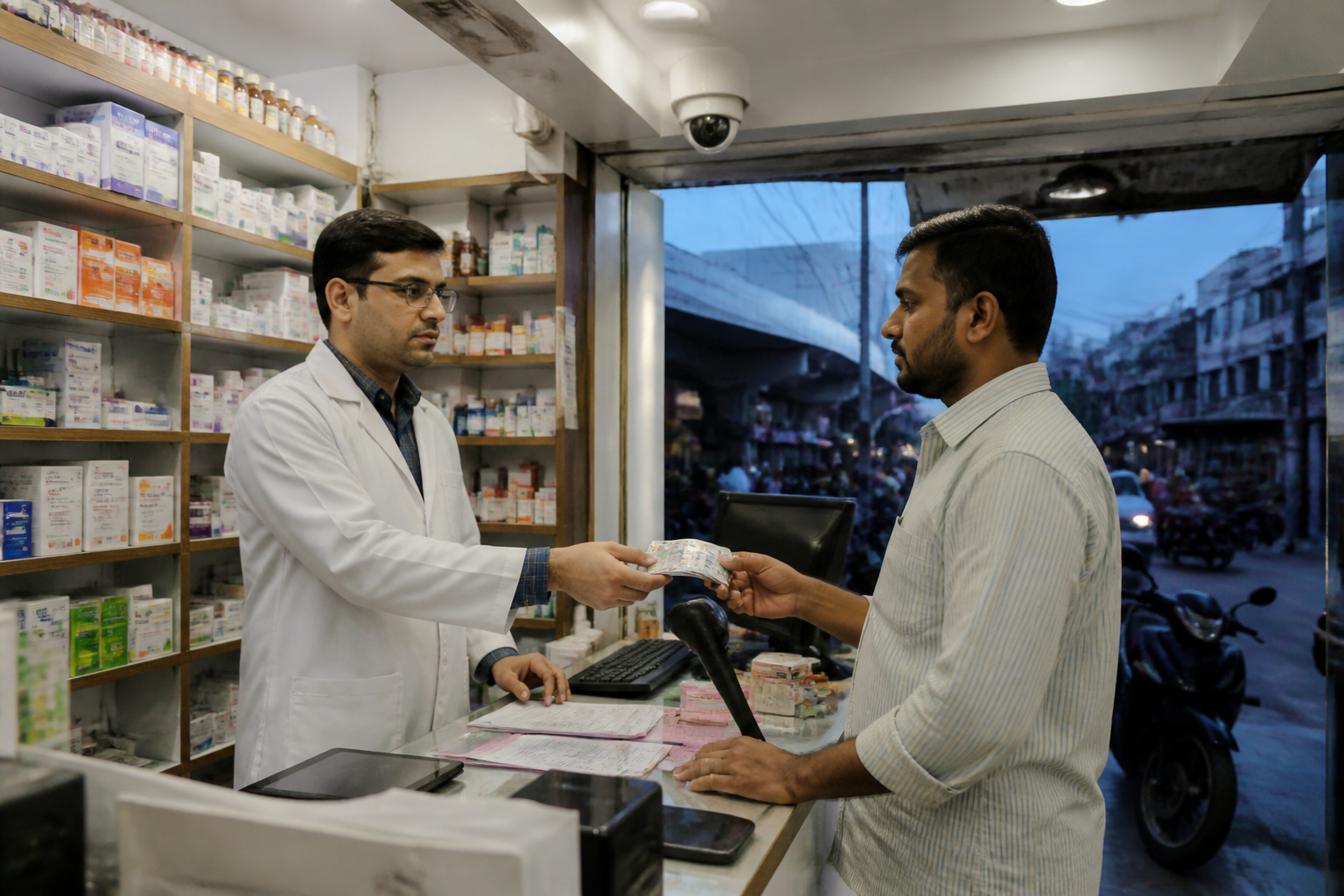
The Union Health Ministry’s proposal to make prescription medicine sales at retail stores traceable through mandatory CCTV surveillance has brought attention to a system in which consumers often receive medicines without prescription checks, qualified pharmacist support or proper bills. A LocalCircles survey of about 1.06 lakh responses from consumers across 327 districts suggests that the neighbourhood chemist remains central to medicine access, even as basic safeguards are inconsistently followed.
The survey found that 64% of respondents said their chemist never or rarely asked for a doctor’s prescription before selling medicines during the previous 12 months. Only 15% said their chemist mostly or always refused to sell medicines without a prescription. These findings do not establish that every medical store operates in this manner, but they indicate that prescription enforcement is not experienced as a consistent condition of purchase by a large share of consumers.
That distinction matters because the proposed CCTV requirement is not simply a technology intervention. It is an attempt to create a record of a transaction that is currently difficult to audit at the point where medicines move from the regulated supply chain to the consumer. Under the draft notification described in the report, the supply, other than by wholesale, of any drug sold on the prescription of a Registered Medical Practitioner would have to take place under a CCTV surveillance system installed and maintained at the premises.
The proposal comes amid intensified enforcement in multiple States against chemists selling prescription medicines without valid prescriptions, operating without registered pharmacists and failing to provide proper bills. The available material does not specify the number of enforcement actions or the penalties imposed, but it places the proposed surveillance requirement within a wider effort to improve compliance at retail outlets.
The survey also points to a second weakness: the person available at the counter is not always a qualified pharmacist. Only 31% of respondents said they were able to get assistance from a qualified pharmacist most of the time or always when they needed help with medicines or disease-related queries. Another 27% said they never or very rarely received such assistance, while 13% said they were assisted by someone who was not a qualified pharmacist.
This makes the retail medicine store more than a point of sale. For many consumers, it is also the first place where they seek guidance about a medicine, dosage or disease-related question. The survey does not assess whether the advice received was clinically appropriate, but the responses show a gap between the expectation that a chemist can provide medicine-related assistance and the regular presence of qualified personnel.
The neighbourhood store’s importance is reinforced by the survey’s purchasing data. Of 16,822 respondents who answered how they had primarily purchased medicines in the previous 12 months, 86% said they depended mainly on local chemists. Only 14% primarily used ePharmacy apps. This distribution means that any effort to improve prescription compliance, consumer records and medicine safety has to work through physical retail outlets rather than relying mainly on digital commerce.
Home delivery does not eliminate the compliance problem. Among 15,473 respondents asked about prescription checks during medicine deliveries, 41% said a prescription was never or rarely requested. The survey does not explain whether these deliveries were made by local stores, online platforms or other channels, nor does it identify the medicines involved. It nevertheless indicates that the shift from counter purchases to doorstep delivery does not automatically create a stronger verification process.
The billing findings add another layer to the traceability question. Of 20,573 respondents, 26% said they were not provided a GST bill when buying medicines from local chemists. The survey described a bill as more than a tax document because it carries the batch number, expiry date and identity of the seller. Those details can help establish where a medicine came from and provide a record if it is later found to be expired, defective or counterfeit.
This is the institutional logic behind combining prescription checks, pharmacist requirements, bills and surveillance. Each measure addresses a different point in the transaction. A prescription establishes the medical authorisation for specified medicines. A qualified pharmacist provides professional oversight. A bill identifies the seller and product details. CCTV can potentially show whether the transaction took place and whether the required process was followed. None of these measures, on its own, resolves every compliance failure.
The survey’s finding on counterfeit or ineffective medicines makes the record-keeping issue more serious. Of 18,457 respondents who answered that question, 15% said they had purchased medicines that were later found to be fake or counterfeit. The report does not provide independent confirmation for each consumer response, nor does it identify the products or locations involved. The figure should therefore be read as a measure of reported consumer experience, not as an official estimate of counterfeit medicines in circulation.
The survey also needs to be read with its sampling structure in mind. The responses came from consumers across 327 districts, with 63% men and 37% women. Tier-1 districts accounted for 52% of respondents, tier-2 districts for 29% and tier-3, 4 and 5 districts for another 29%, as reported. The individual questions received different numbers of responses, ranging from 15,473 to 20,573 in the findings cited. That means the percentages across different questions should not be treated as measurements from one identical respondent group.
These limitations do not make the findings irrelevant. They clarify what the survey can and cannot show. It identifies recurring consumer-reported experiences across a wide geographic spread, but it is not presented as a regulatory inspection or a complete audit of India’s medical stores. The survey can signal where the retail system is failing from the consumer’s perspective; enforcement data and official inspections would be needed to establish the scale and legal incidence of those failures.
The proposed CCTV requirement also raises an implementation question: what exactly will be recorded, retained and reviewed? The supplied material confirms the proposed obligation to install and maintain CCTV at premises dispensing prescription drugs, but it does not specify retention periods, access protocols, technical standards, inspection procedures or the consequences of non-compliance. Without those details, surveillance may create footage without necessarily creating effective oversight.
The same problem applies to bills and pharmacist availability. A bill is useful only if the information on it is complete and can be linked to the product and seller. A pharmacist requirement is meaningful only if a registered pharmacist is present during dispensing and is responsible for the transaction. The survey’s responses indicate that the formal safeguard and the consumer’s experience do not always coincide, but the available material does not identify where or why the gap occurs.
For city residents, the issue is shaped by proximity and dependence. Local chemists are used by far more respondents than ePharmacy apps, making them a crucial part of everyday urban access to medicines. That convenience can also make the retail counter a point at which regulatory rules are either made visible through a prescription check and bill or effectively bypassed. The proposed surveillance system is therefore aimed at a highly distributed network of neighbourhood businesses rather than a small number of central facilities.
The evidence confirms a compliance and traceability problem reported by consumers, alongside a government proposal intended to make prescription sales more auditable. It does not yet establish how the CCTV framework would operate in practice, whether it would improve prescription compliance, or how authorities would verify pharmacist presence and billing. Those questions will depend on the final notification, the technical and enforcement rules attached to it, and the results of inspections after implementation.
