


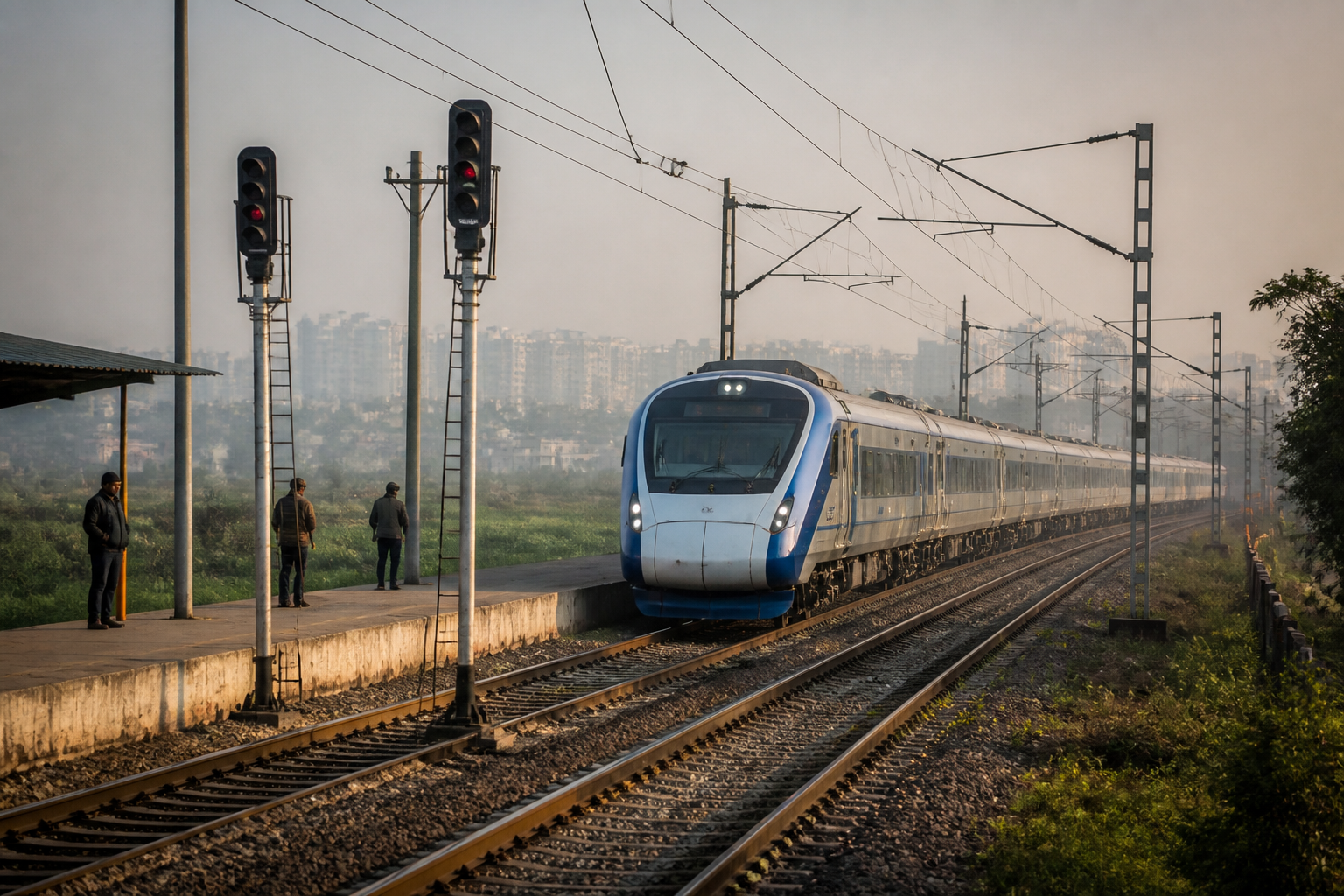
The proposed extension of India’s hydrogen train to Delhi is being driven less by a straightforward expansion plan than by a difficult operational reality: the service running between Jind and Sonipat is carrying only about 40 to 60 passengers a day on a train designed for up to 2,600. The railway’s response—considering an extension to Azadpur station near Delhi’s wholesale fruit and vegetable market—shows how the success of new transport technology depends on route design, demand and network capacity as much as on the technology itself.
The hydrogen-powered train currently covers an 89-kilometre route between Jind and Sonipat in Haryana. According to the report, railway officials are considering extending it to Azadpur in Delhi so that the service can reach a larger travel market. The proposal is still under consideration, and officials are monitoring the train’s operation and any trial run for an extension before making a final decision.
That caution is significant because the train is not being assessed only as a technology demonstration. It is already operating as a passenger service on an existing railway corridor where demand has remained weak. Railway staff told the publication that the hydrogen train replaced a DEMU service that also had low passenger numbers. Three other DEMU trains continue to operate on the route, but staff said none is carrying enough passengers because the number of office commuters and industrial workers travelling between Jind and Sonipat is limited.
The immediate operational change has been a reduction in frequency. The train is currently making one round trip a day, although initial announcements had indicated that it would make two. The low ridership therefore affects not only passenger numbers but also the utilisation of an expensive and technically significant asset. Extending the route to Delhi is being considered as a way to increase usage, but the proposal also exposes the limits of treating route length as a substitute for a clearly established passenger market.
## The route is the real test
The case raises a basic planning question for new rail services: should a train be placed on a corridor because the technology is ready, or should the technology be matched first to a corridor with sufficient and predictable demand? The report does not provide a detailed ridership study or a revenue assessment, but the available figures show a sharp difference between the train’s potential capacity and its present use. A service capable of carrying 2,600 passengers at a time is currently attracting only a small fraction of that capacity each day.
Local passengers have suggested that extending the service to Delhi would be the best option. Their proposal reflects the way regional rail demand is often shaped by destination access. A connection to Delhi could potentially link the train to a larger employment, wholesale and interchange market than the current Jind-Sonipat section. The proposed endpoint, Azadpur, is close to Delhi’s wholesale fruit and vegetable market, giving the extension a specific urban destination rather than an arbitrary terminus.
However, local passengers have also suggested an alternative route involving Panipat and Safidon if operational difficulties prevent an extension to Delhi. They see this as a possible Haryana circuit. That proposal indicates that the issue is not simply whether the hydrogen train should travel farther, but whether its route can connect places with stronger travel relationships and create a coherent regional service.
The distinction matters. A longer route can increase the distance covered without improving the number of useful journeys. For passengers, the value of a train depends on where it starts and ends, how frequently it runs, whether it connects with work and market destinations, and how it fits into the rest of the rail network. The current report establishes the ridership problem and the options under consideration, but it does not establish whether either proposed alignment would generate sufficient demand.
## Safety and capacity constrain expansion
Railway officials are also treating the extension as a safety and operating issue. One official said a group of experts is continuously monitoring the train’s operation between Jind and Sonipat and its potential extension to Delhi. The official described hydrogen propulsion as a new technology for Indian Railways and said passenger safety remained the priority.
A senior railway official cited another constraint: the hydrogen train has 10 coaches and can carry up to 2,600 passengers, while Delhi’s limited track capacity and heavier passenger pressure mean that trains with 18 to 20 coaches are generally required. This creates a mismatch between the train’s physical configuration and the conditions of the Delhi network. Even if the train has enough range to reach the capital, the extension would still have to fit into a busier and more capacity-constrained system.
Fuel range is less of a concern, according to the report. The train can travel between 250 and 300 kilometres on a full tank, while refuelling is currently available only at Jind. The train can therefore travel about 150 kilometres in one direction, and the distance between Delhi and Jind is approximately 130 kilometres. The available fuel range does not, however, remove the need for operational planning. A service that depends on a single refuelling location must still coordinate turnaround, maintenance and scheduling around that facility.
The railway’s own statements point to a staged approach. Officials have highlighted two months of successful operation and the commitment of the expert team involved in daily operations, while also saying that the extension will be decided carefully. The report does not specify a final approval, launch date, fare structure, timetable or infrastructure modification for the Delhi proposal. Those omissions are important because they leave the plan at the assessment stage rather than the implementation stage.
## Hydrogen rail cannot escape ordinary transport economics
The train was launched on 17 July as India’s first indigenous hydrogen-powered train. Railway officials described it as a pilot project for cleaner and more sustainable transport technology and linked it to the country’s self-reliance objectives. They also said the project placed India among countries including Germany, Japan, China and the United States working on hydrogen-powered rail transport.
That technological achievement does not automatically solve the practical problem of passenger service planning. The Jind-Sonipat experience suggests that a clean propulsion system still has to operate within the same conditions that shape conventional rail: population distribution, employment patterns, competing services, station access, timetable convenience, route connectivity and network capacity. Replacing a low-demand DEMU with a hydrogen train does not itself create demand. The report indicates that the earlier DEMU service also struggled with low passenger numbers.
This is the central institutional lesson in the proposed Delhi extension. A pilot can demonstrate that a train works mechanically and safely, but a public transport service must also demonstrate that it serves a meaningful travel market. The present figures show that technical capability and passenger utilisation are moving at different speeds. The railway is now considering a network change to address that gap.
The question is also relevant to how India evaluates emerging transport technologies. A hydrogen train may be valuable for building domestic capabilities, testing maintenance systems and developing operational expertise. But when it is deployed on a passenger route, its performance is judged by more than its propulsion system. Its public value depends on whether it provides useful mobility and whether the railway can operate it efficiently within existing infrastructure.
For now, the evidence confirms three things. The hydrogen train is operating on the Jind-Sonipat route; passenger numbers are substantially below its stated capacity; and railway officials are examining an extension to Azadpur in Delhi while monitoring safety and operations. It remains unclear whether the Delhi route will be approved, whether it can accommodate the train’s 10-coach formation, and whether a longer alignment will produce sustained demand. The next important milestones are the expert-monitored trial and the railway’s decision on the proposed extension or an alternative route through Panipat and Safidon.
