


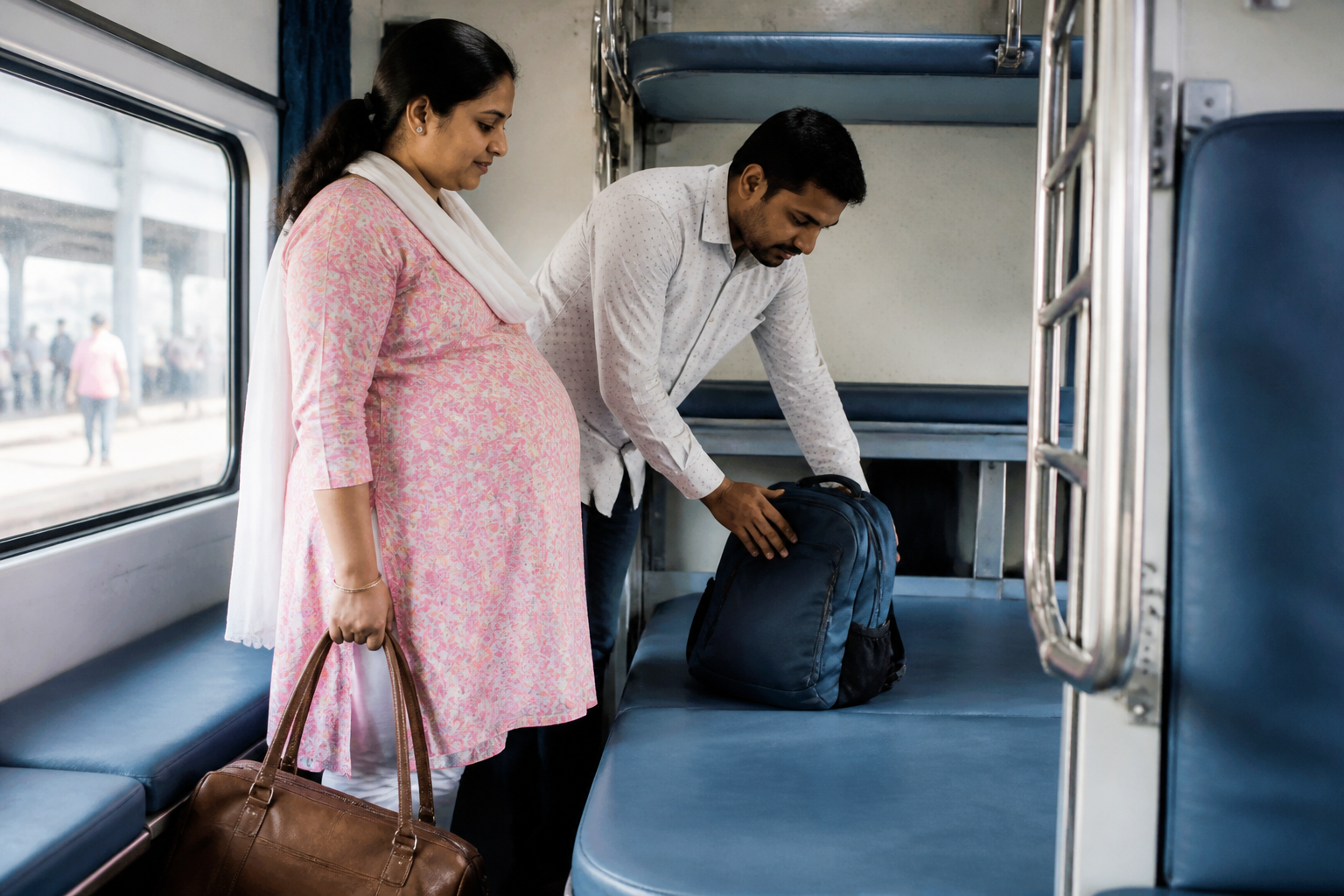
The Delhi High Court has sought responses from the Railway and the Centre on a plea seeking online access to lower-berth reservations for pregnant women, highlighting a reported gap between the railway’s reservation policy and the IRCTC booking process.
A bench comprising Chief Justice Devendra Kumar Upadhyay and Justice Tejas Karia issued notice to the Railway and the central government during a hearing on a public interest litigation filed by Anunay Sahay. The court adjourned the matter to September 30.
The plea seeks a facility through online ticket booking that would allow pregnant passengers to obtain the lower-berth priority stated in the existing railway reservation policy. The court observed that the policy already provides priority for lower berths to pregnant women, but the IRCTC platform does not currently offer a mechanism through which they can access the benefit online.
According to the petition, pregnant women are consequently required to visit a physical reservation counter with a certificate from a registered doctor. The petition argues that this process undermines the purpose of the lower-berth provision, which is intended to respond to the physical needs and convenience of pregnant passengers.
The court noted that IRCTC operates as an agent of the Railway. It said responsibility for ensuring compliance with the railway’s reservation policy rests with the Railway, and expressed the expectation that the Railway and the Centre would take appropriate steps to direct IRCTC to implement the facility on its platform.
The issue places the online ticketing system at the centre of access to a public transport entitlement. Although the reservation policy may recognise a specific passenger need, the benefit remains difficult to obtain if the digital booking system does not capture the relevant eligibility or provide a route for verification.
The petition’s contention is that the IRCTC application prevents pregnant women from using the lower-berth facility during online booking. The current process described before the court requires them to shift from the digital platform to a physical counter and carry medical documentation, creating an additional administrative step for passengers seeking an accommodation already recognised in the reservation policy.
The court’s observation also raises an institutional question about the relationship between policy-making authorities and the digital platforms through which public services are delivered. In this case, the court indicated that the Railway cannot avoid responsibility for implementation merely because ticket reservations are accessed through IRCTC.
No direction ordering an immediate change to the online booking system was reported in the proceedings. The Railway and the Centre have been asked to respond to the plea, and the matter is scheduled to be heard next on September 30.
