


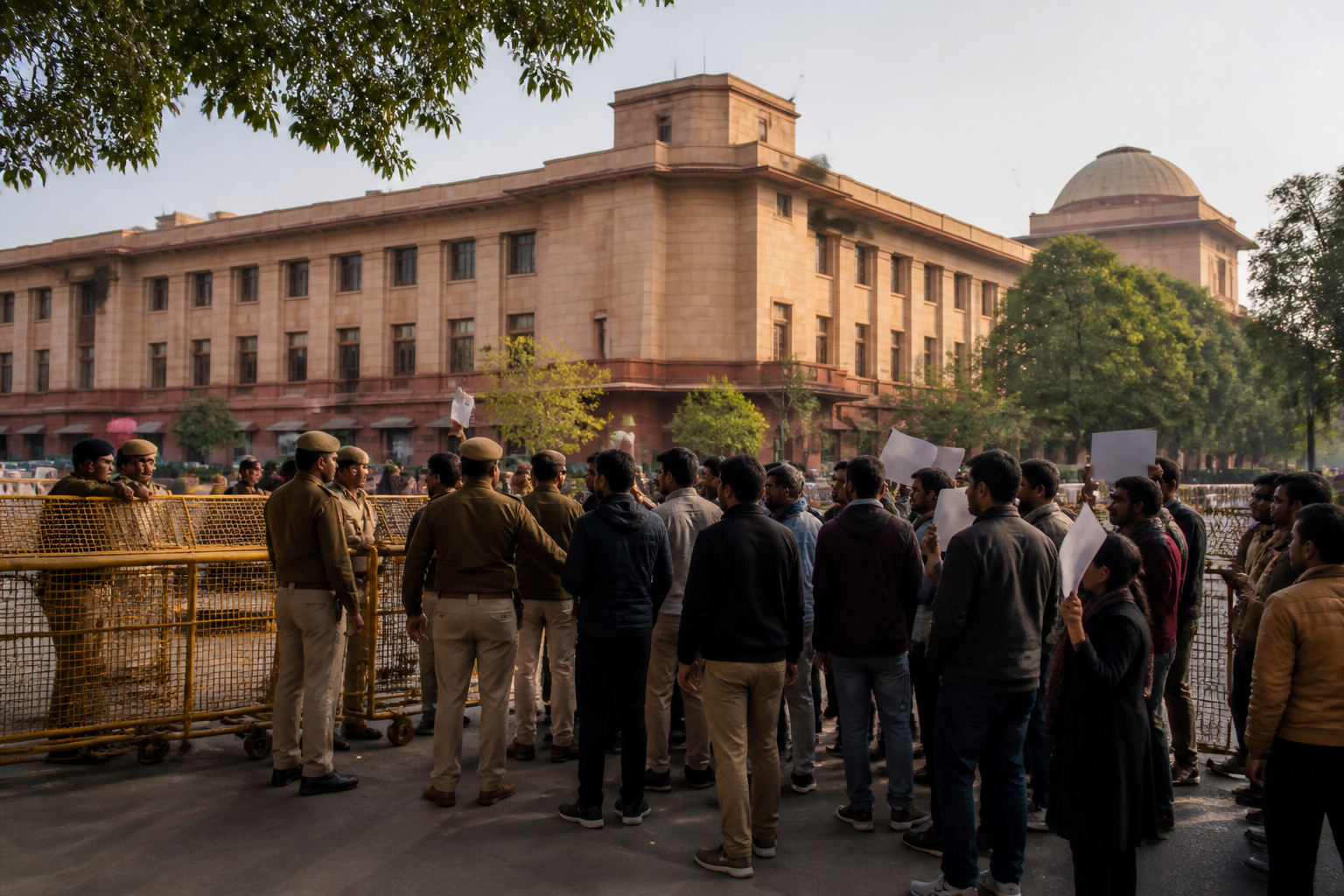
The Delhi High Court has questioned Delhi Police’s decision to deny permission for an anti-reservation protest at Jantar Mantar, saying authorities could impose conditions or restrictions instead of imposing what appeared to be a blanket ban on the gathering.
Justice Swarana Kanta Sharma raised the issue while hearing a petition filed by the Kshatriya Karni Sena. The petition concerns permission to hold a demonstration at Jantar Mantar, as well as the suspension of the organisation’s accounts on Meta platforms and a WhatsApp number. The court was told that the Instagram account had subsequently been restored, while the Facebook account’s live-video facility and the WhatsApp number remained suspended.
The petitioner’s counsel, Roshan Dhanai, told the court that Delhi Police had initially indicated that permission would be granted. However, a letter sent on the 15th said permission could not be given because the police feared that more people might attend than the organisers had stated and that the gathering could not be controlled.
The court questioned that reasoning and asked why permission had been rejected solely because of an apprehension about the possible size of the crowd. Justice Sharma said authorities could impose conditions and restrictions and allow the demonstration, particularly because it was expected to last only a few hours.
“Can you reject it? Why? Can such an order be passed? Just because you apprehend that some people may come?” the judge asked, according to the report. She also reiterated that restrictions could be imposed while granting permission rather than refusing the application outright.
Appearing through video conference for Delhi Police, Additional Solicitor General Chetan Sharma said the police had referred to Supreme Court guidelines and were acting in accordance with them. He described the area as sensitive and said that permission was being denied to others as well. He also referred to concerns over limited space at Jantar Mantar and the possibility that social-media engagement could translate into a gathering larger than the venue could accommodate.
The petitioner’s counsel argued that online views could come from outside Delhi and did not indicate that the same number of people would attend the protest physically. He also pointed to Jantar Mantar’s established role as a protest venue and said Delhi Police had adequate control over the location.
The exchange highlights the administrative challenge of managing demonstrations in central Delhi, where crowd size, traffic movement, security and access to public spaces have to be handled simultaneously. The police told the court that gatherings at Jantar Mantar can affect the whole of central Delhi because of the area’s limited capacity and its location within a dense administrative and commercial district.
The court also asked whether permission could be considered if the venue were changed or additional restrictions were imposed. The police said the possibility would be examined after obtaining instructions. Justice Sharma again questioned how a complete prohibition could be justified without first considering conditions or an alternative location.
The Delhi High Court will hear the matter next on September 22. Delhi Police is expected to return with instructions on whether the protest can be permitted subject to restrictions or held at another location.
