


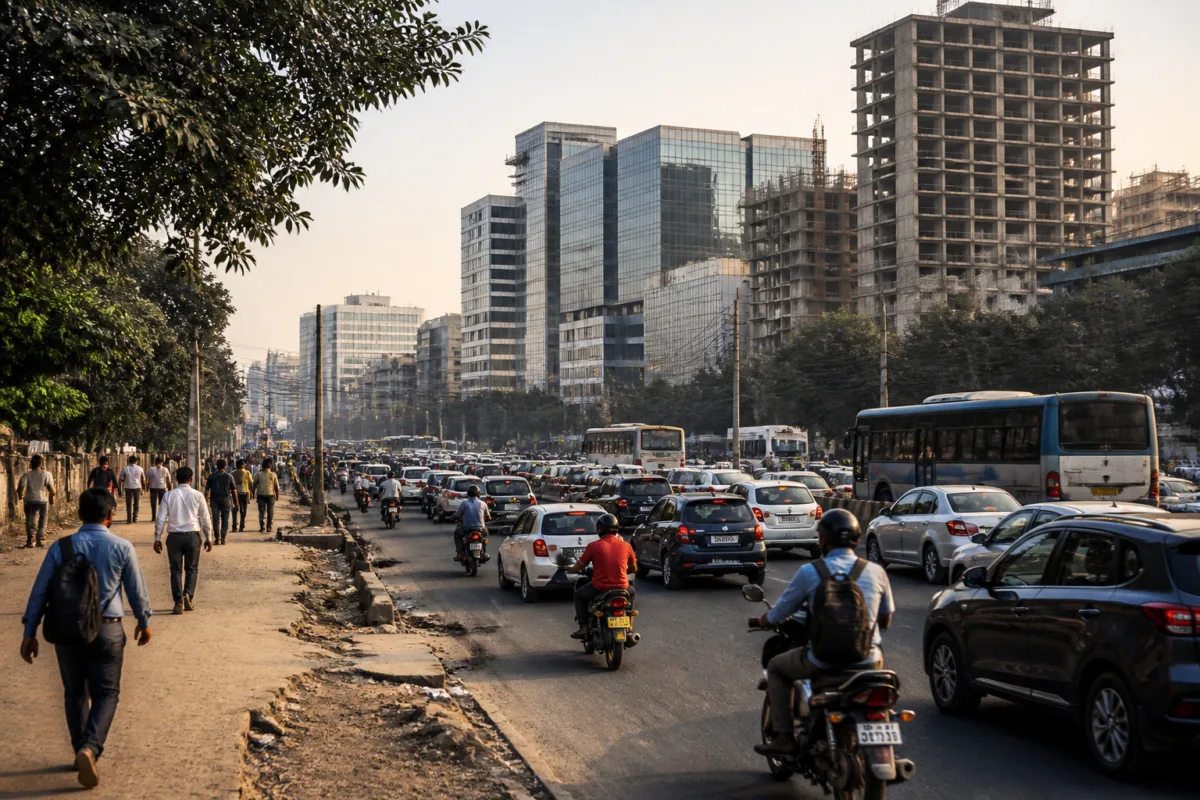
Hyderabad’s 421st position in the Oxford Economics Global Cities Index 2026 reveals a city whose economic and talent advantages are no longer enough to define its urban success. The city ranks 248th for economics and 241st for human capital, but falls to 818th for quality of life and 657th for the environment, exposing a widening gap between the strength of its growth engine and the everyday conditions experienced by residents.
The ranking places Hyderabad behind Delhi, Bengaluru, Mumbai and Chennai in the overall table of 1,000 cities worldwide. Its position is not a verdict on one municipal service or one year of administration. It is a composite signal about how a city converts economic output, jobs and skills into healthier, more affordable and more functional urban life.
That distinction matters because Hyderabad is often presented as one of India’s leading urban growth stories. Its corporate ecosystem, universities and skilled workforce have helped it attract investment and employment. The Oxford Economics index recognises those advantages. But the same expansion has increased pressure on housing, roads, transport networks and environmental systems. The result is a city that appears stronger in economic statistics than in the daily experience of moving through it, finding affordable housing or accessing a healthy environment.
The index’s economics category considers the size of a city’s economy, growth prospects, GDP per capita, employment growth and economic diversity. Hyderabad’s 248th position indicates that it has developed a substantial economic base and retains the characteristics associated with future expansion. Its 241st position in human capital similarly reflects the presence of universities, skilled workers and a corporate ecosystem capable of supporting knowledge-intensive activity.
However, economic strength does not automatically produce liveability. Hyderabad ranked 818th in quality of life, marginally behind Mumbai at 817th. According to the report as described in the source material, this category considers income inequality, income per capita, household spending on housing and utilities, health, crime rates, and access to recreational and cultural facilities. These indicators move the discussion beyond whether a city creates jobs. They ask whether residents can afford to live near those jobs, whether essential services remain accessible, and whether urban growth produces a safe and healthy environment.
This is the central contradiction in Hyderabad’s ranking. The city’s economy can expand while its residents face rising household costs and longer journeys. A growing technology and services economy can increase demand for housing in particular corridors without ensuring that lower- and middle-income households have affordable options nearby. New employment can coexist with congestion when the distribution of jobs, homes and public transport does not keep pace with one another.
The available ranking does not establish that any one factor caused Hyderabad’s low quality-of-life position. It does, however, identify the kinds of urban pressures that make the result significant. The source report points to pollution, worsening traffic congestion, poor road conditions in parts of the city, rising housing costs and pressure on urban infrastructure. Together, these concerns describe the costs of expansion when the physical systems of a city lag behind its economic geography.
Mobility is particularly important in this relationship. When public transport is inadequate or unreliable, households become more dependent on private vehicles. That increases traffic, travel time, fuel expenditure and emissions. Congestion also reduces the effective value of employment: a job may be economically attractive, but less beneficial if reaching it requires long and unpredictable daily journeys. The source material does not provide a detailed breakdown of Hyderabad’s public transport performance, but it identifies stronger public transport and reduced vehicle dependence as essential areas of action.
Road quality adds another layer to the problem. Roads are not only transport corridors; they are the base infrastructure for buses, emergency services, walking and local commerce. Poor road conditions can increase travel delays and safety risks while weakening the reliability of the wider network. In a rapidly expanding city, maintenance failures can become more consequential because new development increases traffic on existing infrastructure before replacement or expansion is completed.
The environmental ranking presents a related but distinct picture. Hyderabad stands at 657th, ahead of Mumbai at 782nd and Delhi at 915th, but behind Bengaluru at 528th. The environment category assesses air quality, emissions intensity and exposure to natural hazards. Hyderabad’s position is therefore neither a complete failure nor evidence that environmental pressures are under control. It suggests a mixed performance in which the city compares better than some metropolitan peers on the listed measures but still remains far from the stronger end of the global ranking.
Air pollution and emissions intensity are closely linked to the way a city grows. Vehicle dependence, the location of jobs, construction activity, energy use and the quality of public transport all influence the environmental burden of urban expansion. Yet the ranking also includes exposure to natural hazards, reminding policymakers that environmental performance is not limited to air quality. A city’s resilience depends on how well its infrastructure and planning systems manage risks that can disrupt homes, mobility and essential services.
Hyderabad’s ranking therefore raises an institutional question: which agencies are responsible for converting growth into liveability? Economic expansion is shaped by investment, companies, labour markets and higher education. Quality of life depends on a wider administrative system involving municipal services, transport agencies, road authorities, housing markets, health systems, environmental regulators and planning institutions. These responsibilities are distributed, while residents experience them as one city.
That distribution can make urban problems difficult to solve. A transport agency may expand a corridor without controlling the location of new housing. A planning authority may approve growth without directly managing daily road maintenance. Municipal improvements may not address regional commuting patterns. Housing costs may rise through market pressure even when infrastructure investment is concentrated in a limited number of employment districts. The Oxford ranking cannot resolve these institutional questions, but its category-wise results make the fragmentation visible.
The housing dimension is especially important because the quality-of-life category includes household spending on housing and utilities. The source material also notes rising housing costs in Hyderabad. This connects affordability to transport and infrastructure rather than treating it as an isolated real-estate issue. When households cannot afford homes close to employment, they are pushed towards peripheral locations, informal arrangements or longer commutes. The resulting pressure appears in traffic, emissions, household budgets and demand for road and transit capacity.
The data also shows why an overall rank can conceal more than it reveals. Hyderabad’s 421st position is neither a simple success nor a simple decline. It is an average of different urban capabilities, and the gap between 241st in human capital and 818th in quality of life is more informative than the overall number alone. The city has assets that support prosperity, but its weaker social, environmental and service outcomes limit how broadly that prosperity is experienced.
Comparisons with other Indian metros reinforce this point. Hyderabad performs better than Mumbai and Delhi in the environment category but trails Bengaluru. In quality of life, it sits almost level with Mumbai, with Hyderabad at 818th and Mumbai at 817th. These comparisons should not be read as a complete league table of urban performance because each category measures multiple indicators. They are more useful as prompts to examine which metropolitan systems are better converting economic strength into everyday benefits.
The index also changes the meaning of the phrase “quality of life”. It is not simply a matter of aesthetics, lifestyle branding or the presence of high-income neighbourhoods. It includes inequality, health, household costs, safety and access to recreation and culture. A city can have modern offices, high-value employment and internationally connected firms while still producing unequal access to basic urban advantages. Hyderabad’s results underline the difference between a city being attractive to capital and being comfortable, affordable and healthy for a broad resident population.
For policymakers, the immediate issue is not whether Hyderabad should stop growing. The evidence supplied in the ranking does not support that conclusion. Instead, it shows that growth needs to be assessed alongside the systems that carry it. Public transport, road conditions, pollution control, environmental management and housing affordability are not secondary amenities to be addressed after economic expansion. They influence whether expansion remains productive and whether its benefits reach residents beyond the most advantaged groups.
The ranking also cannot by itself establish a trend over time because the supplied material provides the 2026 positions but no earlier Hyderabad scores or methodology changes across editions. What it does establish is a current imbalance. Hyderabad’s economic and human-capital performance is substantially stronger than its quality-of-life and environmental performance. That imbalance is the most important fact in the result.
The next stage of scrutiny should therefore focus on the underlying indicators: how housing and utility costs are changing, whether public transport capacity is keeping pace with job growth, how road conditions vary across the metropolitan area, and how air quality and emissions are being managed. The Oxford Economics index identifies the gap. Closing or widening that gap will depend on the decisions made across Hyderabad’s planning, transport, housing, infrastructure and environmental institutions.

