


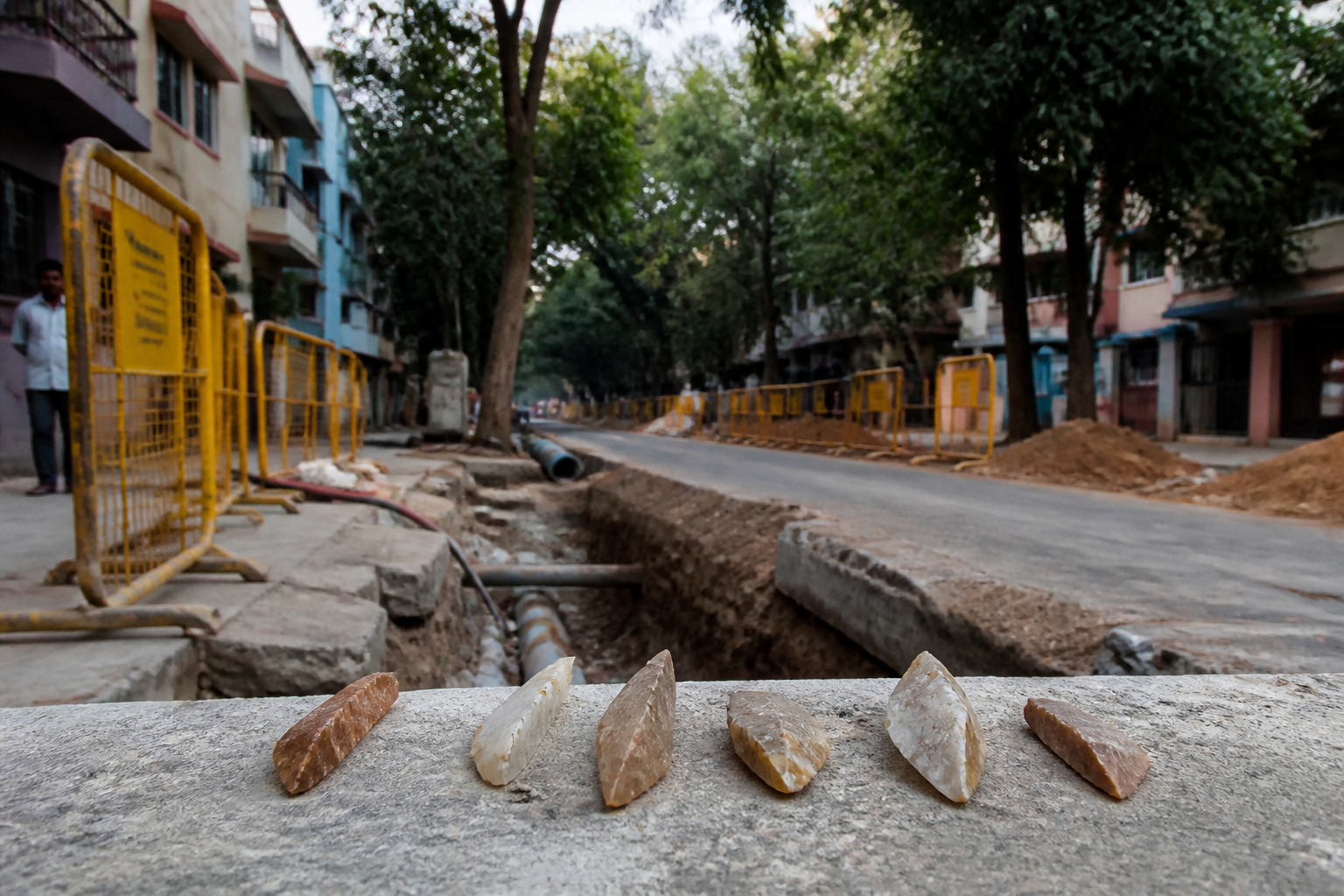
A water-pipeline repair near Banashankari in Bengaluru produced an archaeological claim far older than the city’s familiar historical timeline: five quartzite and quartz implements that retired archaeologist K B Shivatarak linked to the Palaeolithic age, potentially placing human activity in the area around four lakh years ago. But the discovery also illustrates the limits of reading deep urban history from isolated objects, because another senior archaeologist questioned whether the stones were shaped by humans at all.
The objects were found in May 2016 near the Kadirenahalli underpass at Bendrenagar in Banashankari II Stage. The Bangalore Water Supply and Sewerage Board had dug up the road to repair a leaking water pipeline. Shivatarak, a retired professor of ancient history and archaeology who lived nearby, noticed stones collected by workers during the excavation. He selected some, washed them and compared them with implements he had encountered during research into prehistoric sites in Tumakuru, Mandya and Chitradurga districts.
The five objects he retained included a hand-axe, a scraper, a leaf-like implement, a hammer stone and a miniature hand axe. According to the report, they measured between 7 and 11 centimetres in length and between 4 and 7 centimetres in breadth. Shivatarak identified quartzite and quartz as the materials and said the forms appeared suited to different activities, including hunting and the processing of animal remains.
His interpretation would significantly extend the story of Bengaluru. The city is usually discussed through its better-known settlements, rulers, cantonment-era development, lakes, roads and technology economy. A Palaeolithic association would place the question of human presence in the area hundreds of thousands of years earlier than those documented urban histories. It would also shift attention from the city as a planned or inherited settlement to the landscape that existed before Bengaluru became a city.
That distinction matters. The discovery did not take place at a planned archaeological excavation or within a protected site. It emerged during ordinary civic maintenance, when a leaking pipeline forced workers to cut into an urban road. The episode therefore connects the history beneath Bengaluru to the infrastructure that supports its present-day expansion. Roads, drains, water lines and utility corridors routinely disturb layers of soil, but the administrative purpose of such work is usually repair and service delivery, not historical investigation.
In this case, the road excavation created an unexpected opportunity for observation. Workers collected stones, and a nearby resident with archaeological experience recognised forms he considered significant. The chain of discovery was informal rather than institutional: a public utility intervention, followed by local curiosity and individual interpretation. That does not establish the archaeological claim, but it shows how evidence can surface outside the settings where heritage is normally expected to be found.
The central uncertainty is whether the five objects are genuinely tools fashioned by early humans. Shivatarak described them as the first Palaeolithic cultural remains discovered in the city and suggested that they could indicate human presence around four lakh years ago. He also identified another location near Abhimaan Studio in Kengeri where similar-looking stones had been found, although he was still studying those objects at the time of the report.
Prof Ravi Kori Settar, a retired professor of archaeology at Karnatak University, questioned that interpretation. Settar pointed out that quartzite quarries had not been found around Bengaluru and noted that Palaeolithic tools in Karnataka were generally associated with northern areas and locations such as Kibbanahalli near Tumakuru. He suggested that the Banashankari stones might have acquired their shapes naturally or might merely resemble prehistoric implements without having been fashioned by humans.
That disagreement is not a minor qualification. In prehistoric archaeology, resemblance alone cannot settle whether a stone is a tool. The material, shape and apparent use may be relevant, but the surrounding geological and archaeological context is also important. The reported absence of identified quartzite quarries around Bengaluru, as highlighted by Settar, raises a question about how the stones reached the site. The supplied account does not establish whether the objects were recovered from a defined archaeological layer, associated with other material, or examined through a formal excavation.
The location of the find adds another layer of complexity. Banashankari II Stage is now an established urban neighbourhood, with roads, buildings and underground utilities. Construction and repairs can mix soil and move stones away from their original position. The report does not provide enough information to determine whether the objects remained in their original context when the pipeline trench was opened. That gap does not disprove Shivatarak’s interpretation, but it limits how confidently the discovery can be used to date human presence in Bengaluru.
The episode also exposes the difference between an archaeological possibility and an established historical fact. The four-lakh-year timeline was presented as Shivatarak’s claim. It was not confirmed in the supplied account through a formal excavation, an institutional archaeological report or a consensus among specialists. Settar’s contrary assessment means that the most defensible conclusion is narrower: five stones found during civic work prompted a serious question about prehistoric activity in the Bengaluru area, but the question remained unresolved.
This is where the city’s infrastructure becomes part of the evidence. Bengaluru’s public works are usually measured through immediate outcomes: whether a leak is repaired, a road is restored or a utility resumes normal operation. Yet excavation also changes the physical record of the city. Every trench can expose material from an earlier landscape, while every repair can disturb or remove that material. The Banashankari discovery suggests that urban maintenance has an overlooked relationship with heritage documentation.
It would be inaccurate to turn that relationship into a claim that every unusual stone found during a road repair is archaeological evidence. The disagreement in this case demonstrates why casual identification needs to be followed by specialist assessment. At the same time, the incident shows the cost of treating excavation only as a technical operation. If workers, residents or officials do not notice unusual material, a potentially important clue can disappear when the trench is filled and the road is resurfaced.
The institutional responsibilities are not clearly established in the supplied report. The Bangalore Water Supply and Sewerage Board was carrying out a water-leak repair, while the initial interpretation came from a retired academic living nearby. The account does not identify a formal handover of the objects to an archaeological authority, a documented excavation, a laboratory examination or an official heritage listing. Those absences are important because they explain why the discovery remains a claim rather than a settled addition to Bengaluru’s history.
The story also raises a planning question about what lies beneath rapidly urbanised areas. Bengaluru’s present built form can make the city appear historically recent in everyday life: apartment blocks, traffic corridors, commercial streets and utility networks dominate the visible landscape. But urban development overlays older geological and human histories. The Banashankari objects, whether genuinely worked tools or naturally shaped stones, emerged because contemporary infrastructure cut through that concealed ground.
The evidence currently supports three separate conclusions. First, the objects were found during a 2016 water-leak repair near the Kadirenahalli underpass. Second, Shivatarak interpreted five of them as Palaeolithic implements and linked them to possible human presence around four lakh years ago. Third, Settar disputed that interpretation and offered natural formation or resemblance as alternative explanations. The supplied material does not resolve the disagreement.
That unresolved status is precisely what makes the episode useful for understanding urban archaeology. Bengaluru’s historical record is not produced only by monuments, archives or planned excavations. It can also be disturbed by routine infrastructure work and noticed by people who happen to understand what they are seeing. But the movement from discovery to evidence requires documentation, context and independent scrutiny.
For now, the Banashankari stones should be treated neither as proof that humans lived in Bengaluru four lakh years ago nor as an irrelevant roadside curiosity. They represent a contested archaeological possibility uncovered by a civic repair. The larger lesson is concrete: as Bengaluru continues to build, repair and replace the networks beneath its streets, the city’s infrastructure may also be opening brief windows into landscapes that urban growth has buried.
