


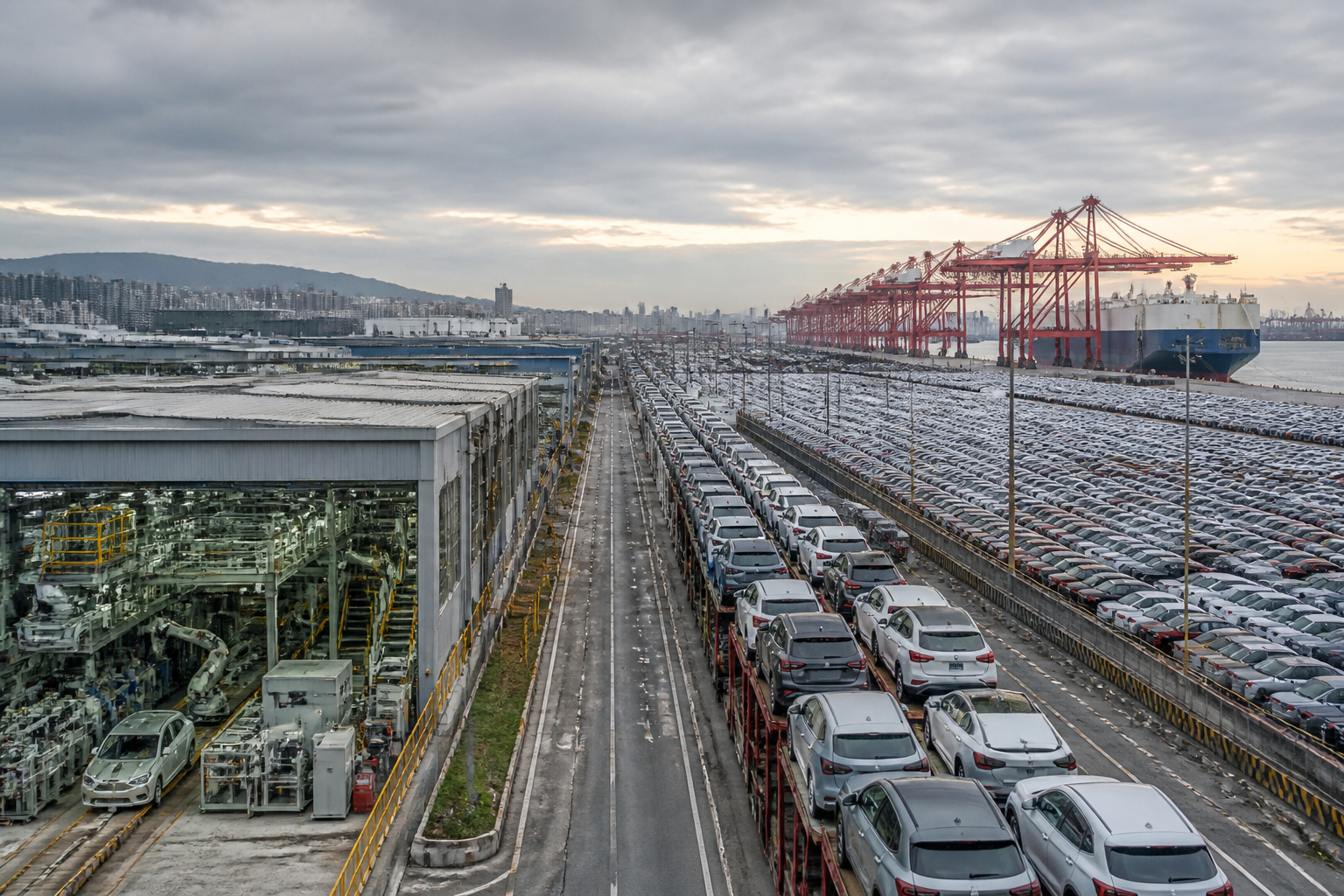
Toyota’s proposed restructuring with Chinese partners is more than a corporate transaction. It is an early test of whether China’s vehicle industry can reduce excess capacity without intensifying the employment, regional and trade pressures created by years of factory expansion. The proposed tie-up between Guangzhou Automobile Group (GAC) and FAW Group comes as China’s car market contracts, domestic profits weaken and manufacturers increasingly depend on exports to absorb production.
The immediate proposal involves two state-owned Chinese automakers that operate separate joint ventures with Toyota. GAC said it planned to acquire part of FAW’s stake in an unnamed vehicle-manufacturing joint venture, while Chinese state media identified the venture as FAW Toyota. The structure could bring Toyota’s two China operations closer together after decades of separate partnerships with FAW in northern China and GAC in the south.
That geography matters because the arrangement reflects how China’s auto industry was built. Foreign manufacturers entered a rapidly expanding market through local partnerships, with factories, suppliers and dealer networks developing around separate provincial and corporate interests. Toyota’s two joint ventures were designed for scale during a period of strong demand. They now face a market in which domestic brands have gained ground in electric and hybrid vehicles, while consumers have more than 100 competing brands to choose from.
The result is a mismatch between industrial capacity and actual demand. China has enough production capacity to make more than 55 million vehicles a year, according to data compiled by Gasgoo Automotive Research Institute and cited by Bloomberg on September 16. Local sales were less than half that figure last year, according to the China Passenger Car Association. The gap is not simply an accounting problem. It represents factories, supplier networks, land, energy use, logistics systems and employment tied to output that the domestic market cannot absorb.
The financial effects are already visible. Industry profits fell 20% in the first half of the year, according to Bloomberg, while official data cited by Reuters put vehicle-manufacturing profit margins at 1.5%, their lowest level in nearly a decade. With too many manufacturers competing for too few buyers, price cuts have become a primary method of defending market share. That strategy may keep factories operating, but it also compresses margins and makes duplicated investment harder to sustain.
The pressure has pushed the surplus beyond China’s borders. Passenger vehicle sales in China fell 23.4% year on year in June to 1.62 million units, marking a ninth consecutive monthly decline, while exports rose 82.1% to 882,000 vehicles, according to China Passenger Car Association data cited by Reuters. In the first half of the year, domestic sales fell 20.4% to 8.8 million vehicles, while exports increased 70.6% to 4.28 million.
This export surge has converted a domestic capacity problem into a global industrial and regulatory issue. Chinese automakers have expanded across Europe, Southeast Asia, Latin America and the Middle East, supported by lower manufacturing costs, integrated battery supply chains and aggressive pricing. BYD’s exports nearly doubled in June to more than 175,000 vehicles even as its domestic sales fell 22%, according to a Reuters report cited in the supplied material.
For cities and urban economies, the significance lies in the systems behind those numbers. Vehicle manufacturing is not confined to assembly plants. It supports component suppliers, freight corridors, ports, dealerships, repair networks and industrial employment. When production expands faster than demand, the consequences are distributed across that system. A factory may continue to operate while margins deteriorate; suppliers may remain dependent on a small number of manufacturers; and local economies may become exposed to decisions made by companies seeking to defend market share across a crowded national industry.
The proposed Toyota structure is therefore a possible response to duplication rather than a complete solution to overcapacity. GAC and FAW would remain independent, but overlapping production and operations could potentially be reduced. This is different from directly merging rival state-owned automakers, an approach that has previously encountered employment concerns and regional protectionism. Consolidating foreign-brand joint ventures first could provide a less disruptive route to rationalisation.
Claire Yuan, a Hong Kong-based credit analyst at S&P Global Ratings, told Bloomberg that the transaction could serve as a test case for deeper integration among state-owned enterprises. The proposal could show whether operational consolidation can proceed without requiring an immediate merger of the parent companies. It also raises a more difficult institutional question: who bears the cost when capacity that was once encouraged as industrial development becomes economically redundant?
China’s government has repeatedly warned about overcapacity and damaging price wars. Its top economic planner reiterated support for mergers and restructuring among major automakers last week, according to the supplied report. That position indicates that the issue is being treated as a sector-wide structural problem rather than an isolated difficulty at one company. However, the report does not establish the terms, timing or employment consequences of the proposed Toyota-related transaction.
The pressure is not evenly distributed between foreign and Chinese manufacturers. Toyota’s two China joint ventures accounted for 7% of passenger vehicle sales in the first eight months of the year, ranking behind BYD, Geely Auto and Volkswagen. In 2021, the two ventures together ranked second, behind Volkswagen. The change shows how quickly the competitive order has shifted as domestic brands have improved their electric and hybrid offerings.
Toyota’s dealer network has contracted alongside its market position. FAW Toyota’s network fell more than 15% to 651 stores this year from a peak of 773 in 2022. GAC Toyota’s network declined more than 10% to 620 from 693, according to data cited by Reuters. Dealer consolidation is a visible sign of adjustment, but it also affects local commercial activity, service employment and consumer access to sales and maintenance networks.
The larger challenge is technological and consumer-facing, not merely physical. Bill Russo, founder of Shanghai-based consultancy Automobility, said the proposed move had industrial logic because Toyota could make sales and distribution more efficient and reduce overlapping investment. He also said the more significant challenge was the loss of relevance of global automakers in consumer-facing technology. Chinese brands such as BYD, Geely and Chery have gained market share with rapidly developed electric and hybrid vehicles and are now expanding overseas.
That distinction is important for understanding what restructuring can and cannot achieve. Combining operations may reduce duplicated investment, but it does not automatically restore demand or close the technology gap. A more efficient network can still be strategically weak if its products no longer match consumer expectations. Jia Ke, founder of consultancy Auto Business Review, said shrinking industry profits were making redundant investment and internal inefficiencies increasingly difficult to sustain, according to Reuters.
The international response adds another layer to the reset. The European Union imposed additional tariffs on Chinese electric vehicles in October 2024 after concluding that they benefited from unfair state subsidies. Other countries have also increased scrutiny of Chinese vehicle imports. These measures do not remove China’s production surplus; they change the cost and access conditions under which that surplus can be exported.
For receiving markets, lower-priced vehicles may increase consumer choice and accelerate electric-vehicle adoption, but the supplied evidence does not establish the effects in any particular country. What is clear is that the export push is now interacting with trade policy. Industrial capacity built to serve China’s domestic market is becoming part of a global competition over manufacturing, subsidies, technology and market access.
The next two to three years are likely to be a period of restructuring, with S&P Global Ratings expecting a broader wave across the industry, according to the report. The key indicators will be whether manufacturers consolidate plants or joint ventures, whether dealer networks continue to shrink, whether price competition eases and how governments respond to the employment and regional consequences of closures or reduced output. The supplied material does not establish which companies will exit, merge or retain their current capacity.
China’s car overcapacity is consequently not only a story about too many vehicles. It is a test of how an industrial system built around rapid expansion manages the transition to slower domestic demand and more technology-led competition. Toyota’s proposed arrangement with GAC and FAW may become an early model for reducing duplication, but the evidence already shows that the underlying adjustment will involve factories, suppliers, workers, cities, trade routes and the future direction of global mobility manufacturing.
