


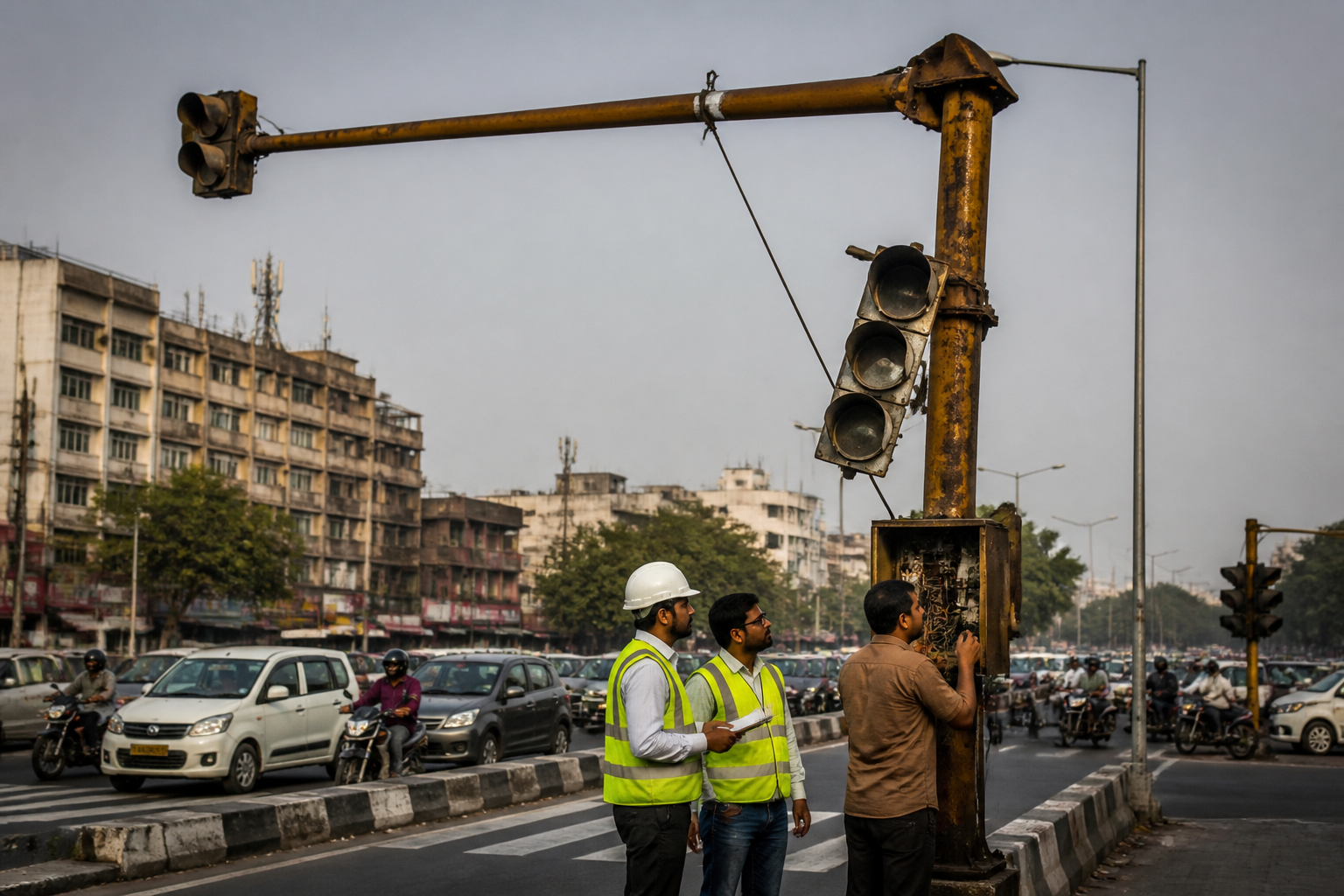
Delhi-NCR urban safety is being tested not only by accidents, illegal construction or transport disruptions, but by what happens before those events. A traffic signal pole reportedly showed signs of rust and had been flagged for repair before it fell on vehicles in central Delhi. In Gurgaon, unauthorised floors, illegal paying-guest accommodation and commercial use of residential properties have persisted long enough to require repeated enforcement drives. Road-rage cases, rising H1N1 infections and a contractual bus drivers’ strike add different forms of pressure to the same regional system.
Taken separately, these incidents belong to different administrative categories. A damaged signal pole is a maintenance issue. An illegal PG is a planning and enforcement issue. Road rage is a policing and road-safety issue. Rising infections place pressure on hospitals, while a bus strike affects the reliability of public transport. Taken together, however, they reveal a common weakness: Delhi-NCR’s institutions often become most visible after a risk has already produced harm or disruption.
That distinction matters in a region where infrastructure, housing and mobility are tightly interconnected. A failure in one part of the urban system can quickly transfer pressure to another. When bus services are disrupted, commuters turn to the Metro and app-based transport. When unauthorised housing activity expands inside residential neighbourhoods, enforcement agencies must address not just one building but the accumulated effects of changing land use, room density and parking demand. When a road incident occurs, cameras and recordings may help establish what happened, but they do not prevent the next dangerous journey.
The Minto Road incident illustrates the problem of maintenance becoming an emergency. The traffic signal pole, installed in 2010, fell on vehicles on a Tuesday night, injuring two people. Police were investigating whether seepage and rust had weakened its base. The report also said the pole had visible wear around the bottom and that the agency responsible for maintaining it had been alerted about repairs approximately five days before the collapse.
The key institutional question is therefore not limited to why the pole fell. It is what happened after the warning was received. A maintenance system has several links: a defect must be noticed, reported, assigned to an agency, recorded, repaired and checked. A failure at any one of those stages can turn a manageable defect into a public-safety incident. The warning may exist, but without clear ownership and a time-bound response, it does not become prevention.
This is a recurring challenge in large cities. Rust, seepage, cracks, loose fixtures, damaged pavements and broken street lights are often visible before they become dangerous. The difficulty is less about recognising deterioration than about ensuring that information moves through the responsible institution and produces an action that can be verified. The Minto Road case, as described in the report, raises precisely that accountability gap without establishing which part of the maintenance chain failed.
Gurgaon’s enforcement drives show the same issue in the built environment. The Department of Town and Country Planning resumed action in Sushant Lok-1 and South City-1 against unauthorised additional floors, commercial activity in residential buildings, illegal PGs and misuse of stilt parking. More than 17 properties were sealed or faced demolition in the latest operation, after around 27 properties had been targeted in two earlier campaigns.
One property reportedly containing 23 rooms and being used as an illegal PG was sealed. These details show the scale and complexity of the problem, but they also point to the limits of one-property-at-a-time enforcement. When a residential building gains additional floors, is divided into multiple rooms or begins operating commercially, its use changes faster than the formal character of the neighbourhood may change. Parking, access, waste, water demand and emergency response requirements can all be affected, even when enforcement action is directed at a single property.
The report also refers to illegal colonies around the 900-metre restricted zone near the Indian Air Force ammunition depot, where long-standing construction restrictions remain relevant. That example moves the issue beyond individual violations. The administrative challenge is detecting construction early enough to prevent isolated infringements from becoming a cluster. Once unauthorised activity is widespread, enforcement becomes more disruptive, more contested and harder to reverse.
This is where the difference between planning control and enforcement becomes important. Enforcement acts on a violation that has already occurred. Planning control requires authorities to monitor building activity, land-use changes and occupancy patterns before a violation becomes normalised. The supplied report does not establish how these systems are organised or where the specific failures occurred, but the repeated campaigns indicate that sealing properties after the fact has not eliminated the underlying pressure.
Road safety adds another layer to the region’s preventive challenge. On Gurgaon’s Golf Course Road, footage from a motorbike and CCTV reportedly assisted the investigation into a woman who was chased and rammed by a car. Police formed a five-member special investigation team, arrested two accused and took them into custody for crime-scene reconstruction. The First Information Report was later expanded to include charges related to stalking, outraging the modesty of a woman and attempt to murder.
In Greater Noida, a 32-year-old man was seriously injured after being hit by a car at Ek Murti Chowk in the early hours of September 5. The report said he suffered multiple fractures in his legs, hand, knees and spine. Police later arrested the 24-year-old driver and impounded the vehicle.
The incidents differ in their immediate facts, but they underline the limits of relying on post-incident evidence. CCTV, dashcam footage and mobile recordings can identify vehicles, establish sequences and support prosecution. They are valuable tools for investigation. But their use after a crash or an assault also shows that the system is operating primarily in response mode. The preventive question is whether dangerous driving, aggressive behaviour and unsafe road conditions are being detected and deterred before someone is injured.
Public health and public transport demonstrate how urban safety extends beyond visible physical hazards. Haryana’s H1N1 count rose from 163 on August 26 to 378 on September 16, while Gurgaon’s count increased from 12 to 46. Hospital admissions across the state more than doubled from 27 to 58 over the same period, according to the report. These numbers do not describe a road or building failure, but they show how quickly pressure can accumulate in hospitals, households and workplaces.
The strain on public services was also visible when contractual Delhi Transport Corporation drivers went on strike over wages and social-security benefits. Bus services were disrupted in several parts of Delhi, leaving commuters with fewer options and increasing demand for the Metro and app-based transport. In a region where daily travel depends on transfers between different modes, a disruption in one network can produce crowding, congestion and higher dependence on alternatives.
This is not only a question of whether a particular strike is justified or whether a particular agency responded adequately. It is a question of system resilience. A transport network with limited redundancy will transmit disruption quickly. A housing enforcement system that detects violations late will face larger and more difficult operations. A maintenance system without clear closure checks may record complaints without preventing failures. A public-health system under pressure may have less capacity to absorb a sudden rise in cases.
The report’s incidents therefore point to a common administrative sequence: a warning appears, responsibility is assigned unevenly or slowly, and action becomes visible only after an accident, violation, health surge or service disruption. That pattern should not be overstated; the supplied material does not provide a region-wide audit of response times, complaint records or enforcement outcomes. It also does not establish that every incident could have been prevented. But it does show several examples in which the gap between early risk and later action is central to understanding what happened.
For Delhi-NCR, the larger urban question is whether agencies can move from event-driven response to routine risk management. That requires more than additional cameras, sealing drives or emergency investigations. It requires the institutions responsible for infrastructure, planning, policing, health and transport to identify risks, assign ownership and demonstrate closure before those risks become public crises. The evidence supplied here confirms the cost of delayed action, while leaving open how consistently the region’s agencies track warnings and measure prevention.
The next test is not simply how quickly authorities respond to the latest incident. It is whether the repairs, investigations, enforcement actions, public-health measures and transport arrangements described in the report produce documented follow-through. In a fast-growing metropolitan region, urban safety will be judged as much by the failures that are prevented as by the emergencies that are managed.
