


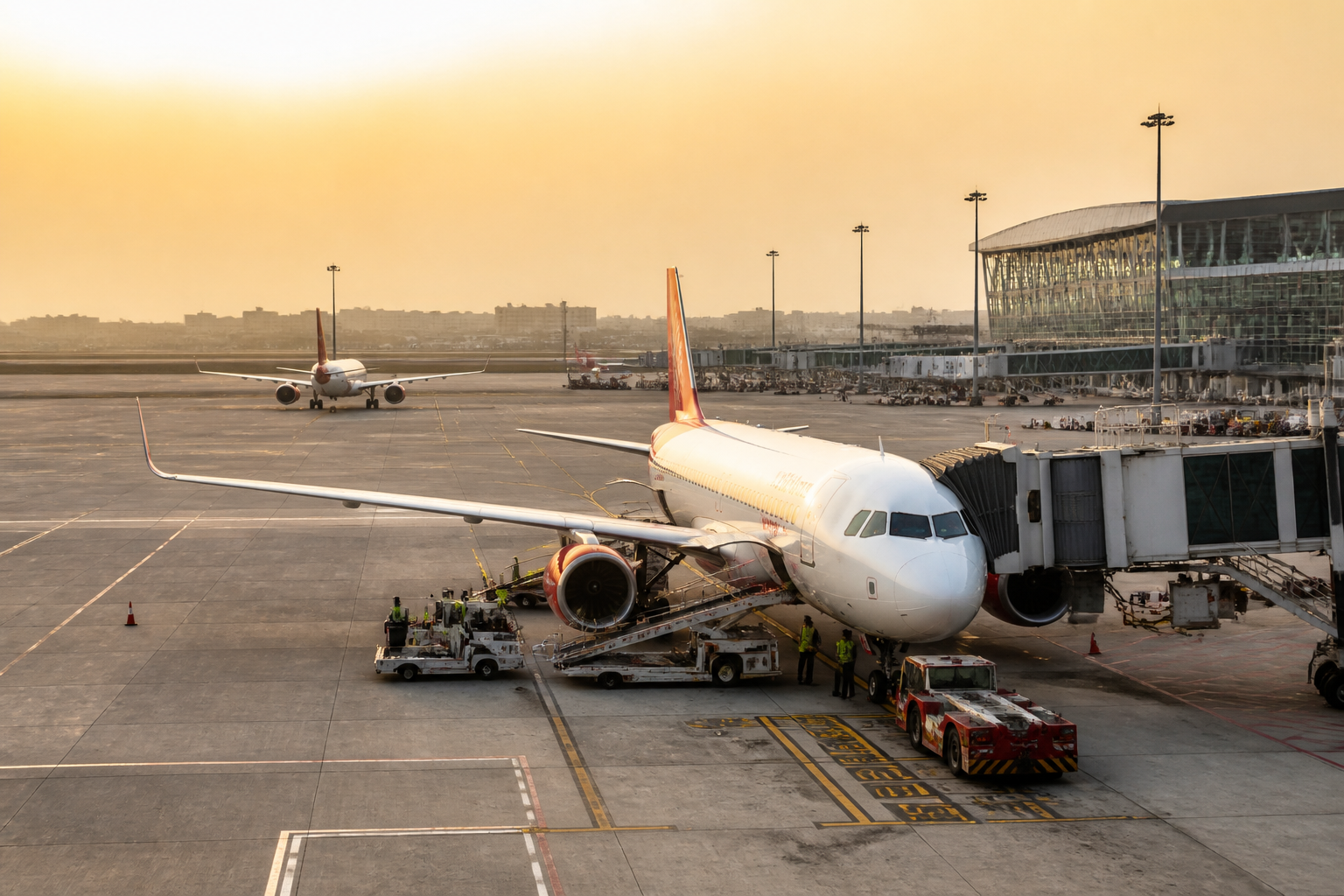
Air India’s decision to reduce domestic capacity in September is more than a schedule adjustment. It shows how India’s aviation expansion is being shaped by a less visible constraint: airlines may have growing fleets and ambitious long-term plans, but passengers experience growth only when aircraft are available, maintained, delivered and deployed on viable routes.
According to a report by Loksatta – Mumbai, Air India has reduced its planned September capacity by 8.8% compared with the previous year. The report attributes the move to a shortage of aircraft, rising fuel costs and restrictions affecting airspace. The airline is now concentrating available aircraft on routes where demand and economic viability are higher, rather than expanding capacity uniformly across its network.
That distinction matters for cities. Domestic air travel is part of the urban transport system that connects metropolitan centres, business districts, industrial clusters, tourism markets and regional airports. When an airline reduces flights, the effect is not limited to a timetable. It can alter the frequency of connections between cities, affect the options available to business and leisure travellers, and increase the importance of competing airlines on routes where capacity has been withdrawn.
The immediate story is therefore about aircraft deployment. The broader story is about the difference between planned airline growth and usable transport capacity.
## Capacity growth is not the same as network reliability
The report, citing aviation data company OAG, says Air India’s capacity has fallen from 3.5 million seats to 3.2 million seats in September, an 8.8% decline. It also refers to a separate comparison in which the airline’s scheduled capacity declined from 23.8 million seats to 22.7 million seats, or 4.5%, in September 2025. Because the report presents these figures as different year-on-year comparisons, the precise basis of each series is not explained in the supplied material. The consistent point is that scheduled capacity has been reduced rather than expanded.
For passengers, scheduled capacity is the operational layer that matters most. Fleet announcements and expansion plans do not automatically translate into more departures. An aircraft can add capacity only when it is available for service, meets maintenance requirements, is delivered on schedule and can be assigned to a route that supports the cost of operation.
This creates a gap between corporate strategy and the passenger experience. An airline may be expanding over the long term while simultaneously cutting flights in the short term. Air India’s current position, as described in the report, reflects that tension: its fleet is expected to grow, but its immediate schedule is being constrained by the availability and readiness of aircraft.
The result is a more selective form of expansion. Instead of adding flights across the network, the airline is placing available aircraft on routes with stronger demand and higher economic viability. That approach can protect utilisation and financial performance, but it also means that routes with weaker demand or lower margins may receive less capacity, even when they remain important for regional connectivity.
## Why fleet availability becomes an urban issue
Airports are often discussed as fixed infrastructure: terminals, runways, taxiways and passenger facilities. But airport connectivity depends equally on the availability of aircraft and the commercial decisions of airlines. A city can have airport capacity and still experience weak connectivity if carriers cannot operate enough flights or choose to deploy aircraft elsewhere.
This is particularly relevant in a country where urban economies are distributed across multiple metropolitan and regional centres. Air links support time-sensitive travel between cities, but the value of those links depends on frequency as much as on the existence of a route. A single daily flight and several daily flights do not offer the same level of flexibility to passengers, companies or institutions.
The report does not identify the specific routes affected by Air India’s September reductions. It does, however, indicate that aircraft are being prioritised for routes with stronger demand and better viability. That suggests a network being managed through commercial selection rather than broad-based capacity expansion. The urban consequence is uneven connectivity: some city pairs may retain or gain access to aircraft, while others may see fewer choices.
The effect also extends to airport planning. Terminals and supporting facilities are designed around expected passenger and aircraft movements. When airline schedules change, the operational picture can shift even if the physical infrastructure remains unchanged. A reduction in flights can lower activity on some routes while increasing concentration on others. The supplied report does not provide airport-level data, so the precise local effects cannot be established here, but the mechanism is clear from the airline’s stated deployment strategy.
## The constraints behind the cut
Three pressures identified in the report help explain why capacity expansion has become difficult: aircraft shortages, higher fuel costs and airspace restrictions.
Aircraft availability is not simply a question of how many planes an airline owns or expects to receive. The report specifically refers to aircraft availability, maintenance and delivery schedules as factors affecting capacity. Each of these creates a potential gap between the nominal fleet and the number of aircraft that can be placed into daily commercial service.
Maintenance removes aircraft from the operating schedule for planned or necessary work. Delivery schedules determine when additional aircraft can actually enter the network. Availability affects whether the existing fleet can sustain the planned timetable. Together, these factors make schedule expansion dependent on operational readiness rather than only on the airline’s long-term fleet plan.
Fuel costs add a financial constraint. When operating costs rise, the commercial value of a route changes. A flight with strong passenger demand may still be less attractive if its costs increase sharply, while a route with consistently high demand and stronger revenue potential may become a priority for the available fleet. This helps explain why the airline is focusing on routes described as both in demand and economically viable.
Airspace restrictions add an infrastructure and governance dimension. The report does not specify the nature, location or duration of the restrictions, so their precise operational effect cannot be assessed from the supplied material. Their inclusion alongside aircraft shortages and fuel costs nevertheless shows that airline capacity is shaped not only inside the carrier but also by the wider aviation operating environment.
## Air India and IndiGo are both reducing planned capacity
Air India is not the only major carrier cited in the report. IndiGo, described as the country’s largest airline, has reduced its September capacity by 4.5% to 11.26 million seats, according to the same account.
The comparison is important because it indicates that the issue is not presented solely as an Air India-specific fleet problem. Both major airlines are reported to be reconsidering where aircraft should be deployed rather than simply pursuing network-wide expansion. The scale and causes may differ between carriers, but the scheduling pattern points to a more cautious phase in domestic aviation.
That caution changes the meaning of headline growth. A market can continue to have ambitious expansion plans while its near-term schedules become more selective. The number of aircraft in a future fleet does not determine the number of flights available today. The practical test is whether aircraft can be operated reliably at a cost that supports the route.
For passengers, this can create uncertainty even without a formal route cancellation. A lower frequency can make a connection less convenient, reduce flexibility during disruptions and increase dependence on another carrier. For cities, it can make connectivity more sensitive to airline decisions and operational constraints.
## The larger policy question is capacity quality
The report’s central lesson is that aviation capacity should not be measured only through fleet size or long-term expansion announcements. The more meaningful measure for urban mobility is usable, scheduled and economically sustainable connectivity.
That requires attention to the institutions and systems around airlines: aircraft maintenance and delivery, fuel economics, airspace management, airport operations and route viability. These elements sit across corporate, regulatory and infrastructure domains. A constraint in any one of them can prevent planned growth from becoming passenger-facing capacity.
Air India’s September schedule, as reported, reflects an attempt to balance long-term expansion with immediate operational limitations. Its decision to favour routes with higher demand and viability is commercially understandable within the facts provided. But it also underlines a structural question for India’s urban transport network: how resilient is connectivity when expansion depends on a small number of large carriers and when available aircraft are concentrated on the strongest routes?
The evidence currently establishes a capacity reduction, the operational pressures cited by the airline and a more selective deployment strategy. It does not establish which individual city pairs have lost flights, how fares have changed, or whether alternative carriers have replaced the reduced capacity. Those are the next facts needed to assess the full effect on passengers and urban economies. For now, the September schedules show that India’s aviation growth is being tested not by ambition, but by the ability to convert aircraft and infrastructure into dependable daily service.
