


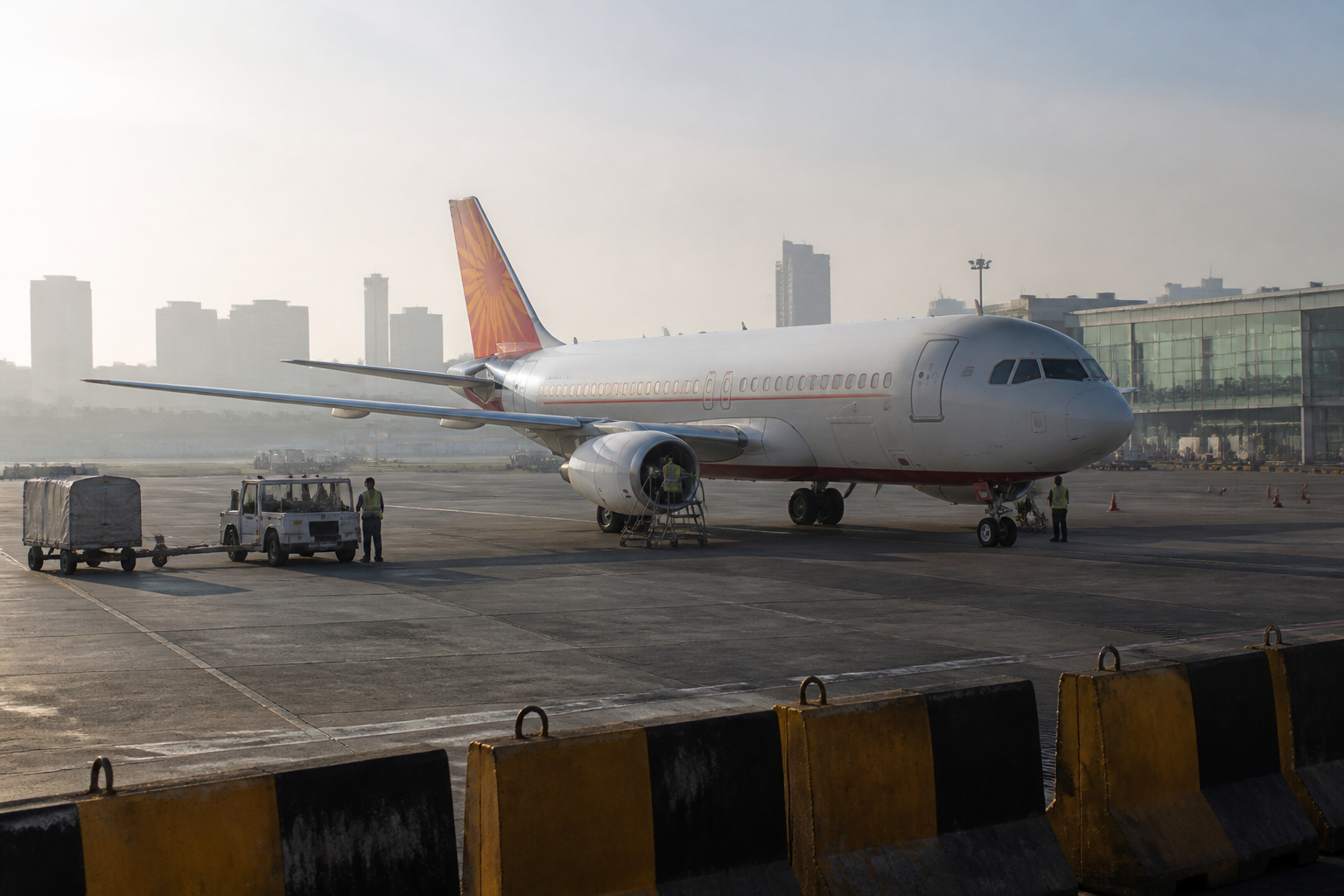
Air India’s decision to reduce scheduled domestic capacity in September highlights a difficult phase in the airline’s expansion: a larger long-term ambition is being pursued alongside immediate limits on aircraft availability, maintenance, deliveries, fuel costs and airspace operations. The reduction is not simply a change in the number of flights. For passengers and cities dependent on air links, it shows how quickly network capacity can be reshaped when an airline has to deploy a limited fleet towards routes it considers most viable.
According to data cited from aviation analytics company OAG, Air India’s scheduled September capacity has fallen by 8.8% year on year, from about 3.5 million seats to 3.2 million seats. The report also states that the airline’s September 2025 scheduled capacity had declined by 4.5%, from 23.8 million seats to 22.7 million seats. The figures indicate that the latest reduction comes after an earlier contraction, rather than representing an isolated adjustment.
The central tension is between fleet growth on paper and aircraft availability in daily operations. An airline can have an expansion plan, aircraft orders or a larger intended fleet, but its published schedule depends on aircraft being available, maintained and delivered on time. Each of those conditions affects how many flights can actually be operated. The report attributes Air India’s current constraints to a shortage of aircraft, higher fuel costs and restrictions affecting airspace.
This distinction matters for urban connectivity because scheduled capacity is experienced at the city level through frequency, timing and route availability. A reduction in total seats may not affect every airport or every route equally. Air India’s stated strategy, as described in the report, is to use available aircraft on routes where demand and economic viability are stronger. That approach concentrates scarce capacity where the airline expects the best operational and commercial returns.
For Mumbai, one of India’s largest aviation markets and a major business and tourism gateway, the effect of such decisions is likely to be felt through the availability of seats and flight timings on particular domestic routes. The supplied report does not identify the specific Mumbai routes affected, nor does it provide route-level cancellation or fare data. It therefore establishes a broader capacity shift rather than proving that every Mumbai passenger or destination has faced the same reduction.
The development also reveals how airline networks are being managed in a period when expansion is no longer only about adding destinations. The report says airlines are paying greater attention to where aircraft are deployed instead of simply expanding capacity. This changes the operational question from how many aircraft an airline intends to operate to where those aircraft can be used reliably and profitably.
IndiGo’s figures provide a wider industry context. The country’s largest airline has also reduced its September capacity by 4.5%, bringing it to 11.26 million seats, even as its fleet continues to expand. The comparison does not establish that both airlines face identical constraints, but it indicates that capacity decisions are affecting more than one major carrier. The available data points to a market in which fleet growth and seat growth are not moving in a straightforward parallel.
Several operational layers sit behind the headline numbers. Aircraft availability is the first. A plane that is unavailable because of maintenance or delayed delivery cannot support the planned schedule. Maintenance planning is the second, because aircraft utilisation depends on how much time is required for inspections, repairs and servicing. Deliveries form a third layer: a growing order book or an expanding fleet plan does not immediately translate into seats if aircraft enter service later than expected. Fuel costs and airspace restrictions add further pressure to the economics and feasibility of individual flights.
These factors make a published schedule an institutional and financial decision as much as a transport timetable. The airline must decide which routes receive aircraft, how much redundancy is available when a plane is unavailable, and whether a service can sustain its operating costs. The report’s reference to demand and viability suggests that Air India is prioritising routes where the available aircraft can support stronger commercial performance. It does not provide the airline’s route-level financial thresholds or a detailed breakdown of how the decisions were made.
The capacity figures also underline the importance of distinguishing between fleet expansion and network reliability. A carrier can be undergoing a long-term transformation while still reducing flights in the short term. That apparent contradiction is possible because expansion requires time: aircraft must be delivered, introduced into service, staffed, maintained and integrated into the schedule. Until those processes are complete, the airline may have to manage existing capacity more tightly.
For passengers, the immediate urban consequence is uncertainty around frequency and choice. When capacity is concentrated on selected routes, travellers on other routes may face fewer departure options, less convenient timings or greater dependence on competing airlines. The supplied report does not provide evidence on changes in ticket prices, passenger loads or airport congestion, so those effects cannot be quantified here. But the capacity reduction establishes the operational condition from which such passenger-level consequences may emerge.
For airports and cities, airline capacity is part of wider connectivity infrastructure. Domestic flights support business travel, tourism, regional access and links between economic centres. However, the report does not claim that the reduction has weakened any particular city’s connectivity or that alternative carriers cannot compensate. The significance lies in the way a major carrier’s scheduling choices can alter the distribution of available seats across the domestic network.
The institutional responsibility for managing this situation is distributed. The airline controls fleet deployment and scheduling. Maintenance and aircraft delivery timelines shape the supply available to it. Fuel prices influence operating costs, while airspace restrictions affect how routes can be operated. Passengers experience the combined result, but no single factor alone explains the capacity change described in the report.
The available numbers show a clear pattern: Air India’s September capacity is lower than the previous year, after a reported reduction in September 2025 as well, while IndiGo has also reduced capacity despite fleet expansion. What they do not show is whether the reductions are temporary, how long specific constraints will last, or whether capacity will be restored uniformly across routes. Those questions remain outside the evidence supplied.
Air India is therefore balancing two different time horizons. Its long-term expansion plan depends on building operational capacity, while its near-term schedule must work with aircraft that are actually available. The September reduction demonstrates that the second requirement can take precedence over the first. The next important evidence will be whether future schedules show capacity recovery, continued concentration on high-demand routes, or further changes linked to aircraft availability, maintenance, deliveries, fuel costs and airspace restrictions.
