


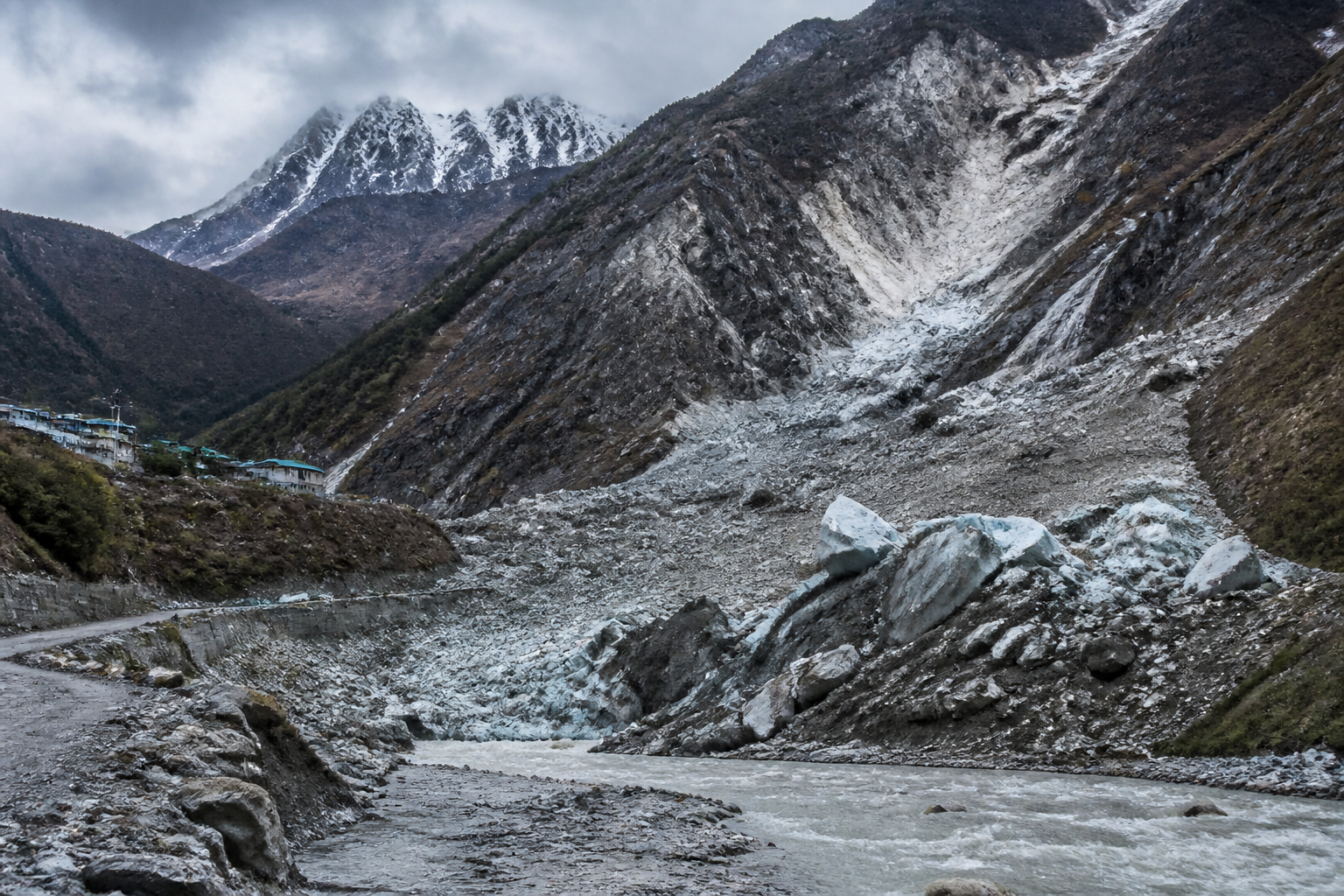
The collapse of roughly 2 square kilometres of rock wall and glacier ice on Nepal’s Langtang Lirung mountain was not explained by a single trigger, according to researchers cited in a World Weather Attribution study. Their assessment is that climate change created the conditions that made the late-August disaster more likely, by thinning glaciers, thawing permafrost, increasing meltwater and shifting precipitation from snow to rain. Flooding after the collapse affected parts of Nepal and Tibet, killed around 1,400 people and left thousands missing, according to the report.
That distinction matters. The researchers did not claim that warming alone mechanically caused the collapse. Instead, they described a mountain slope whose geological vulnerability was compounded by long-term environmental change and unusual weather immediately before the failure. The finding places the disaster within a wider Himalayan risk pattern: hazards are increasingly shaped by the interaction of unstable terrain, retreating ice, altered precipitation and settlements that depend on fragile mountain corridors.
The study’s central conclusion is that human-induced climate change played a role in the preconditioning of the disaster. Friederike Otto, a climatologist at Imperial College London, said warming contributed through permafrost thawing, glacier thinning and the occurrence of more rainfall instead of snow. These processes operate over different time scales. Glacier thinning changes the physical stresses acting on mountain slopes, while permafrost thaw can weaken rock that had remained frozen and comparatively stable. Intense rainfall and meltwater can then add pressure during a shorter period.
The Langtang Lirung collapse occurred after an unusually warm period in the Himalayan region. The study said mean temperatures in August were around 5 degrees Celsius higher than normal, with 1.5 degrees Celsius of that increase attributed to climate change. The assessment also identified unusually high snowfall in October and November of the previous year. Once temperatures rose, the accumulated snow contributed to the volume of meltwater, potentially helping trigger the collapse.
The evidence therefore points to a compound hazard rather than a simple temperature story. The previous winter’s snowfall increased the available water, the following warmth accelerated melting, and long-term glacier and permafrost retreat had already altered the stability of the slope. A 7.8 magnitude earthquake that struck the same mountain in 2015 may also have weakened the underlying bedrock, although the study said its precise impact remained unclear.
Walter Immerzeel, a mountain hydrologist at Utrecht University, described the location as a geologically vulnerable slope that may have been weakened by the 2015 earthquake and destabilised further by glacier and permafrost retreat, excessive meltwater and exceptional warmth before the collapse. His formulation is significant because it avoids assigning the disaster to one cause while still identifying climate change as an important factor in the sequence.
The report also gives a longer-term indicator of changing mountain conditions. Glaciers in the region have been thinning by about half a metre a year since 2000. Over time, that rate of ice loss can change the distribution of weight and stress across a mountain system. It can also affect the way water moves through ice, rock and soil. The supplied report does not establish how these changes are being incorporated into local planning or disaster-management systems, but it shows why assessments based only on past hazard records may no longer be sufficient.
For communities in Nepal and Tibet, the urban and infrastructure implications extend beyond the immediate collapse zone. Mountain settlements, roads, bridges, power assets, tourism facilities and communications links are often concentrated along narrow valleys and river corridors. A sudden release of rock, ice or water can therefore affect multiple systems at once, cutting access and disrupting essential services even when the initiating failure occurs far from a large city. The report records severe human consequences but does not provide a detailed inventory of damaged infrastructure or the number of affected settlements.
This is also a governance problem. A glacier collapse is a natural hazard, but the level of damage depends partly on where people live, how infrastructure is designed, whether warning systems reach communities and which institution is responsible for acting on scientific alerts. In a transboundary mountain region, the effects can cross administrative borders, as the flooding affected parts of both Nepal and Tibet. The study, as described in the report, establishes the climate and geological factors but does not set out the responsibilities of national, provincial or local authorities.
The World Weather Attribution group’s role is to assess how climate change influences extreme events using peer-reviewed methods. Its assessment is not presented as a forensic reconstruction that can measure every contribution with complete precision. The researchers themselves noted the difficulty of determining the exact role climate change played in the collapse. That limitation is important: attribution can identify how warming altered the likelihood or severity of conditions, but it does not remove the uncertainty inherent in a complex mountain failure.
The temperature figures provide the clearest quantitative signal in the report. August temperatures were about 5 degrees Celsius above normal in the Himalayan region, and the study attributed 1.5 degrees Celsius of the increase to climate change. The regional glaciers’ thinning rate of approximately half a metre per year since 2000 provides the longer baseline. Together, these figures connect an acute shock with a multi-decade process. One describes the exceptional warmth before the collapse; the other describes the gradual loss of ice that may have changed the slope’s stability.
The sequence also shows why climate resilience cannot be treated only as a question of reducing emissions, even though the study attributes part of the warming to human-induced climate change. It is equally a question of adapting infrastructure and settlement systems to changing physical conditions. In the Himalayas, that means understanding where slopes, glaciers, permafrost and meltwater interact, and translating that knowledge into decisions about roads, buildings, bridges, evacuation routes and emergency communication. The supplied material does not confirm whether such measures are in place at Langtang Lirung or elsewhere in the affected region.
The disaster also complicates the use of historical precedent. The 2015 earthquake is part of the slope’s history, while the glacier thinning and permafrost thaw represent longer environmental changes. Earlier incidents may show where failures occurred in the past, but they may not fully capture the risks created by warmer temperatures and altered precipitation. The study’s findings suggest that hazard assessment must account for changing baseline conditions rather than treating the landscape as static.
What the evidence confirms is a chain of contributing conditions: a geologically vulnerable slope, possible weakening from the 2015 earthquake, long-term glacier thinning, permafrost thaw, unusually high snowfall in the previous autumn, exceptional August warmth and increased meltwater. What remains uncertain is the precise weight of each factor and the exact mechanism by which the slope failed. The study also does not establish the detailed infrastructure losses, the effectiveness of local warnings or the status of recovery efforts.
The next stage for authorities and researchers is therefore not simply to label the Langtang Lirung event as a climate disaster. It is to determine how changing glacier and permafrost conditions should alter monitoring, hazard mapping, infrastructure standards and emergency planning across Himalayan settlements. The report’s evidence makes one point clear: climate change did not need to act alone to increase the danger. It helped reshape the conditions under which a vulnerable mountain slope could collapse.
