


Bengaluru’s temperature rose to 33.2°C on September 14, placing the city just 0.1°C below its highest recorded September maximum since 1951. The reading would be notable on its own, but its significance is amplified by a 30% rainfall deficit across Karnataka, a 95% shortfall in Bengaluru South district and warnings of continuing dry conditions. Together, the figures show how heat stress and water stress are beginning to reinforce each other across the city-region.
According to weather data cited by Bangalore Mirror from the Namma Karnataka weather update, Monday’s temperature was the second-highest September maximum recorded in Bengaluru. The city’s September record is 33.3°C, set on September 16, 1951. The previous second-highest September reading was 33.2°C, recorded on September 25, 2015. Temperatures were higher around the metropolitan area: Kempegowda International Airport recorded 34.2°C, while HAL recorded 33.1°C.
The city reading was around 4.6°C above normal for the period. That difference matters in a place whose public image and everyday functioning have long been associated with relatively moderate weather. A hotter afternoon affects more than comfort. It can raise demand for electricity, increase exposure for people working outdoors, intensify the need for drinking water and make homes, roads and public spaces more difficult to use, particularly where shade and ventilation are limited.
The September spike also follows another record-setting episode. Bengaluru recorded 33.6°C in July 2026, exceeding the earlier July record of 33.3°C set in 1914 and 1926. Two record or near-record heat episodes within a few months do not, by themselves, establish a long-term climate trend. They do, however, form part of a pattern that makes the city’s exposure to weather variability harder to treat as an isolated event.
The immediate problem is not only heat. Karnataka received 516.4 mm of rain between June 1 and September 13, against a normal 735 mm for the same period, according to India Meteorological Department data cited in the report. The resulting 30% deficit had increased from 28% during the first week of September. Bengaluru South district recorded the state’s largest shortfall at 95%, while south interior Karnataka faced a 37% deficiency.
These numbers point to a city-region problem rather than a simple forecast problem. Bengaluru’s drinking water supply, electricity system, construction activity, public health and household budgets are all affected by the availability and timing of rain. A deficit during the monsoon period reduces the margin available to manage later demand. It can also increase dependence on stored water, groundwater and tankers, although the supplied report does not quantify how much any of those sources are being used.
The geography of the deficit is uneven. Coastal districts including Dakshina Kannada, Udupi and Uttara Kannada recorded a combined 27% shortfall. North interior Karnataka faced a 21% deficit, while south interior Karnataka recorded a 37% deficiency. The contrast shows why statewide averages can conceal sharper local stress. Bengaluru’s 95% deficit in the southern district is not representative of every part of Karnataka, but it is an important warning about how differently rainfall conditions can affect districts within the same state.
The city’s urban form makes that unevenness consequential. Bengaluru is a large, expanding metropolitan area with different levels of access to piped water, shade, green cover and reliable public infrastructure. The report does not provide ward-level temperature, water-supply or health data, so it cannot establish which communities are experiencing the greatest burden. But the combination of an above-normal afternoon and a severe district-level rainfall deficit makes the question of unequal exposure central to any assessment of the city’s climate vulnerability.
The regional weather pattern is also linked to wider climate systems. The report says El Niño conditions are strengthening in the Pacific and cites the US National Oceanic and Atmospheric Administration’s expectation that they will intensify through the end of 2026. El Niño can influence rainfall and temperature patterns across regions, but the supplied evidence does not assign the Bengaluru heat reading to El Niño alone. The more defensible conclusion is that a large-scale climate signal is coinciding with local rainfall stress and an unusually hot urban afternoon.
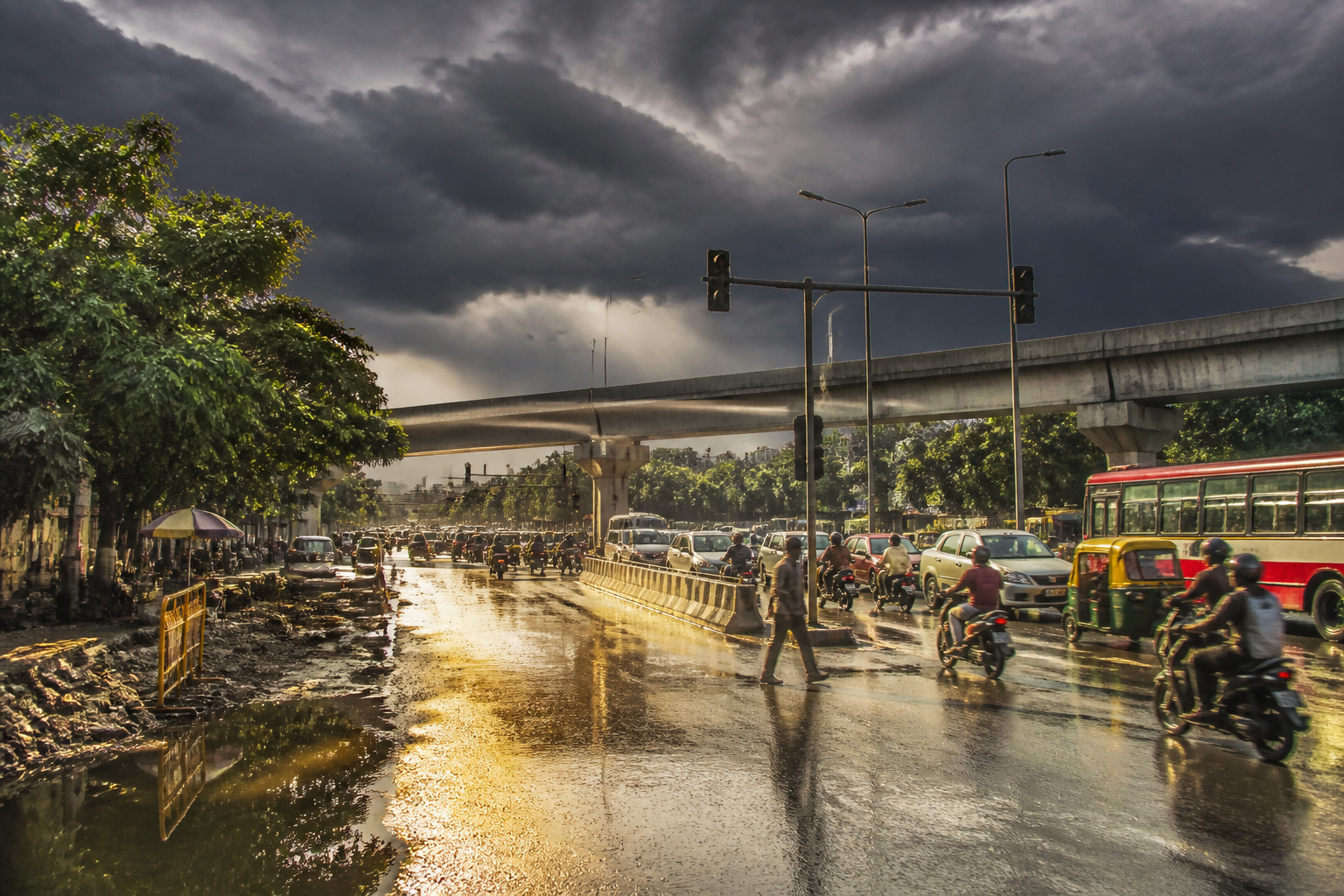
That distinction is important for governance. A city cannot control a Pacific climate pattern, but it does control how it prepares for heat, water scarcity and intense rainfall. The same weather cycle can expose different weaknesses at different times: dry conditions place pressure on water availability, while sudden heavy rain can overwhelm roads and drainage. Bengaluru’s experience on Tuesday illustrated that contradiction. Rainfall brought some relief from the heat, but waterlogging was reported on roads and flyovers, traffic slowed and stagnant water accumulated in several locations.
The sequence raises a structural question about urban resilience. Relief rain is not automatically useful rain if the city cannot absorb, store or safely move it. At the same time, a dry spell is not simply a weather inconvenience if the city has limited buffers for drinking water and electricity. The supplied report does not measure reservoir levels, groundwater conditions, storm-water capacity or power demand, so it cannot determine which system is under the greatest pressure. It does show that heat, rainfall and mobility disruptions are occurring in close succession.
The institutional response is currently focused on monitoring and immediate preparedness. Karnataka Chief Minister D K Shivakumar said the state was facing drought, drinking water and electricity concerns, and that arrangements were being made to ensure drinking water supply. He also said the government was assessing the situation across the state and would make further announcements after discussions with farmers. The statement places the issue within a wider state-level framework that includes agriculture as well as urban supply.
The India Meteorological Department forecast largely dry conditions along the coast until September 19, with light rain possible at isolated places in parts of north and south interior Karnataka. For Bengaluru, the Meteorological Centre forecast generally cloudy skies, light to moderate rain or thundershowers and gusty winds of 30-40 kmph. Maximum and minimum temperatures were expected to be around 32°C and 21°C. Dr N Puviarasan, Scientist F and head of the Meteorological Centre, attributed the continuing rainfall activity to the prevailing monsoon trough and associated weather systems.
The forecast offers short-term guidance, but it does not resolve the planning challenge. Bengaluru needs institutions that can act across weather conditions rather than respond to each event separately. Heat advisories, drinking-water arrangements, electricity planning, road management and drainage maintenance sit with different agencies and often operate on different timelines. The report identifies the pressure points but does not establish how these agencies are coordinating or whether current contingency plans have been activated.
For residents, the immediate experience is likely to remain uneven. Some parts of the city may receive rain and temporary cooling, while others face heat, traffic disruption or waterlogging. The airport’s 34.2°C reading and the city’s 33.2°C reading also show why location matters when communicating weather risk. A single citywide number cannot describe conditions across Bengaluru’s built-up areas, transport corridors and peripheral districts.
What the evidence confirms is a convergence of warning signs: Bengaluru came close to its September temperature record, Karnataka’s rainfall deficit widened to 30%, Bengaluru South district recorded a 95% shortfall and the official forecast pointed to a largely dry pattern in parts of the state. What remains uncertain from the available material is the effect on water reserves, public health, electricity consumption and different neighbourhoods. Those indicators will determine whether this remains a difficult weather episode or becomes a deeper test of Bengaluru’s urban resilience.
