


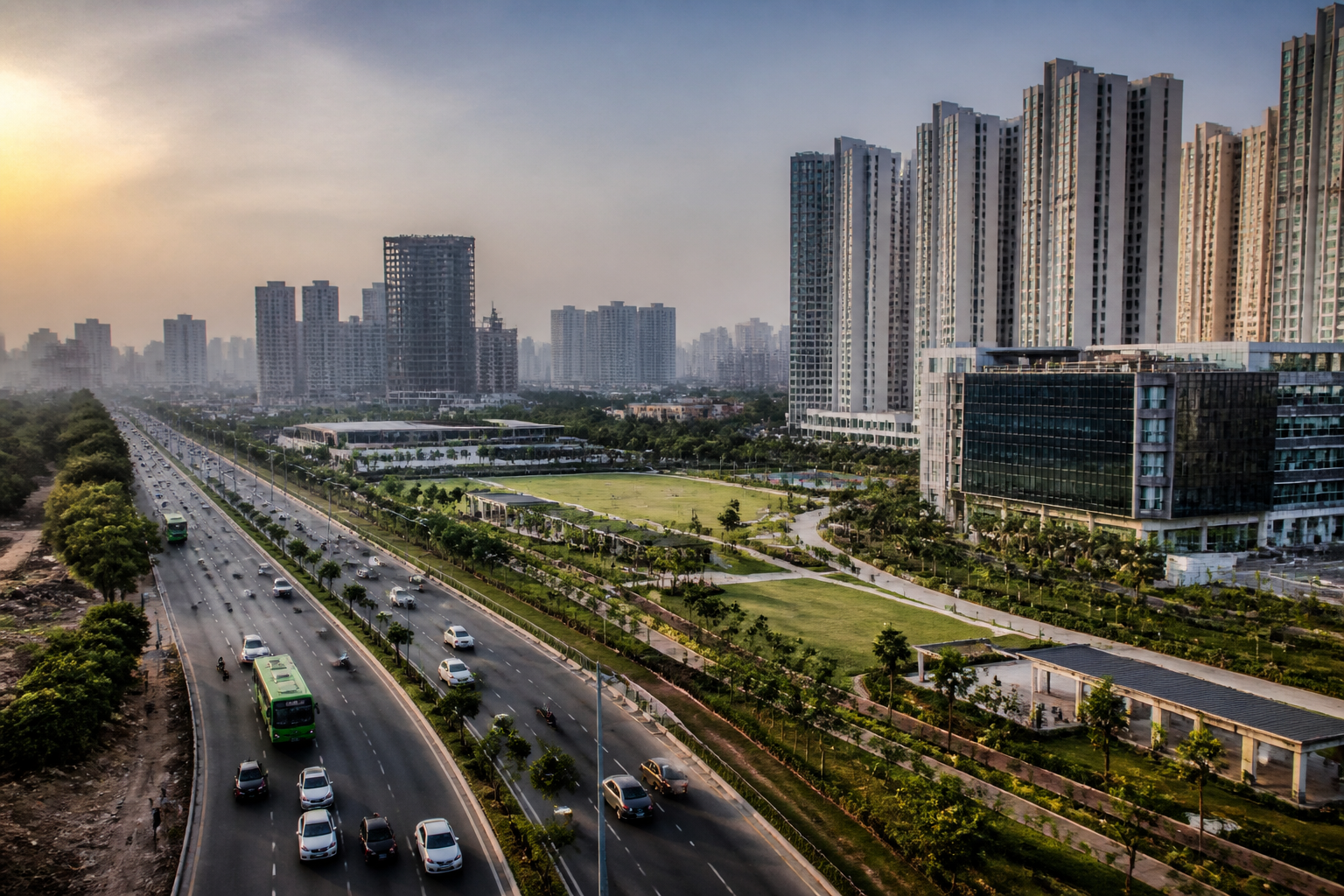
A 12.5-acre land parcel in Noida’s Sector 108 has attracted a bid of around Rs 1,850 crore, more than twice the Noida Authority’s reserve price of Rs 835 crore. The bid by real-estate developer M3M, which outbid DLF, is not only a contest between two large builders. It is a signal of how land scarcity, premium housing demand, commercial expansion and new infrastructure links are reshaping development along the Noida-Greater Noida Expressway.
The immediate event is significant because the price paid for the parcel reflects the expectations attached to its location. The land is designated for a mixed-use project with a maximum of 40% residential and 60% commercial development. That allocation gives developers access to two linked markets: premium homes for high-income buyers and commercial space for businesses, institutions and employees working in the surrounding office districts.
According to a Noida Authority official cited in the report, older sectors in the northern part of Noida, including Sectors 19, 27, 28 and 30, have become saturated. The result is not simply a shortage of empty plots. It is a shift in where the city can accommodate new development at scale. The sectors along the Expressway are emerging as the next major development belt because they offer larger opportunities for mixed-use projects and remain connected to established residential, commercial, institutional and recreational areas.
This makes Sector 108 a useful case study in how urban expansion often happens. A city does not necessarily grow because a single new project appears. Growth accelerates when several forms of demand begin reinforcing one another. Premium housing attracts commercial services. Commercial districts generate demand for nearby residences. Educational institutions and hospitals widen the daily catchment. Green spaces and planned recreational areas add to the appeal of the location. Once these elements are present, a vacant parcel can command a value far beyond its reserve price because developers are buying access to an already forming urban ecosystem.
The official cited in the report said premium residential projects between Sector 44 and the Expressway have property rates of up to Rs 9 crore. That concentration of high-end housing is generating demand for commercial establishments serving affluent residents. The same official pointed to Amity University in Sector 125, schools such as Lotus Valley, and private hospitals including Felix and Yatharth within a radius of 6 km from the area. These institutions matter because they create regular movement, employment and consumption beyond the residential towers themselves.
The proposed land-use mix in Sector 108 also reflects the changing logic of the Expressway corridor. The 40% residential and 60% commercial configuration is described by the Noida Authority official as attractive to builders because nearby areas already contain Grade A office developments, including Advant Navis Business Park and SkymarkOne in Sector 98. Employees in these offices may seek residences nearby, creating a potential relationship between workplaces and housing that is central to mixed-use development.
That relationship, however, should not be reduced to a simple promise of shorter commutes. The available information establishes that commercial and residential demand are being planned together, but it does not establish how many homes will be built, what proportion will be affordable, or whether the eventual project will reduce travel for workers across income groups. The value of Sector 108, as currently described, is therefore anchored primarily in premium demand and commercial potential rather than in a demonstrated solution to Noida’s wider housing needs.
The Expressway itself is another part of the land valuation story. Sector 108 is reported to be 9.5 km, or about a 14-minute drive, from the Delhi Noida Direct flyway. It is also described as 52 km, or about a 50-minute drive, from Noida International Airport in Jewar. The airport has added to the area’s appeal because the Expressway is currently the main road route for travel between Noida and the airport, according to the Noida Authority official.
The airport connection introduces a second layer of expectation into the corridor’s real-estate market. The official said freight operations could generate demand for logistics parks and related commercial activity along the route. That is an indication of possible future land-use pressure, but the supplied evidence does not quantify freight volumes, logistics demand or the amount of land that may eventually be required. What can be established is that the airport is already influencing how public officials and developers assess the strategic value of locations along the Expressway.
Connectivity is also being used to support the case for Sector 108. The area is described as having regular e-bus services to the airport. A metro line runs from Botanical Garden to Sector 137, and the Noida Metro Rail Corporation has proposals for a line intended to improve connectivity from the sector. These transport links are important to the area’s development prospects, but they also show the difference between existing access and proposed access. The e-bus service and existing metro connection are operating or available according to the report; the additional NMRC line remains a proposal.
That distinction matters in a land market where future infrastructure can be capitalised into present-day prices. A parcel can become more attractive when buyers and developers expect better connectivity, but the timing, alignment, financing and delivery of proposed infrastructure determine whether that expectation becomes a functioning urban advantage. The supplied report does not provide details of the proposed line’s route, cost, approval status or completion timeline. Sector 108’s connectivity story therefore combines current infrastructure with an uncompleted planning possibility.
The land bid also reflects an increasingly competitive market along the Noida-Greater Noida Expressway. Reetesh Singh, managing partner at Realistic Advisory & Consultancy, said very little land is now available along the Expressway and that large builders do not want to lose a location. Paras Satija, founder and chief executive of PlanWell Realty, said the corridor is changing the dynamics of real estate in Noida and that major real-estate brands and branded residences have emerged there over the last year.
Satija also said prices have increased drastically, in some cases by as much as four times. He cited land in Sector 105, adjacent to Sector 108, where the price was around Rs 1,50,000 per square metre in 2016 and Rs 3,70,000 per square metre now. These figures are attributed to Satija and are not presented in the report as a comprehensive index for the entire Expressway. They nevertheless illustrate the kind of price escalation that can make land acquisition increasingly difficult for smaller developers and can alter the economics of future housing supply.
The emergence of brands such as Godrej, Tata, Birla and M3M, along with the presence of Max Estates’ Estate 128 across from Sector 108, points to a market in which brand strength is becoming part of the location premium. For local developers, the issue is not only competing for land. It is competing in a market where buyers may associate larger brands with construction capacity, amenities, financing access and perceived reliability. The report also records queries from builders based in Hyderabad, suggesting that the corridor’s appeal is reaching beyond the immediate Noida market.
This competition creates a structural tension. On one side, larger developers can bring capital and build sizeable mixed-use projects in areas where land parcels are scarce. On the other, higher acquisition costs can push projects towards premium pricing because developers need to recover the cost of land, construction and approvals. The available material does not establish the eventual prices of homes or offices in Sector 108, but the Rs 1,850 crore bid and the reported rise in neighbouring land values show how the cost base is changing before construction begins.
The Noida Authority’s role is central to this transformation. It controls the land auction framework, sets reserve prices and determines the permitted use mix for the parcel. In this case, the authority’s reserve price of Rs 835 crore and the successful bid of around Rs 1,850 crore provide a visible measure of market competition. The difference between the two figures is also a reminder that public land decisions can influence the pace and profile of urban development well beyond the auction itself.
For the authority, the challenge is to ensure that new projects are integrated with transport, public spaces and existing institutions rather than treated as isolated real-estate enclaves. The report identifies green spaces, parks and playgrounds as part of Sector 108’s appeal. It also establishes that the area sits within a wider network of offices, schools, hospitals and residential projects. What remains unclear is how the new development will connect to this network at street level, how traffic will be managed, and whether public transport capacity will expand in step with construction.
Sector 108 therefore represents more than a high-value land transaction. It captures the next phase of Noida’s outward development: a shift from relatively available land to strategic competition for parcels located within emerging mixed-use corridors. The Expressway is becoming valuable not merely because it connects places, but because it concentrates the conditions that make new development commercially viable—premium housing, offices, institutions, roads, metro access and the prospect of airport-linked activity.
The evidence confirms that the parcel has drawn an exceptional bid because developers see Sector 108 as part of a larger growth corridor rather than as an isolated plot. It does not yet confirm how the project will affect housing affordability, congestion, infrastructure capacity or employment patterns. Those questions will depend on the project’s final design, approvals, construction schedule and the delivery of proposed connectivity improvements. The next important developments will therefore be the formalisation of the land transaction, the details of the mixed-use plan and the infrastructure decisions that determine whether the Expressway’s real-estate growth becomes integrated urban expansion.
