


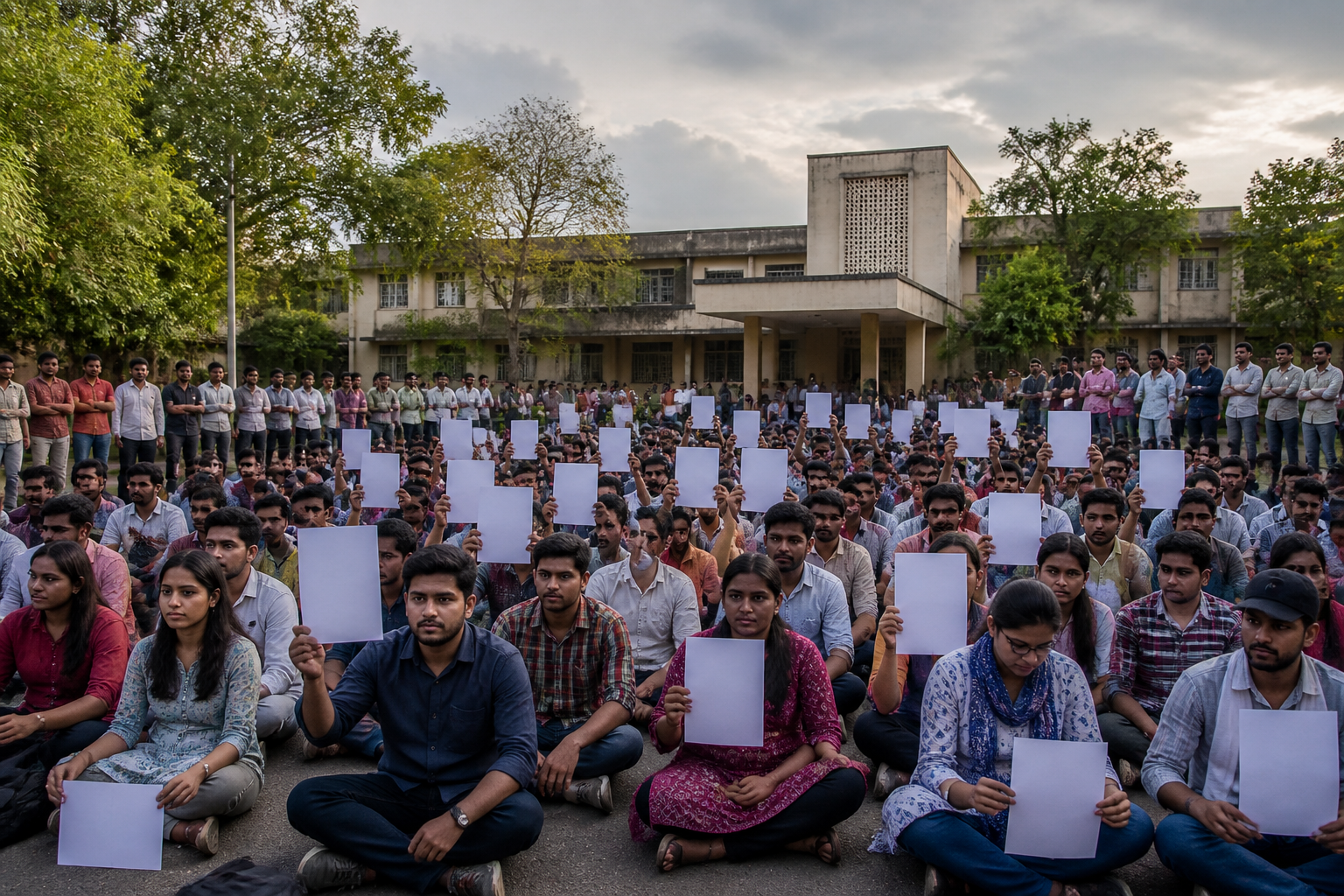
The three-month protest at Mahatma Gandhi Antarrashtriya Hindi Vishwavidyalaya in Wardha is not only about six students facing an FIR. It is the visible result of a four-year administrative decision that moved Women Studies and Film Studies programmes to the university’s regional centre in Prayagraj, froze PhD admissions amid litigation and left existing scholars navigating an academic arrangement that students and teachers say has weakened access to courses, faculty and facilities.
The university, founded in 1997 as a Central University and described as India’s only university dedicated to the promotion of Hindi, has become the site of a dispute over what happens when a programme is shifted between campuses without equivalent institutional capacity. The matter now combines questions of academic continuity, regional access, student protest rules and the responsibilities of a public university towards students already admitted to its programmes.
The immediate dispute began on July 3, when more than 250 students signed a petition and submitted it to the administration. They sought the reopening of the Women Studies and Film Studies departments in Wardha, the resumption of PhD admissions, the revival of language programmes and the reinstatement of discontinued diploma and certificate courses in English, French, Japanese, Chinese, Spanish and Urdu.
The protest escalated on August 20, when students gathered near the university’s administrative building. That night, an FIR was filed against Rajesh Kumar Yadav, Ramchandra, Niranjan Kumar, Rakesh Ahirwar, Rahul Kumar and Shiv Pujan. The charges include wrongful restraint, obstructing a public servant and common intention. The university told The Indian Express that students had locked the entry and exit gates, confined officials inside the building and stopped Vice-Chancellor Kumud Sharma’s vehicle as she was leaving. The administration also alleged that the protest had not been authorised.
The police account places the incident within the framework of a bailable case rather than a custodial crackdown. Officers at Wardha’s Ramnagar Police Station said the university had submitted photographs and videos as evidence. A senior police official said the students had been served notices and released, adding that the police were not treating them as criminals. Police officials also said university employees had called the 112 emergency helpline after the building was locked.
The university subsequently stated that its Discipline Committee had recommended an independent inquiry. Pending that inquiry, six students and research scholars were barred from entering the campus, while being given an opportunity to present their case. The university published its rules concerning protests on August 31, after the incident.
The institutional conflict, however, predates the FIR by several years. In 2021, a notification ordered the relocation of all Women Studies and Film Studies courses from Wardha to the university’s regional centre in Prayagraj. The university said the move was intended to increase enrolment and was being undertaken in “lokhit”, or public good. The relocation took effect in 2022.
The notification said existing PhD students would continue at the Wardha campus. That provision created a separation between the location of enrolled scholars and the location of the departments and much of the faculty responsible for their academic work. Students were not simply applying to a new campus; they were continuing programmes whose institutional base had shifted after their admission.
The consequences are reflected in the numbers supplied in the report. When the departments were moved, Women Studies had more than 16 students and Film Studies had more than 18. The two courses now have 14 students in total, with seven students each across undergraduate and postgraduate programmes. In 2021-22, 15 students were pursuing PhDs in the two disciplines: six in Film Studies and nine in Women Studies.
The reduction in enrolment does not by itself establish why students left or why admissions declined. But the accounts from faculty and students indicate that the relocation affected the practical conditions under which the programmes could operate. Five teachers in the two departments were mostly based in Prayagraj, while faculty members told The Indian Express that the regional centre did not have a full-fledged campus or adequate facilities.
One teacher said the courses previously had around 22 students each but now had hardly four students in total. Another said Film Studies studios were locked because there was no faculty. Existing PhD students, the teacher said, wanted to study but did not have the funds to travel to Prayagraj. The evidence points to an administrative mismatch: the university retained students at Wardha while key academic resources were concentrated elsewhere.
Ramchandra, a Women Studies PhD scholar since 2021-22 and one of the students named in the FIR, said students had initially believed the courses would run on both campuses. Over time, he said, they understood that the Wardha campus would not have the departments at all. His account describes a change in the practical meaning of the programme after students had already entered it.
That distinction matters for public institutions. A department can be shifted on paper, but academic programmes also depend on laboratories, studios, libraries, teachers, supervision and affordable access to the campus where those resources are located. For research scholars, the problem is not limited to attending lectures. Their work depends on continuing supervision and access to institutional facilities over an extended period.
The PhD admissions freeze added another layer of uncertainty. Admissions were stopped for the 2022-23 academic year after allegations of irregularities and ongoing litigation. The Nagpur Bench of the Bombay High Court allowed new admissions to resume in July this year, but the university has begun admissions for the 2022-23 batch. The four-year dispute therefore contains both a relocation problem and an admissions backlog.
Vice-Chancellor Sharma has said that shifting the departments back to Wardha would be a lengthy process because students have already been admitted at the new location. She described some student demands as baseless and accused the protesters of creating chaos on August 20. On PhD admissions, she said the process would restart soon.
That response establishes the administration’s central position: reversing the relocation is not an immediate administrative correction because the Prayagraj centre now has students admitted to the programmes. The students’ position is different. They argue that the Wardha campus has lost departments and courses that are necessary for academic life, and that the university has not maintained the facilities required for students who remained there.
The dispute also exposes the limits of treating a regional centre as an equivalent campus without evidence of equivalent capacity. The university has three regional centres, but faculty cited in the report said the Prayagraj centre did not have a full-fledged campus or facilities. The decision to move a programme therefore involved more than changing its address. It changed the relationship between academic departments, students and the physical infrastructure supporting them.
The students’ wider demands reinforce that point. They are asking not only for the return of two departments but also for the revival of language programmes and discontinued diploma and certificate courses. The list includes languages that connect the university’s stated Hindi-oriented mission to broader language learning. Whether every course can or should be restored is a question for the university’s academic and administrative processes, but the demands show that students see the dispute as a decline in the range of programmes available on the Wardha campus.
The university has also been accused by students of targeting those from outside Maharashtra. The six students named in the FIR are from Bihar, Uttar Pradesh and Madhya Pradesh. The supplied material does not establish that the university acted on the basis of students’ state of origin. It does, however, show why the allegation has become part of the protest: students who travel across state borders for education may face greater financial and logistical difficulty when a programme is moved to another city.
The conflict now has two parallel tracks. The disciplinary process will examine the August 20 incident, including the allegations that students blocked gates and stopped the Vice-Chancellor’s vehicle. The academic dispute concerns the relocation of departments, the condition of the Prayagraj centre, the continuity of PhD supervision and the restoration of admissions and courses. An independent inquiry into student conduct cannot by itself resolve the institutional questions that brought students to protest.
The university’s next steps, as stated by the administration, are the disciplinary inquiry and the restart of PhD admissions. The students will be given an opportunity to present their case in the inquiry. The unresolved question is whether the university’s response will address only the conduct alleged on August 20 or also examine whether the relocation produced an arrangement in which students remained enrolled but lost practical access to the academic resources associated with their programmes.
The Wardha dispute therefore offers a clear measure of institutional capacity. Moving a department requires more than a notification, and restarting admissions requires more than permission to admit students. For a public university, the decisive test is whether students can continue their programmes with access to teachers, facilities and affordable academic support. In this case, that test remains contested while the FIR and the university’s inquiry move forward.
