


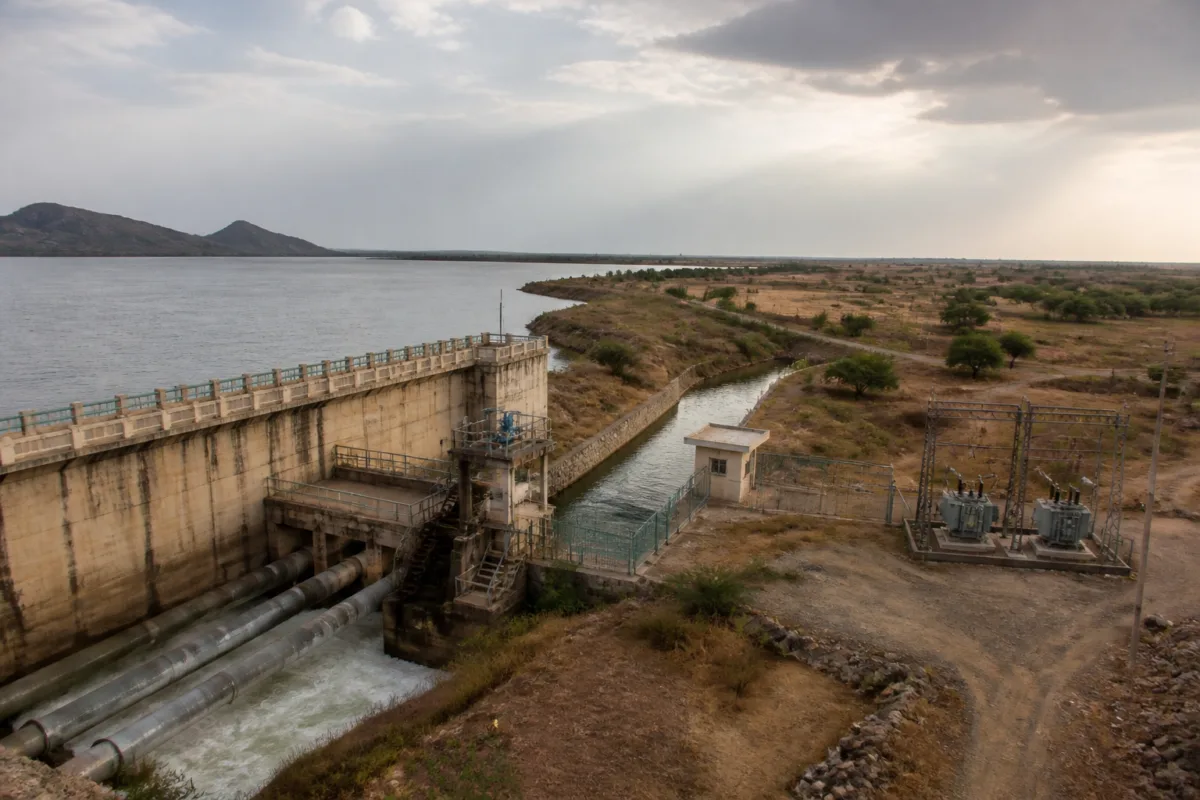
The latest demand for Godavari-Krishna river linking places Nalgonda’s water crisis back at the centre of Telangana’s unfinished irrigation debate. Speaking at the Dindi Reservoir in Nalgonda district, Telangana Rakshana Sena chief Kalvakuntla Kavitha argued that linking the two river basins would offer a permanent response to water scarcity and fluoride-related drinking-water problems. Her intervention also exposed a more immediate institutional conflict: whether Dindi should receive water through the proposed Yedula diversion or through infrastructure connected to the Godavari basin.
Kavitha criticised the state government’s proposal to bring water to Dindi from Yedula, describing the plan as technically difficult and impractical. According to the report, she questioned how additional water could be diverted to Dindi when the Palamuru-Rangareddy Lift Irrigation Scheme was itself struggling to secure adequate water from the Krishna basin. Her argument is therefore not simply about choosing between two projects. It raises a question about whether new irrigation commitments can be sustained when the source basin, pumping infrastructure and existing schemes are already under pressure.
The dispute centres on the relationship between Dindi Reservoir, the Palamuru-Rangareddy project and the proposed Yedula transfer. Kavitha alleged that design changes at the Yellur pump house, including its conversion from an open-cut structure to an underground facility, had adversely affected the Palamuru-Rangareddy project. She also claimed that available water levels and infrastructure limitations made the proposed diversion to Dindi unviable. These claims were made during her presentation and are not independently assessed in the supplied report; however, they identify the type of technical detail that will determine whether the proposal is workable.
The alternative advanced by Kavitha is to use Godavari water through the partially completed Baswapur Reservoir under the Kaleshwaram project. She said completing Baswapur and related infrastructure would allow water to reach Dindi and surrounding areas more efficiently. The proposal shifts the immediate focus from securing more water from the Krishna basin to completing assets associated with the Godavari system. It also makes the status of unfinished or partially completed infrastructure central to the debate.
That distinction matters because water-transfer projects are not defined only by the destination they promise to serve. Their viability depends on the source basin, reservoir levels, pumping arrangements, elevation differences, power requirements, land and construction status, and the coordination of multiple agencies. The supplied report does not provide the hydrological studies, design documents, cost estimates or operational calculations needed to establish whether the Yedula proposal or the Baswapur-based alternative is technically superior. What it does show is that the political debate is already moving ahead of publicly available evidence in the account provided.
Kavitha’s larger proposal is the interlinking of the Godavari and Krishna rivers. She said the idea had previously been advocated by former prime minister P. V. Narasimha Rao and argued that a linkage could address both irrigation needs and fluoride-related drinking-water problems in Nalgonda by increasing the availability of river water. In this framing, river linking is presented as a way to connect agricultural supply with drinking-water security rather than treating them as separate administrative problems.
The report, however, does not establish the scale of the proposed linkage, its route, the institutions that would implement it, the water allocation arrangements required, or the environmental and financial assessments that would precede construction. Nor does it provide evidence that additional river water alone would eliminate fluoride exposure. The claim remains an argument advanced by Kavitha, while the underlying public-health and water-quality question requires separate evidence on sources, treatment, distribution and household access.
Nalgonda’s water problem is therefore presented through two connected but distinct systems. The first is irrigation, where reservoirs, lift schemes, diversions and pumping infrastructure determine whether farms receive water. The second is drinking water, where the quality and reliability of supply determine whether households remain dependent on local groundwater or other sources. A project may improve irrigation availability without automatically resolving drinking-water contamination. Conversely, a drinking-water intervention may not address the agricultural losses associated with drought-like conditions. The supplied report does not detail how the proposed river linking would integrate these two systems.
The political responsibility for the current situation is also contested. Kavitha accused successive governments of failing to complete key irrigation projects and alleged that the Congress government had created disputes between Mahabubnagar and Nalgonda rather than providing practical solutions. She further claimed that projects that were already substantially complete had not been finished, while new initiatives were being announced without adequate surveys or planning. These are political allegations, and the report does not include a response from the state government or a project-by-project assessment of completion status.
Kavitha also acknowledged that mistakes had been made during the previous BRS regime in the irrigation sector and said she was willing to take responsibility for having been part of that government. At the same time, she maintained that the present government had failed to advance key projects over the past three years. That admission is significant because it shifts the discussion away from a simple change-of-government narrative. The report depicts an infrastructure chain in which unfinished works, design decisions and disputed priorities span more than one administration.
The numbers available in the report are limited but politically important. Kavitha demanded compensation of ₹25,000 per acre for farmers facing drought-like conditions and linked the demand to concerns over water supply, fertiliser availability and rising input costs. The figure indicates the scale of relief being sought by affected farmers, but the report does not state how many acres or farmers would qualify, the estimated fiscal cost, or whether the demand has been accepted by the government.
The same lack of publicly supplied numbers applies to the proposed water solutions. No capacity for Baswapur Reservoir, projected water volumes for Dindi, construction costs, completion deadlines or additional power requirements are provided. There is also no comparative assessment of the Yedula proposal and the Baswapur route. Without these details, the debate remains centred on competing political and engineering assertions rather than a transparent comparison of alternatives.
The administrative challenge is equally important. The proposals described in the report involve more than one district and more than one river basin. Decisions on water allocation, reservoir operation and project sequencing could affect both Nalgonda and Mahabubnagar, the districts Kavitha referred to while accusing the government of creating disputes. The dispute suggests that the question is not only how to move water, but also how to establish a credible process for deciding whose demand receives priority when projects draw on shared or constrained resources.
For the state government, the immediate policy task implied by the dispute is to clarify the status of the competing projects and publish the evidence behind them. That would require, at minimum, a clear account of the Yedula proposal, the condition of the Palamuru-Rangareddy system, the design changes at Yellur, the completion status of Baswapur and the infrastructure needed to move water to Dindi. The supplied report does not say that such a consolidated assessment has been released.
The river-linking demand also shows how unfinished infrastructure can become a permanent feature of regional politics. When a reservoir, pump house or lift scheme is incomplete, the original project does not simply disappear; it continues to shape new proposals, district-level disputes and claims of administrative failure. In Nalgonda, the immediate argument over Dindi has become a test of whether Telangana’s irrigation planning is being guided by completed technical assessments or by successive promises to redirect water from one basin to another.
The evidence currently confirms that Nalgonda’s water concerns remain tied to unresolved irrigation works, competing transfer proposals and demands for a broader Godavari-Krishna linkage. It does not establish that river linking is the only viable long-term solution, that the Yedula plan is technically impossible, or that completing Baswapur would by itself resolve the district’s fluoride and water-scarcity problems. The next decisive developments will be the state government’s response, the release of technical and hydrological assessments, and clarity on the timelines for Baswapur, Dindi and the related irrigation infrastructure.

