


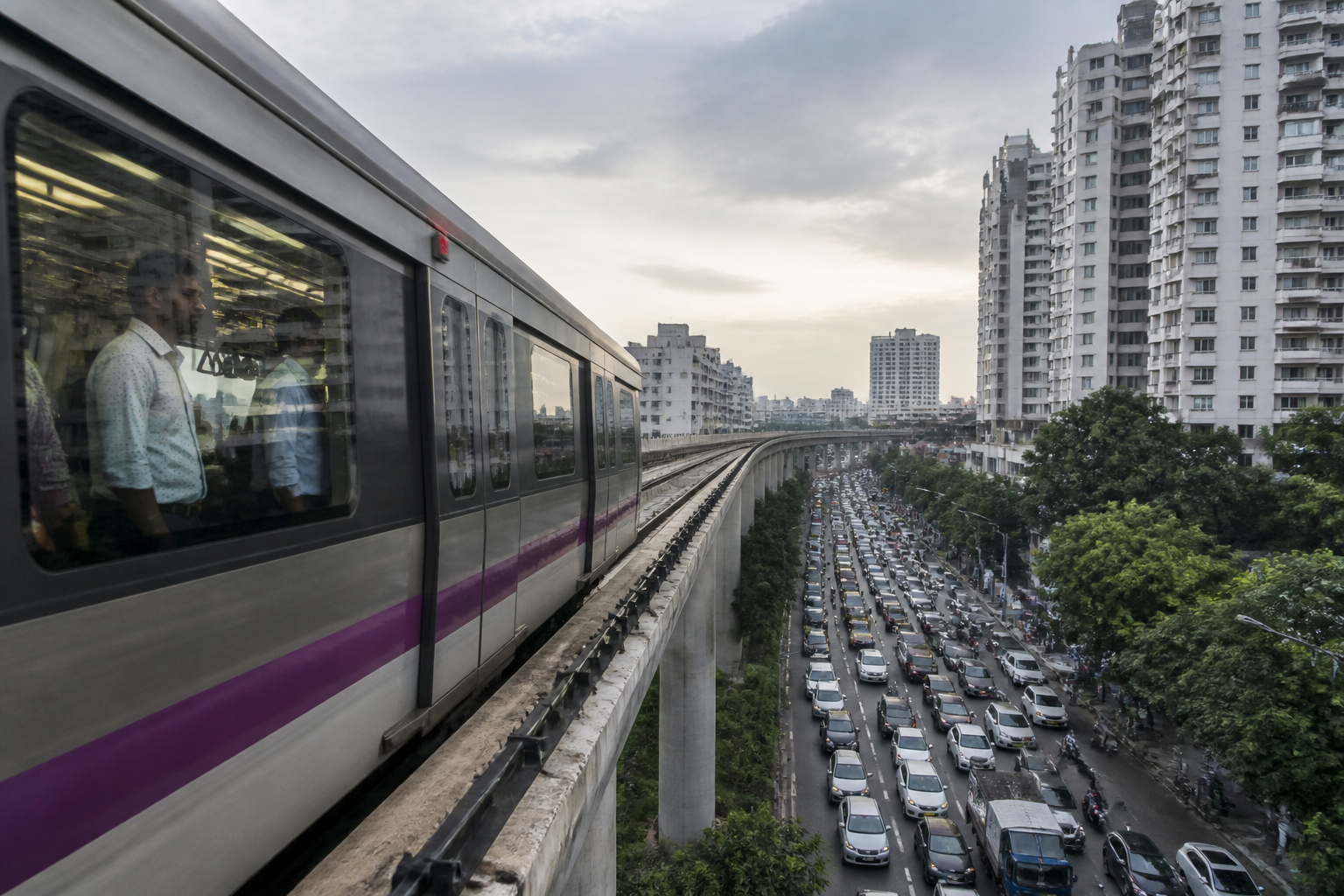
Bengaluru Metro fare comparisons reveal a difficult trade-off at the heart of the city’s transport system: Namma Metro is among the most predictable ways to cross Bengaluru, but it can consume a much larger share of a commuter’s income than comparable rail journeys in cities such as Mumbai, Kolkata, Chennai and Delhi. The issue is not simply the price of a ticket. It is the cost of building a reliable mass-transit network in a city where congestion has made time almost as important as money.
The calculation presented in the supplied analysis is based on a 15-km one-way commute, 22 working days a month and two kilometres of last-mile travel at both ends. Under those assumptions, a Bengaluru commuter spends approximately ₹3,520 every month using Namma Metro as the primary mode. If commuting is limited to 5% of monthly take-home income, the required earnings would be about ₹70,400 a month.
That benchmark is not a statutory affordability threshold. It is a planning and household-budget assumption used to understand the pressure transport places on disposable income. The source also notes that the scenarios depend on assumed travel distances and last-mile costs and may not describe every commuter’s actual experience. But the comparison remains useful because it exposes a structural weakness in Bengaluru’s transport model: the city has a fast-growing metro network, yet its rail options are not sufficiently integrated to distribute the cost of a long daily journey across multiple high-capacity systems.
For a worker earning ₹20,000 a month, the estimated ₹3,520 monthly commute represents nearly 18% of income. At ₹50,000, it still accounts for about 7%. The same transport cost therefore has sharply different consequences across income groups. A higher-income commuter may be paying for reliability, while a lower-income worker may be forced to choose between a costly predictable journey and a cheaper but uncertain road trip.
This is where Bengaluru’s congestion changes the meaning of transport affordability. Road-based options may appear cheaper in some cases, but they impose a time penalty. The source describes road travel as unreliable because of congestion, while rail and metro offer more predictable journey times. A commuter may therefore pay a premium to avoid traffic, particularly when employment is concentrated in corridors serving technology parks and other major work centres.
The alternatives also show why Namma Metro remains attractive despite its cost. An autorickshaw journey over a comparable distance can exceed ₹14,000 a month, according to the comparison. App-based cabs are only slightly cheaper, while bike taxis cost more than twice the estimated monthly metro journey. A private car may cost close to ₹6,000 a month after fuel, maintenance, depreciation, parking and congestion-related expenses are included. These comparisons place the metro in an important middle position: it is not Bengaluru’s cheapest transport option, but it offers a combination of speed, reliability and predictability that road-based modes cannot consistently provide.
The sharper question is why the same advantages cost less in other major cities. The comparison estimates a similar journey at around ₹2,772 in Delhi, approximately ₹2,200 in Chennai, about ₹1,980 in Mumbai and roughly ₹1,760 in Kolkata. These figures incorporate the longer distances travelled by commuters in some of those cities. A longer rail journey can still cost less per month because established suburban systems carry large volumes at relatively low fares.
Mumbai and Kolkata provide the clearest contrast. Both inherited extensive suburban rail networks decades before their modern metro systems expanded. Their transport ecosystems allow commuters to combine suburban rail and metro services, preserving access to high-capacity public transport without making the entire journey dependent on metro fares and road-based last-mile services. Chennai also benefits from an established suburban rail system. Delhi’s rail network serves commuters travelling into the core from the wider National Capital Region, including districts in neighbouring States.
Bengaluru’s rail history is different. Namma Metro has expanded rapidly and now covers 96 km, with an average of 10 lakh passenger journeys a day, according to the supplied report. Yet the city’s suburban rail network has not played a significant role in moving commuters compared with the total number of daily journeys. The result is a system in which the metro carries an important share of predictable urban travel, but does not yet operate within the mature, layered rail ecosystem available in Mumbai or Kolkata.
The Karnataka government, with assistance from the Central Government, is investing in expanding Bengaluru’s suburban rail network. The stated aim is to create another alternative to road transport. That expansion matters not only because it could add capacity, but because it could change the economics of commuting. When suburban rail, metro services and feeder modes are integrated, the cost of a journey need not depend so heavily on a single relatively expensive mode or on last-mile services at both ends.
The affordability issue is also inseparable from housing. The report notes that longer commutes in other cities can provide access to far-flung suburbs where rents are cheaper than in core areas. The additional travel time may be offset by housing savings. Bengaluru commuters, by contrast, face a combination of rising residential pressure, limited rail coverage and severe road congestion. A worker who cannot afford housing near employment centres may have to travel across the city, but the transport system does not always offer an affordable high-capacity option for that distance.
This creates a distributional problem. The source estimates Bengaluru’s population at between 1.30 crore and 1.40 crore and cites Greater Bengaluru Authority estimates of approximately 35 lakh property owners. It also discusses the financial burden of housing loans and rent, using household-budget benchmarks in which home-loan EMIs may reach 50% of net monthly take-home pay and rent may account for up to 30%. These are not measurements of every household, but they illustrate why a transport cost that appears manageable in isolation can become significant when combined with housing expenses.
The comparison therefore points to two different meanings of a mass-transit system. The first is operational: a service must be fast, dependable and capable of avoiding road congestion. On that measure, Namma Metro is increasingly important. The second is distributive: a mass-transit network must be affordable and accessible to a broad section of the population. On that measure, Bengaluru’s system faces a more complicated test, particularly for workers whose salaries are below the ₹70,400 monthly benchmark used in the analysis.
The city’s metro network has become a mobility backbone, but its present role may also reveal the limits of building metro corridors without equivalent investment in suburban rail, interchange systems and affordable last-mile connections. The report suggests that Namma Metro may be especially attractive to people who already own vehicles but want to avoid the stress and uncertainty of driving. That can still produce a public benefit by shifting some trips away from private vehicles. However, the wider objective of mass transit is to provide a practical alternative for people who cannot or do not want to own a vehicle.
Bengaluru’s transport challenge is consequently not a simple question of whether metro fares are high or low. It is a question of how a city distributes the cost of reaching work, education and services. A commuter paying more for a predictable journey may gain productive time and reduce exposure to traffic. A lower-income commuter may instead see the same fare as a direct reduction in savings and essential household spending. The city’s roads make the metro more valuable, while the absence of a mature rail network makes it harder to keep that value affordable.
The available comparison confirms Namma Metro’s operational advantage over many road-based alternatives, but also highlights its affordability gap with cities that have older and more integrated suburban rail systems. The assumptions behind the monthly calculations require careful interpretation, and the figures do not represent every route or household. The developments to watch are the expansion of Bengaluru’s suburban rail network, the integration of rail modes and the ability of the city’s transport system to make reliable commuting accessible beyond higher-income users.
