


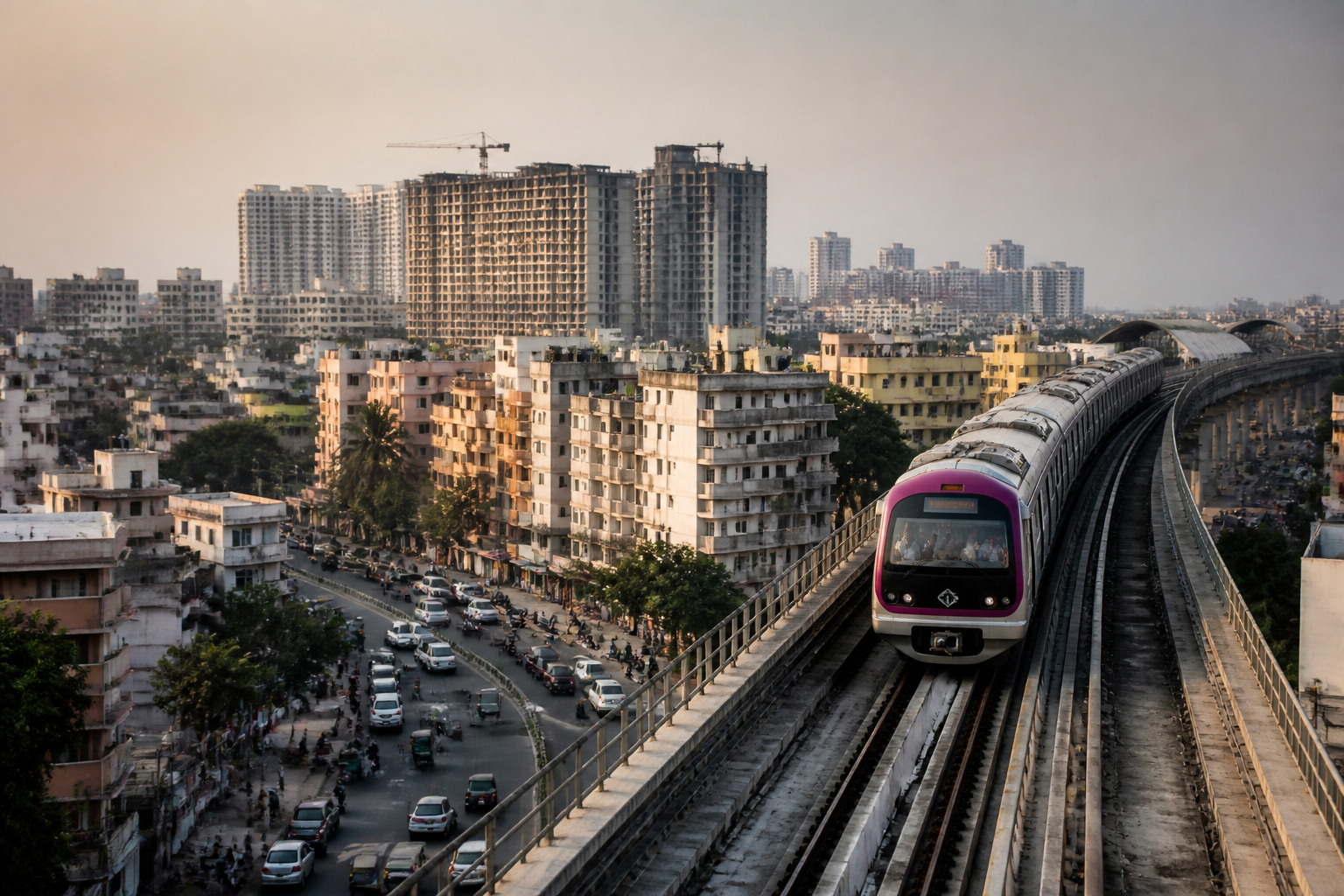
Bengaluru’s housing affordability problem is not only about rents and property prices. It is also about how far a worker can live from the city’s economic core without losing too much money, time and convenience in the daily commute. An analysis published by The Hindu compares Bengaluru with Mumbai, Kolkata, Chennai and Delhi-National Capital Region and finds that the city’s rail-based transport system offers the smallest practical residential catchment around the central business district while costing commuters more at the longest usable metro distances.
The comparison points to an important distinction in urban transport planning: a large metro network does not automatically create a large affordable housing market. Bengaluru’s Namma Metro has improved access to areas such as Whitefield, Kengeri and Madavara, but the analysis estimates that the practical periphery-to-CBD distance remains about 20-25 km, with an average maximum distance of 22.5 km. Even after the airport line opens, the city is expected to remain behind Mumbai, Chennai and Kolkata in terms of the distance that can be covered through a rail-based commute.
That limitation matters because housing costs and commuting systems are closely connected. In cities with extensive suburban rail networks, workers can live much farther from the employment core while still reaching it by relatively low-cost public transport. The analysis estimates that a resident in Mumbai may live as far as 100 km from the CBD, while Kolkata offers a possible rail-accessible radius of about 70-100 km and Chennai about 60-75 km. In Delhi-NCR, commuters can travel from Gurugram, Noida, Greater Noida, Ghaziabad and Faridabad towards the centre, with the practical rail-accessible distance estimated at roughly 30-40 km.
Bengaluru’s comparatively shorter rail reach means that workers who depend on public transport have fewer locations from which they can access the city’s employment centres. The result is not simply a transport disadvantage. It can also narrow the range of housing options available to households that cannot afford to live close to workplaces or absorb the recurring costs of private vehicle ownership.
The difference becomes sharper when monthly commuting costs are compared at the maximum practical rail distance. The analysis estimates that a commuter living 100 km from Mumbai’s CBD may spend about ₹2,080 a month on travel, while a Bengaluru commuter travelling roughly 22-25 km to the CBD may spend approximately ₹3,850. These figures are presented as comparative estimates rather than official fare benchmarks, and the source notes that assumptions about daily distance and last-mile connectivity affect the scenarios.
The comparison reflects the different purposes served by suburban rail and urban metro systems. Suburban rail is designed to move large numbers of passengers over long distances between the core city and outer settlements. Its value lies in extending the geography of the labour and housing markets. Metro systems, by contrast, are primarily designed to provide reliable urban connectivity across dense corridors. They can reduce exposure to road congestion and make travel times more predictable, but they are not necessarily the cheapest option for long-distance commuting.
This distinction helps explain why Bengaluru can have a substantial metro network and still offer workers a smaller affordable commuting radius. The analysis states that Bengaluru has the most extensive network among Indian cities with broadly similar metro-centric transport systems, but also one of the costliest rail-based commuting profiles. The city’s metro is valuable for connecting existing activity centres, but its ability to reshape the housing market depends on how far the network reaches, how much the journey costs and whether passengers can complete the last mile affordably.
The comparison with Mumbai, Kolkata and Chennai is particularly relevant because their suburban rail systems have historically connected distant residential areas to employment centres. The source argues that fixed infrastructure costs can be spread across large passenger volumes and long-distance journeys, helping keep the cost per kilometre relatively low. This gives households a wider choice: they may trade a longer commute for lower housing costs without necessarily replacing the saving with an equally large transport bill.
Bengaluru does not yet have a comparable mature suburban rail ecosystem. As a result, housing and employment remain more concentrated within the city’s effective rail-accessible area. The analysis links this condition to fewer affordable residential choices for workers who rely on public transport. It also suggests that the city’s transport challenge cannot be assessed only through route kilometres or the number of operational metro stations. The more important question is how the network changes access to housing beyond the most expensive and congested employment zones.
Private vehicles offer a different form of access, but the financial trade-off becomes increasingly difficult as commuting distances grow. The analysis estimates that a two-wheeler commute in Bengaluru may cost about ₹2.5 per kilometre, while a car journey may cost approximately ₹8,000-10,000 a month at the city’s stated average maximum commuting distance. At distances of 50-100 km one way, the source estimates that a private car commute could exceed ₹15,000-20,000 a month when fuel, maintenance, depreciation, insurance, parking and tolls are considered. These calculations are indicative and depend on the assumptions used.
The comparison also brings time into the affordability equation. A private vehicle provides door-to-door convenience but exposes commuters to congestion, uncertain journey times, fuel expenses, parking difficulties and vehicle maintenance. Rail systems reduce some of that uncertainty by operating on dedicated infrastructure and carrying many passengers simultaneously. For workers living far from the CBD, the value of public transport therefore comes from a combination of fare, travel time and reliability rather than from the ticket price alone.
This is where the institutional challenge becomes visible. Expanding a metro line can improve mobility along a corridor, but it does not by itself create an integrated regional transport system. A wider housing catchment requires connections between the central city, outer municipalities, employment districts and lower-cost residential areas. It also requires affordable fares, dependable services and last-mile links. The source material does not establish whether Bengaluru’s future rail projects will meet those conditions, but it shows why network expansion should be evaluated through the geography of access rather than only through construction progress.
The comparison also raises a planning question about the relationship between transport investment and land markets. When a rail network reaches distant areas at a manageable cost, households can consider locations farther from the CBD. That can increase labour mobility and distribute housing demand across a larger geography. When the rail catchment is shorter or expensive, demand can remain concentrated near employment clusters and established transport corridors, increasing pressure on housing in those locations.
The evidence presented is not a full affordability study. The source acknowledges that it uses publicly available data and assumptions about distances and last-mile costs, and that the scenarios may not accurately represent every commuter’s daily reality. Fare structures, transfers, service frequency, walkability, feeder transport and actual travel times can vary considerably between cities and neighbourhoods. The comparison is therefore best read as an indicator of the structural relationship between rail reach and housing choice, not as a definitive household-budget calculation.
Even with those limitations, the central finding is clear: Bengaluru’s metro has improved connectivity without yet giving the city the broad, low-cost suburban commuting radius available in Mumbai, Kolkata and Chennai. That gap affects more than transport convenience. It influences where workers can afford to live, how far employment markets extend and how much of a household’s income is absorbed by the daily journey.
The next stage of Bengaluru’s transport planning will therefore be judged not only by the length of new metro lines but by whether rail can connect a much larger residential geography to the city’s economic core at a cost households can sustain. The analysis establishes the problem; assessing whether upcoming rail investments change that equation will require consistent data on fares, travel times, last-mile access and housing costs across the city’s expanding peripheral areas.
