


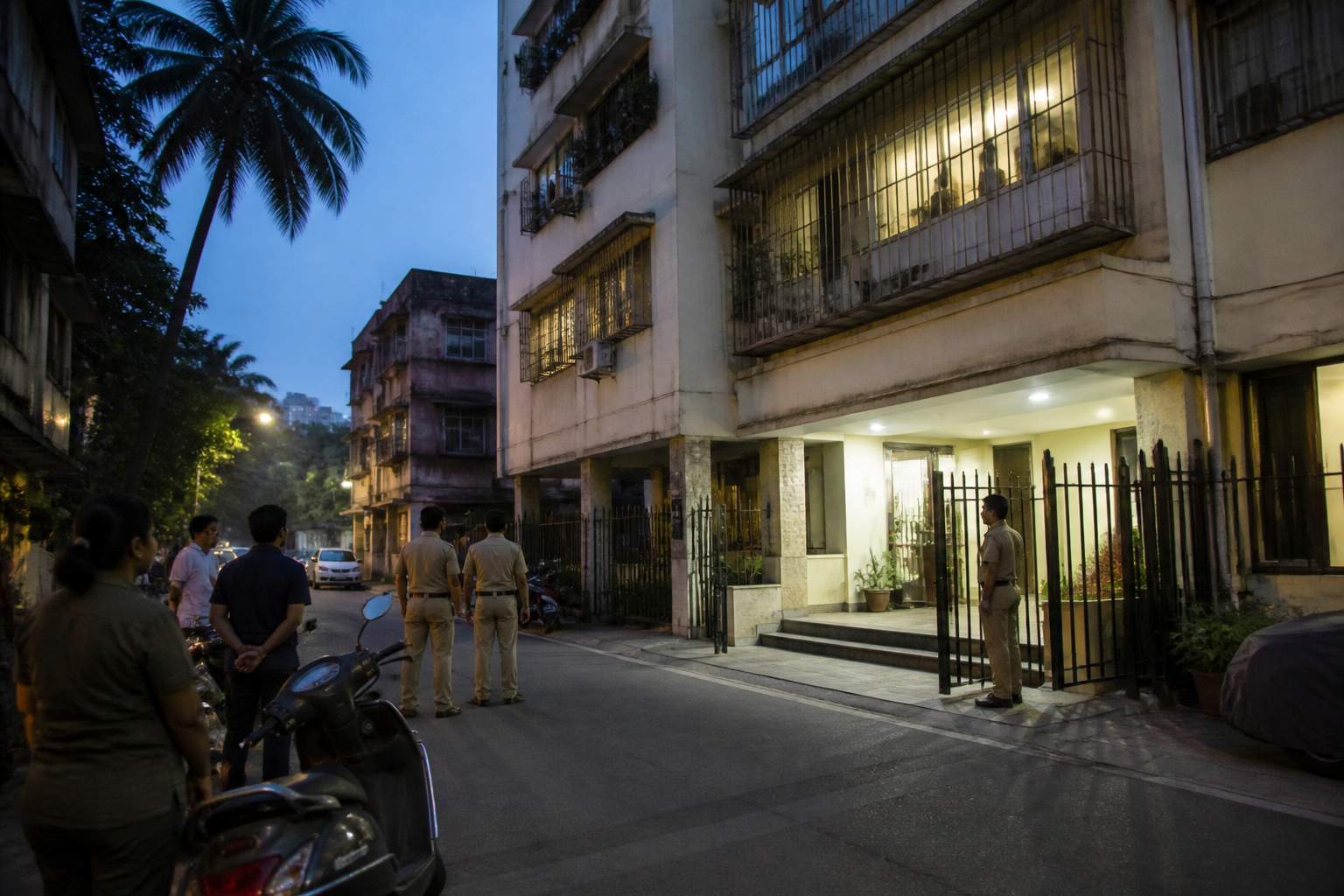
Allegations by a Mumbai postgraduate student that police searched her home for more than nine hours after she joined a pro-Palestine kite-flying campaign have brought a question of institutional accountability into focus: how should the city’s policing system respond when political expression is treated as potentially suspicious, and what safeguards govern the use of coercive powers in a private residence?
The account reported by the Times of India remains contested. Harshada Borade alleged that Bandra police’s anti-terrorism cell searched her residence from 5pm on a Friday until 3am on Saturday without producing a warrant or serving a legal notice. She said plainclothes personnel refused to show identification, entered her personal space, examined notebooks and diaries, recorded book titles, and photographed and videographed her belongings.
Borade also alleged that her friends were mistreated during the operation. The Indian People In Solidarity With Palestine, or IPSP, said six to seven plainclothes personnel who identified themselves as police officers arrived at the residence. The group alleged that Borade was detained without written notice, taken back to the residence, and that two volunteers were handcuffed while phones were confiscated. These claims have not been independently established in the supplied report and are presented as allegations by Borade and IPSP.
The police response, however, confirms that the matter has entered an official review. The report says Bandra police have not registered an FIR against Borade and are gathering details and conducting a background check. DCP (West Zone-2) Mohit Garg said an inquiry was under way “in accordance with procedures established by law”. The statement does not publicly settle whether the search was authorised through a written order, what specific information prompted police action, or whether any material seized during the operation is being treated as evidence.
That gap between the allegations and the official response is central to understanding the case. The public record described in the report contains a detailed account from the student and an organisation associated with her, but it does not include the police version of events in comparable detail. It also does not establish whether a warrant existed, whether another form of legal authorisation was used, or what police meant by conducting a background check. Until those questions are answered, the event cannot responsibly be reduced either to a confirmed unlawful search or to a routine police inquiry.
The reported panchnama may become an important document in resolving those questions. According to IPSP, the document linked the search to a nationwide kite campaign expressing solidarity with children in Gaza. The organisation also said the panchnama listed books and quotations by Bhagat Singh and Savitribai Phule among the items found. It alleged that the document stated the search was not pre-planned but was authorised by senior police officials after personnel found Borade’s “behaviour suspicious”.
A panchnama, as described in the report, could provide a contemporaneous record of what officials searched for, what they observed and who was present. But the supplied material does not reproduce the document in full, identify the legal provision under which the search was conducted, or clarify whether its contents have been accepted by the police. Those details matter because the distinction between a documented investigative step and a discretionary intervention is an institutional one, not merely a dispute between individuals.
The incident also exposes the difficulty of policing expression that crosses political and international boundaries. Borade’s reported activity was a pro-Palestine kite-flying campaign, while the items allegedly recorded during the search included books and quotations associated with Indian anti-colonial and social reform traditions. The report does not say that Borade was charged with an offence, nor does it identify any FIR against her. That combination—political activity attracting police attention without a registered case being reported—makes the basis and proportionality of the intervention particularly significant to the public record.
For a city, this is not only a question about one residence in Bandra. Police operations take place within a dense urban environment where homes, rented accommodation, student networks, activist groups and public campaigns overlap. When an operation involves a private home, friends or volunteers, personal devices and written material, the consequences extend beyond the person initially under inquiry. The house owner has reportedly asked Borade to vacate, showing how an alleged police action can also affect housing security and relationships between tenants and property owners.
The reported seizure or confiscation of phones adds another layer to the institutional question. Phones are simultaneously personal possessions, communication tools and potential sources of information. The supplied report does not establish the legal basis, duration or status of any such seizure. It also does not say whether the devices were returned, examined or formally listed as evidence. Those missing details prevent a conclusion about the action, but they identify the information that an official inquiry would need to clarify.
The account also raises questions about identification and transparency during searches. Borade said plainclothes personnel refused to show identification, while IPSP said the personnel identified themselves as police officers. The report does not state whether uniforms, identification cards, written orders or other documentation were shown. In an operation involving several officers and civilian witnesses, those details are not incidental: they determine how residents can understand who is exercising authority and under what institutional mandate.
The official inquiry therefore has several distinct issues to examine rather than one single allegation. It would need to establish the timeline of the operation, the number and identity of personnel involved, the authority cited for entering and searching the residence, the treatment of Borade and her friends, the handling of phones and other belongings, and the contents and status of the panchnama. The supplied report does not say when the inquiry will conclude or whether its findings will be made public.
The case also illustrates the limits of reporting based on an early account. The Times of India report provides named allegations, an attributed statement from the deputy commissioner and details attributed to IPSP. That is enough to establish that a dispute and official inquiry exist. It is not enough to establish every disputed event as fact. A responsible account must therefore distinguish between what Borade said happened, what IPSP alleged, what police have acknowledged and what remains unknown.
That distinction is particularly important when the subject involves civil liberties and state authority. If the student’s account is substantiated, the matter would raise serious concerns about the safeguards surrounding searches, detention, treatment of civilians and the handling of personal material. If the police account provides a lawful and documented explanation, that explanation would need to address the specific allegations rather than simply confirm that an inquiry is in progress. In both cases, institutional clarity is more important than the competing labels attached to the incident.
The immediate public-interest question is therefore not whether the campaign was politically contentious. It is whether the powers used by the police were clearly authorised, properly documented and exercised in a manner consistent with the procedures the police say they are examining. The answer cannot be inferred from the political subject of the campaign, the presence of books in the home or the absence of an FIR alone.
At present, the confirmed position is limited. Borade and IPSP have made allegations about a search, detention, handcuffing, phone confiscation and threats. Bandra police have not registered an FIR against Borade, are gathering details and conducting a background check. DCP Mohit Garg has said an inquiry is under way in accordance with procedures established by law. The next meaningful development will be the police account of the operation and any documented finding on the authority, conduct and scope of the search.
