


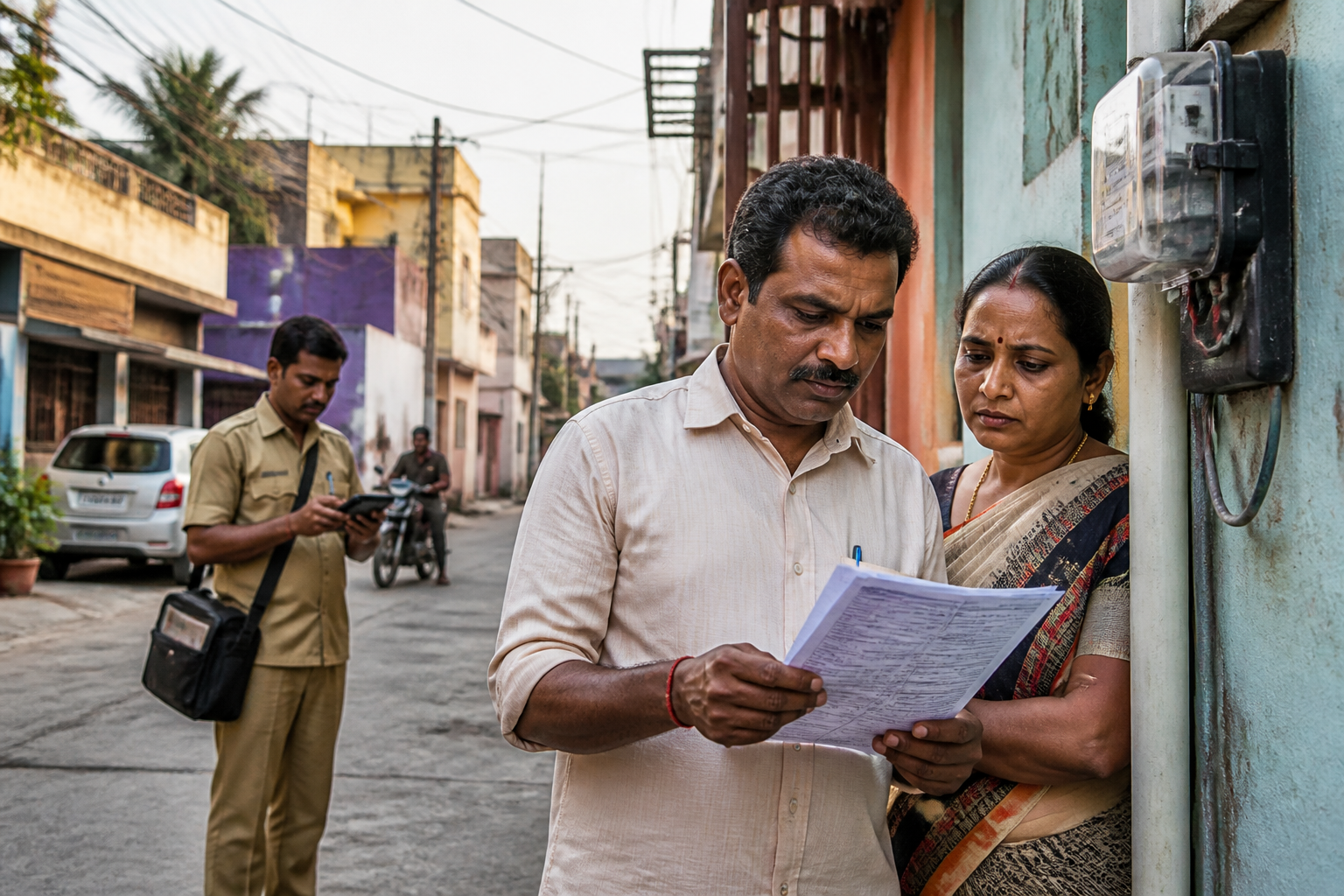
Three-month electricity bills are putting Chennai households at risk of being charged as though their accumulated consumption occurred within a higher tariff period, according to retired Madras High Court judge K Chandru. The issue, raised by a resident of Madhavaram in a legal question published by DT Next, points to a basic urban service problem: when a utility fails to read meters on schedule, consumers may bear the financial consequences of an administrative delay.
The resident said electricity meter assessors in Madhavaram were expected to visit homes once every two months but, because of chronic staff shortages, some readings were being delayed by three months. The resulting bills combine consumption over a longer period. The question to Justice Chandru was whether consumers could demand a pro-rata recalculation so that they were not pushed into higher tariff slabs because of delayed readings.
Justice Chandru described the practice of issuing a three-month bill as illegal and said affected consumers could approach the High Court. His response, as published by DT Next, did not set out a specific Tamil Nadu Electricity Regulatory Commission provision or provide a detailed calculation method for recalculating the bills. That distinction matters: the legal position presented in the article is the view of a retired judge responding to a reader’s question, rather than a cited regulatory order or court ruling supplied in the report.
The immediate problem is not simply the length of a bill. Electricity tariffs are commonly structured around consumption slabs, so the timing and period covered by a bill can affect how a household’s usage is assessed. When readings are taken at the scheduled interval, consumption can be allocated across the relevant billing periods. When a reading is delayed, several months of usage appear together, creating the possibility that the consumer will experience a higher charge than expected for a normal billing cycle.
The Madhavaram complaint also illustrates how a routine utility function depends on administrative capacity. Meter reading requires personnel to visit homes, record consumption accurately, generate bills and provide a channel for correction when the process fails. A shortfall at the first stage can affect the entire chain. The resident said officials remained inaccessible despite community complaints, while the promised transition to smart meters had not resolved the problem because it remained, in the account published by DT Next, only on paper.
This is the institutional gap at the heart of the dispute. A consumer may receive a bill that appears formally generated by the electricity utility but still have difficulty determining whether the amount reflects actual consumption, a delayed reading, a tariff revision or the application of a higher slab. Without a transparent breakdown, the burden of identifying and challenging the error shifts from the utility to individual households.
The complaint also raises a question about the relationship between billing frequency and subsidised electricity supply. The resident said consumers were demanding monthly bills while the utility continued to issue bills at two-month intervals, and that the three-month delay could make consumers pay more beyond the free supply limit. Justice Chandru said the jurisdiction of the consumer court could sometimes be doubtful where an element of free supply was involved. He directed aggrieved consumers towards the High Court, but the supplied report does not detail whether other grievance mechanisms had been used or what compensation framework would apply in individual cases.
That uncertainty is important because a billing dispute can involve more than the amount shown on one invoice. Consumers may need to establish the date of the previous reading, the date of the delayed reading, the units recorded at both points and the tariff slabs applied. They may also need to show whether the delay was caused by the utility rather than by lack of access to the meter. The report does not provide a standard process or documentary checklist for making such a claim, leaving the practical route unresolved for households facing inflated bills.
The story therefore exposes a wider weakness in the governance of essential urban services: accountability is often clearest when infrastructure fails visibly, but less visible when an administrative delay produces a financial penalty. A missed meter-reading visit does not create the same public image as a power outage, yet it can still alter household costs. The affected consumer must then navigate officials, grievance channels or litigation to contest a charge generated by the utility’s own operational failure.
Smart meters are presented in the complaint as a possible response, but the supplied material does not establish a rollout timeline, coverage level or operational design for Madhavaram. Digital equipment alone would not settle every dispute. The system would still need reliable data capture, accessible billing records, clear correction rules and a mechanism to ensure that delayed readings do not automatically transfer the cost of administrative failure to consumers.
For Chennai households, the immediate issue is whether a bill covering three months can be challenged and recalculated without penalising consumption that accumulated only because the reading was delayed. Justice Chandru’s published advice says affected consumers can approach the High Court, while also noting uncertainty around consumer-court jurisdiction where free supply is involved. The next substantive step would require the electricity utility or the relevant regulator to clarify the applicable billing, slab and grievance rules, and how consumers should seek correction when scheduled meter readings are missed.
