


Andhra Pradesh Chief Minister N. Chandrababu Naidu’s directive to prepare for El Niño is not only an agricultural response. It is an attempt to manage a chain of risks that begins with rainfall and crop decisions but can quickly reach irrigation networks, drinking-water supplies, livestock, food markets and household budgets. The state government has asked officials to protect farmers while preventing prices of rice, onions, palm oil and red gram from rising.
The immediate trigger is a reported 50.7 per cent rainfall deficit, with Prakasam, Annamayya and Sri Sathya Sai districts facing the highest shortfalls. Against a kharif cultivation target of 30.84 lakh hectares, sowing had begun on 79 per cent of the area because of El Niño conditions, according to the report. The figures show how a weather shock is already affecting the timing and scale of agricultural activity rather than remaining a distant climate concern.
Naidu’s teleconference brought together officials from different departments, district collectors, field-level staff and personnel from Rythu Seva Kendras. He called for temporary and medium-term plans, demand-based crop cultivation and coordination between public representatives, officials, farmers and irrigation associations. The administrative design matters because the risks described by the government cross departmental boundaries: irrigation agencies manage water, agriculture officials guide cultivation, civil supplies departments monitor essential commodities, and local administrations must respond to drinking-water and fodder requirements.
The state’s response is built around the premise that climate stress can create a simultaneous supply problem in several systems. Lower rainfall can reduce crop output, but it can also change which crops farmers choose, increase demand for irrigation, reduce fodder availability and affect the supply of vegetables and pulses. If stocks are not released or procurement is not managed, the impact may be felt in markets far from the fields where the weather damage occurs.
That is why the chief minister specifically directed officials to assess rice stocks in government godowns and release adequate quantities into the market if necessary. He said onions were being procured from different areas to control prices and called for onion cultivation to be aligned with future demand. Officials were also asked to implement decisions already taken on palm oil and red gram prices. The measures indicate that the government is treating food-price management as part of disaster preparedness rather than as a separate market intervention.
The approach also includes smaller-scale production. Naidu called for kitchen gardens through self-help groups to increase vegetable production and help keep prices under control. The measure cannot replace large-scale agricultural supply, but it shows how the state is attempting to widen the number of production points during a period when rainfall and crop choices are uncertain. The report does not establish the expected output from these gardens or how many households will participate, so their market effect remains unclear.
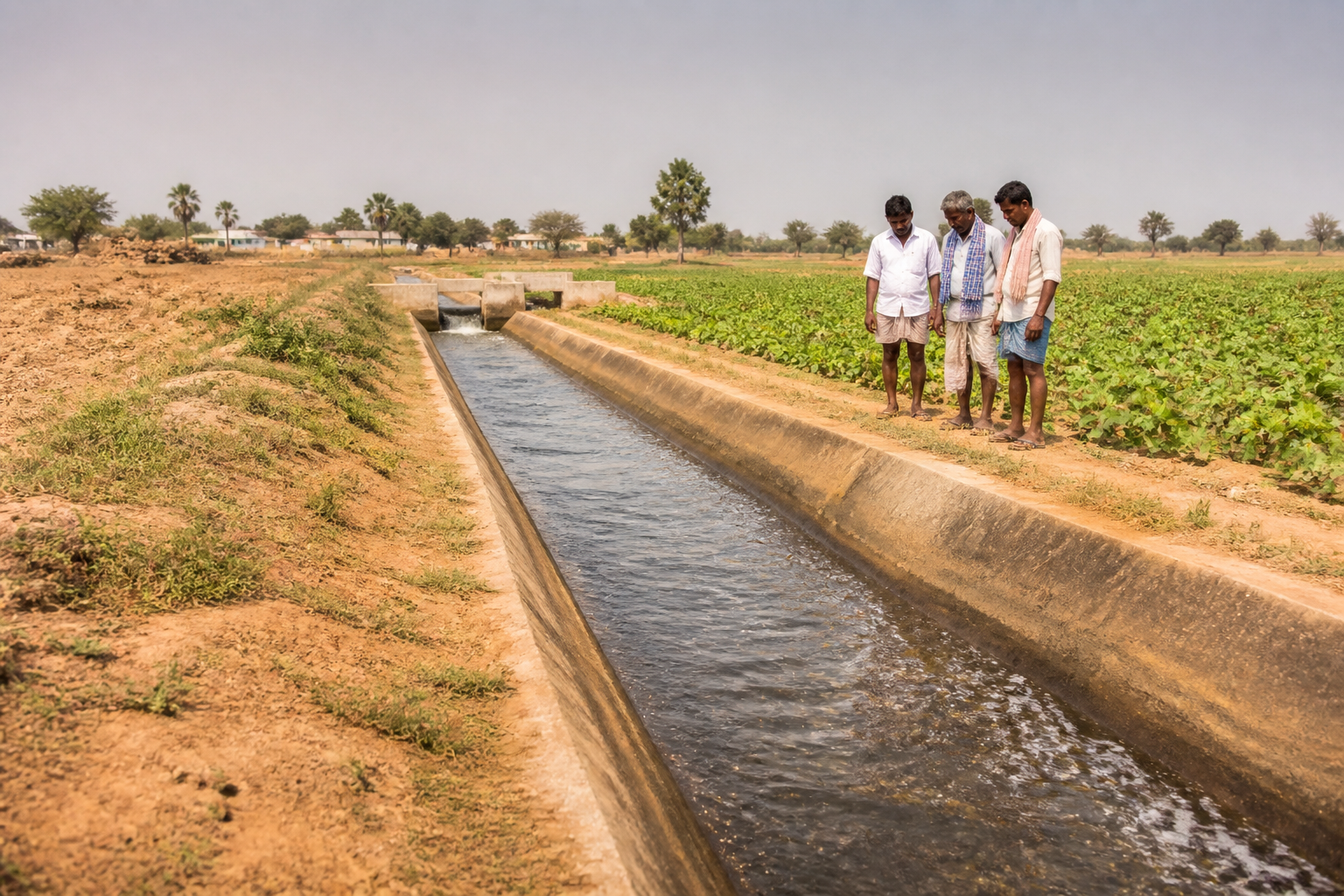
The irrigation response is central to the government’s account. Naidu said water was flowing in the Handri-Neeva canals even during an El Niño-like situation because of advance measures. He said water had been made to flow through the canals within 100 days after spending ₹3,500 crore, and linked the current situation to the pace of irrigation spending over different periods. He cited ₹65,000 crore spent on irrigation between 2014 and 2019, compared with ₹22,000 crore during 2019-24, while arguing that completion of projects would have reduced difficulty during disasters.
These figures were presented by the chief minister as part of the explanation for why irrigation infrastructure matters during a rainfall deficit. The supplied report does not provide an independent assessment of the expenditure figures, project completion rates or the volume of water reaching different command areas. It does, however, identify the operational objective: water must reach tail-end lands, drought-hit areas and communities facing possible drinking-water shortages. The government also said steps were being taken to prevent shortages of drinking water and to provide water and fodder for livestock.
The distribution of the rainfall deficit is important because climate impacts are not uniform across a state. The report identifies Kurnool, Nandyal and Anantapur as districts where El Niño’s impact was more visible on crops. It also says pulse cultivation was performing better while oilseed cultivation remained low. This uneven pattern supports the government’s call for contingency plans rather than a single statewide crop prescription. Officials were asked to encourage pulses, millets and other high-demand crops, explain the benefits of drought-resistant varieties and promote onion and chilli cultivation in non-traditional areas.
The state has already supplied pulses, millets and green-manure inputs for 5.21 lakh hectares and distributed 1.31 lakh quintals of seeds at an 80 per cent subsidy, according to the report. Another ₹60 crore was kept ready for the kharif contingency plan. These numbers suggest that the response is not limited to an advisory. It combines input distribution, subsidised seeds, crop diversification and a reserve allocation. The effectiveness of this framework will depend on whether supplies arrive before sowing windows close and whether farmers have reliable information about water availability and market demand.
Insurance is another institutional link. Naidu said crops had already been insured and directed officials to ensure that farmers received insurance amounts in case of crop losses. He also asked the state to coordinate with the Centre over minimum support prices. Insurance can provide compensation after damage, while minimum support prices and procurement influence whether farmers are willing to shift crops. The report does not specify the insured area, claim-processing timelines or the crops covered, leaving the implementation side of this part of the response to be established.
The government has also allocated ₹190 crore to protect horticulture crops in high-risk Rythu Seva Kendra areas. Naidu instructed officials to use the funds effectively and said green cover should not be allowed to decline. He called for the Jaladhara programme to be intensified by linking it with VBG Ramji works, although the supplied report does not explain the scope, coverage or implementation structure of those works. This is a reminder that climate resilience depends not only on emergency relief but also on the maintenance of ecological and water-management systems.
The urban significance of the plan lies in the way agricultural stress travels through connected markets and public services. Cities and towns depend on rural production for staple foods, vegetables, pulses and edible oils. A rainfall deficit can therefore become a procurement issue, a transport issue, a storage issue and a consumer-price issue. The chief minister’s instruction to monitor rice stocks and control onion prices recognises this connection, even though the report does not provide current prices, stock levels or estimates of possible shortages.
It also reveals the importance of administrative coordination. A district collector, irrigation official, agriculture extension worker, procurement agency and local self-help group may all influence the final outcome, but they operate through different programmes and reporting systems. Naidu’s call for regular field visits and village-level awareness campaigns is intended to connect these layers. The instruction to public representatives to tour villages despite local elections further places implementation at the field level, though the report provides no information on monitoring mechanisms or accountability for missed targets.
The evidence currently confirms three pressures: a large reported rainfall deficit, incomplete kharif sowing against the state target and the need to protect both farm production and essential-commodity prices. It also records a substantial package of irrigation, seed, contingency, horticulture and insurance-related measures. What remains uncertain is how much water will be available through the season, whether crop diversification will match market demand, how quickly insurance claims will be paid and whether procurement and stock releases will prevent price increases. Those implementation questions will determine whether Andhra Pradesh’s El Niño plan functions as a coordinated resilience system or remains a collection of departmental instructions.
