


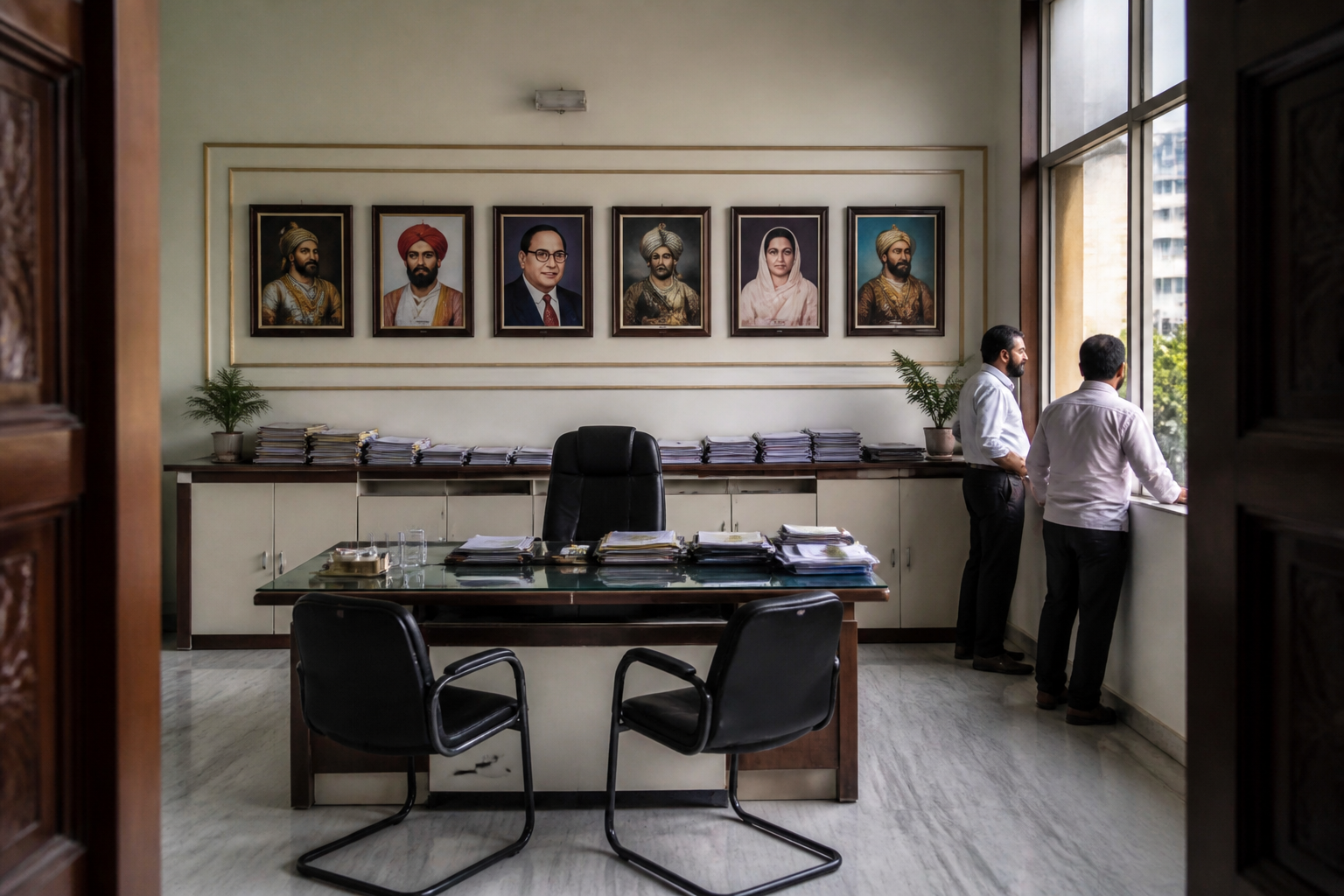
The Malegaon Tipu Sultan portrait row has moved from a municipal office to the Bombay High Court, turning a dispute over one portrait into a test of how Maharashtra’s civic institutions interpret rules governing historical figures displayed in government premises. The court has sought the state government’s response after Malegaon deputy mayor Shan-e-Hind Nihal Ahmed challenged the municipal administration and police direction to remove the portrait from her office.
The case matters because the dispute is not confined to the historical reputation of Tipu Sultan. It concerns the authority under which a municipal administration can decide which portraits may be displayed in an elected representative’s office, how consistently such rules are applied, and whether an action taken inside a civic building can be separated from the political contest surrounding it.
According to the report, the portrait was displayed alongside images of Mahatma Gandhi, Chhatrapati Shivaji Maharaj, Rani Lakshmibai, Subhas Chandra Bose, Dr B R Ambedkar, Savitribai Phule, Mahatma Jyotirao Phule, Bhagat Singh and Rajarshi Shahu Maharaj. The objection was raised by Malegaon civic leader Nilesh Kakde, following which the municipal administration and police asked for the Tipu Sultan portrait to be removed.
The state authorities are relying on a 1965 circular and government resolutions issued in 2002 concerning portraits of national leaders in government offices. The state’s position, as presented in the report, is that Maharashtra has an authorised set of rules and a list of personalities whose portraits may be displayed in government premises, and that Tipu Sultan does not appear on that list.
That position places the case within a familiar administrative question: whether a government office is treated as a neutral institutional space governed by a fixed protocol, or whether an elected office-holder has discretion to represent a wider historical and constitutional tradition. The answer has consequences beyond the particular room in Malegaon because municipal offices across India routinely function as both administrative workplaces and highly visible political spaces.
The petition challenges the selective nature of the action. The deputy mayor’s lawyer questioned why the objection was directed specifically at Tipu Sultan when images of several other historical figures are also displayed in public and government institutions. The petition also refers to the original artistic version of the Constitution of India, which the petitioner says includes an image associated with Tipu Sultan. It cites the presence of his portrait in the Nashik district court and some other public institutions as part of the argument that the municipal action requires judicial review.
These arguments do not, by themselves, settle the legal issue. They do, however, identify the central institutional tension. The existence of a portrait in one public building does not automatically establish that every government office has the same permission to display it. At the same time, if authorities invoke a formal list or government order, the application of that rule must be clear enough to explain why a particular display is prohibited and how comparable cases are treated.
The chronology shows how an administrative decision became a recurring civic dispute. In February 2026, after taking charge as deputy mayor, Shan-e-Hind Nihal Ahmed placed the Tipu Sultan portrait in her office with images of other historical figures. Bharatiya Janata Party and Shiv Sena members from the Eknath Shinde faction, along with local Hindutva organisations, opposed the display. They argued that Tipu Sultan was not included in the official list of national heroes and described the decision as vote-bank politics.
Amid political tension and disruption, the municipal administration removed the portrait while citing government protocol and rules. The deputy mayor subsequently said she would put it back. After renovation work in her office was completed in the last week of August 2026, the portrait was displayed again, this time prominently alongside images including those of Chhatrapati Shivaji Maharaj and Dr Babasaheb Ambedkar. The renewed display led to the legal challenge and the latest court proceedings.
The sequence is significant for municipal governance because it shows how unclear or contested protocols can become operational flashpoints. A rule intended to standardise the appearance of public offices can instead generate repeated enforcement, political mobilisation and litigation when the relevant list, circular or resolution is not accepted as conclusive by all stakeholders. The dispute also demonstrates that decisions inside a municipal building can carry symbolic weight well beyond the physical space involved.
The Bombay High Court’s role at this stage is limited to examining the challenge and seeking the government’s response. A bench comprising Chief Justice Maheshchandra Tripathi and Justice Adwait Sethna directed the Maharashtra government to file its reply. The state opposed the petition, according to the report. The court’s notice does not amount to a final ruling on whether the portrait may remain in the deputy mayor’s office.
The case therefore places several administrative questions before the state. What precisely do the 1965 circular and 2002 resolutions regulate? Do they create a binding and exhaustive list, or provide guidance for government premises? Do the rules apply identically to municipal offices, courts and other public institutions? Who has the authority to enforce them, and what process must be followed before a portrait is removed from an office occupied by an elected representative?
The supplied report does not establish the full text of the circulars, resolutions or any municipal order issued in the matter. It also does not provide the government’s detailed written response or a final judicial interpretation. Those documents will be important to determine whether the dispute turns on a clear prohibition, an administrative practice, or a disagreement over how a general protocol should be read.
There is also a distinction between historical recognition and official display. A figure may appear in a constitutional illustration or in a public institution without that fact automatically deciding the rules for every government office. Conversely, a government list may regulate official displays without resolving broader questions about historical memory or public representation. Keeping those questions separate is essential if the municipal dispute is to be addressed as an administrative matter rather than only as a political confrontation.
For Malegaon, the immediate issue remains the status of the portrait in the deputy mayor’s office and the legality of the action taken by the municipal administration and police. For Maharashtra’s civic bodies, the larger issue is whether rules on public symbols are sufficiently precise, consistently enforced and transparent to withstand challenge. The next substantive development will be the state government’s response before the Bombay High Court and any directions that follow from the court’s consideration of the petition.
