


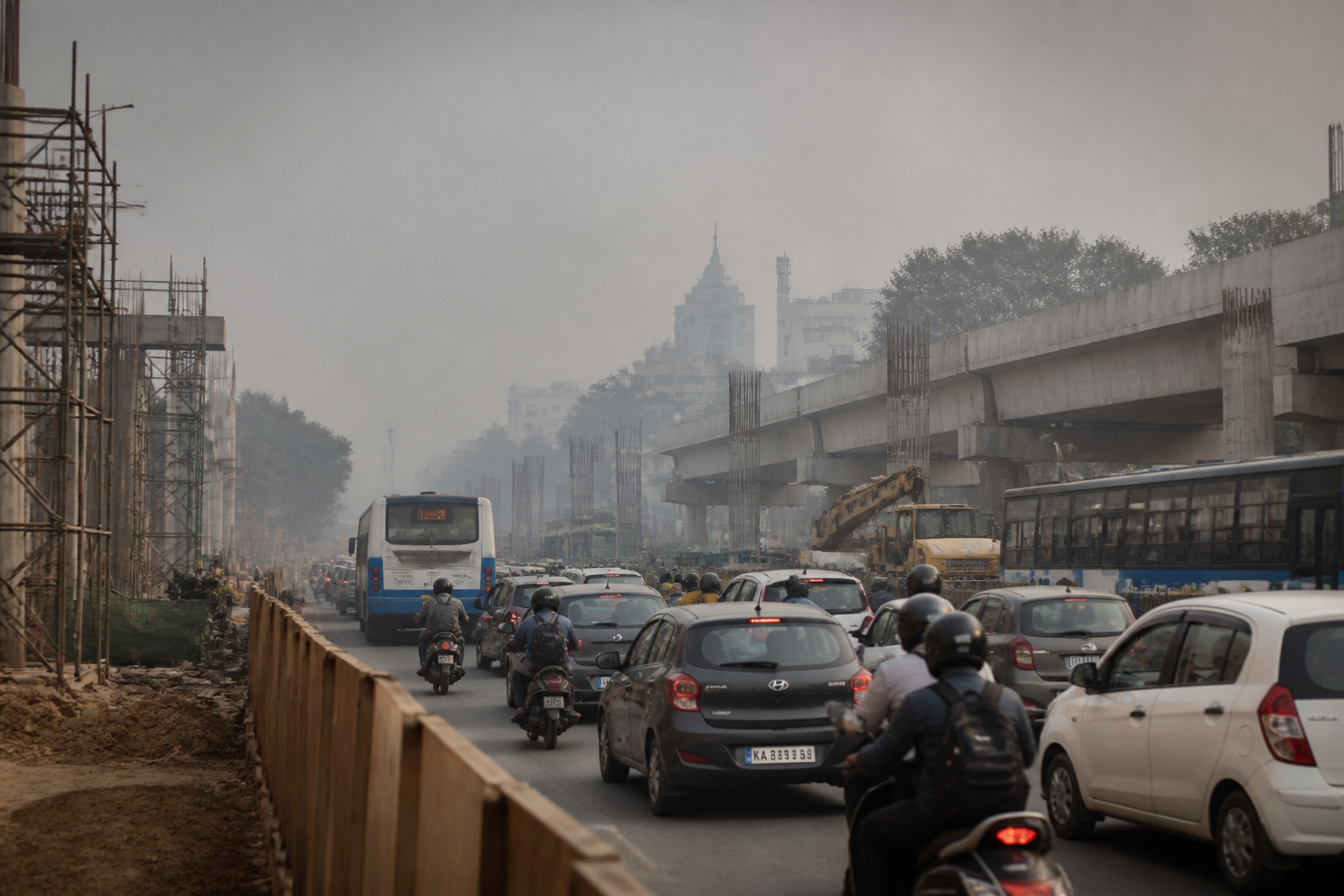
A study by researchers from BMS College of Engineering has placed Bengaluru’s air pollution health hazard index at 3.29, more than three times the internationally accepted benchmark of less than 1 cited in the research. The figure does not describe a single pollution reading. It captures the combined effect of fine particulate matter and other pollutants on residents, raising a larger question about whether the city’s air-quality response is organised around isolated limits rather than cumulative exposure.
The study analysed air-quality data from Bengaluru and four other Karnataka cities — Belagavi, Yadgir, Mangaluru and Madikeri — for 2024. Bengaluru recorded the highest particulate pollution among the locations assessed. Its annual mean PM2.5 concentration was reported at 40.2 micrograms per cubic metre, while PM10 reached 80.4 micrograms per cubic metre.
Those numbers place the city’s air problem within two different regulatory frames. The study said Bengaluru’s PM2.5 concentration was at the edge of India’s National Ambient Air Quality Standards, while PM10 exceeded national limits by approximately 34%. At the same time, the city’s PM2.5 level was far above the World Health Organization’s annual guideline of 15 micrograms per cubic metre. The contrast shows how a city can appear close to one national threshold while remaining substantially above a stricter health-based guideline.
The more important finding is the role of combined exposure. The pollutants assessed included PM2.5, PM10, nitrogen dioxide, sulphur dioxide and carbon monoxide. According to the study, none of these pollutants crossed the danger threshold individually. But their combined presence produced a health hazard index of 3.29. PM2.5 alone accounted for a hazard value of 2.680, or more than 81% of the total index.
This distinction matters for how urban air is managed. A compliance system that checks pollutants one by one may not fully communicate the burden experienced by people breathing the city’s air every day. The study’s index is not a new ambient air-quality standard, but an assessment of the cumulative hazard associated with several pollutants. Its significance lies in showing that individual readings can understate the combined exposure faced by residents.
PM2.5 is particularly important because its particles are small enough to penetrate deep into the respiratory system. The study identified it as the largest contributor to Bengaluru’s calculated health hazard. A city-based healthcare expert quoted in the report linked prolonged fine-particulate exposure with reduced lung capacity and the aggravation of conditions such as asthma. The expert also identified children, senior citizens and pregnant women as higher-risk groups, and said extended exposure could contribute to cardiovascular and respiratory problems.
Children face an additional exposure burden, according to the study. Their daily inhalation dose was described as approximately 1.5 times that of adults. Faster breathing rates and lower body weight mean that the same urban environment can translate into a greater proportion of inhaled pollutants for children. This makes air pollution not only an environmental issue but also a question of how schools, residential neighbourhoods, roads and construction sites are planned and managed.
The city’s sources of exposure are also connected to its pattern of growth. The researchers attributed Bengaluru’s high particulate levels mainly to extreme vehicular density and rampant construction activity. These are not isolated sources. Vehicle emissions are tied to the city’s mobility system, while construction dust is linked to ongoing building activity, road works, material handling and enforcement capacity. Together, they place air quality within the responsibilities of transport agencies, civic authorities, construction regulators and project operators.
The study therefore points towards a governance problem as much as a pollution problem. It called for stronger vehicular emission controls, stricter construction-dust mitigation rules and a faster transition to clean public transport. These measures address different parts of the same urban system: how people move, how buildings and roads are built, and how effectively pollution sources are monitored and controlled.
Bengaluru’s air-quality challenge is not limited to the presence of pollutants at a particular monitoring point. The reported annual means indicate sustained exposure over the evaluated period. The data also show that the city’s PM10 concentration is materially above national limits, while its PM2.5 concentration is well above the WHO guideline cited in the study. The health hazard index adds another layer by combining the effects of multiple pollutants rather than treating each as an independent problem.
Weather can temporarily alter the visible severity of the problem. The researchers noted that natural systems such as the southwest monsoon can scrub pollutants from the air and provide short-term relief. But seasonal improvement does not remove the sources that generate pollution. Once traffic volumes, construction activity and emissions resume, the underlying exposure pattern remains. The study consequently described long-term improvement as dependent on sustained civic action rather than periodic atmospheric cleansing.
That distinction is important for public administration. Temporary reductions in measured pollution can create the appearance of progress without demonstrating that emissions have been structurally reduced. A durable response would require continuous monitoring, control of emission sources and enforcement of construction-dust rules, alongside improvements in public transport. The study also highlighted the need to safeguard Bengaluru’s blue-green spaces, though the supplied material does not establish how much pollution reduction any individual measure would deliver.
Dr KE Ganesh, one of the researchers and a professor at BMS College of Engineering, said that controlling emission sources, continuously monitoring air-quality parameters and protecting blue-green spaces could help improve Bengaluru’s air. The study was published in the Journal of Air Pollution and Health, according to the report.
The evidence currently establishes a serious pollution burden in Bengaluru, but it does not by itself provide a complete citywide health-impact assessment or measure the performance of each intervention proposed. It does, however, clarify the institutional challenge: the city’s air cannot be addressed through a single department or a single pollutant threshold. The next developments to watch are stronger monitoring, enforcement of dust controls, vehicular-emission action and progress towards cleaner public transport, all of which the researchers identified as necessary responses.
