


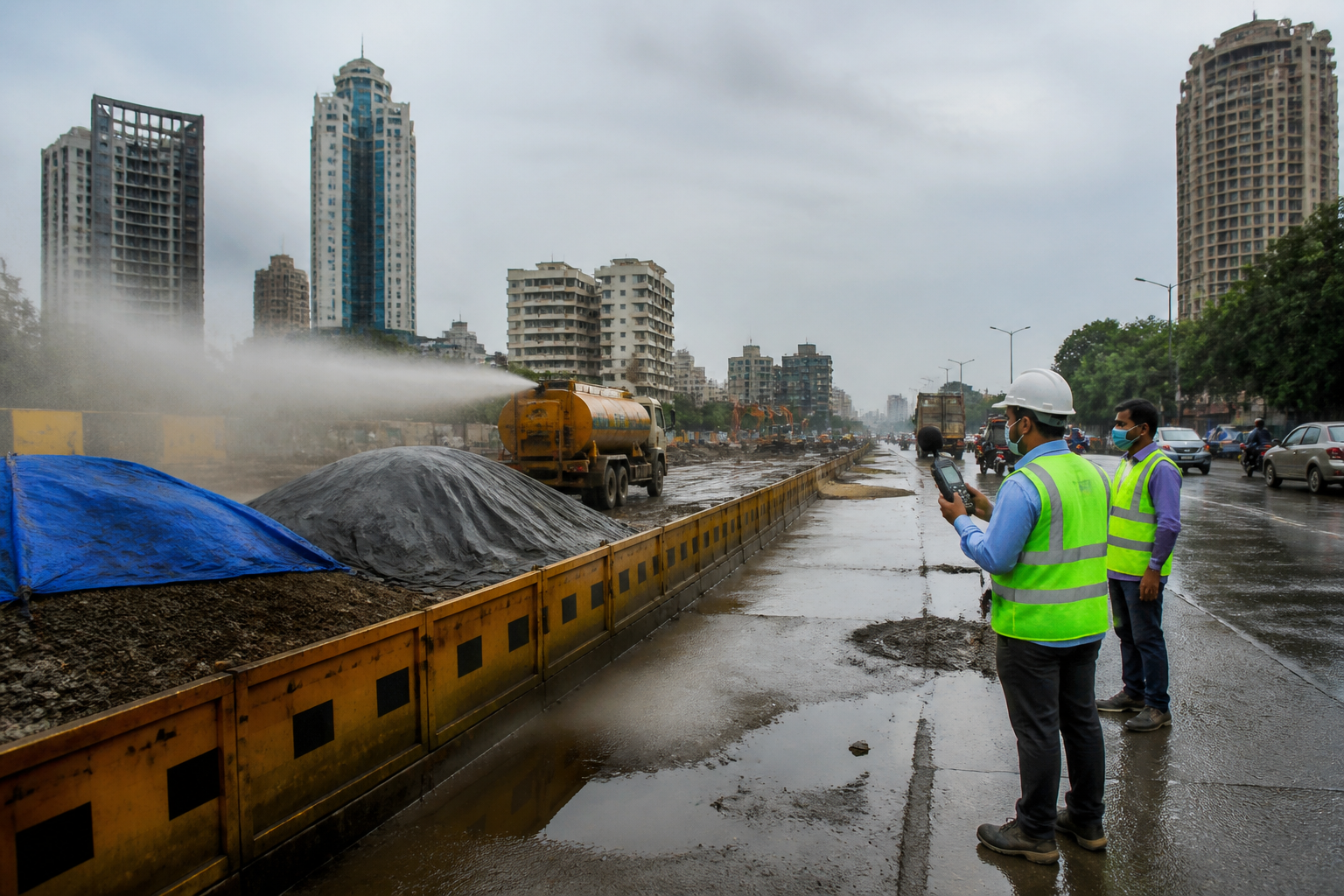
The Brihanmumbai Municipal Corporation’s decision to launch a 15-day campaign against air pollution from October 1 is more than a seasonal enforcement exercise. It is a test of whether Mumbai can control one of the most visible consequences of its infrastructure boom: dust from construction and major public works at the point where it is generated.
The timing is central to the civic body’s approach. According to the Indian Express report, the monsoon is nearing its end and Mumbai is entering the festive and winter months. Rain has helped keep the city’s air quality satisfactory since June, but the BMC expects conditions to worsen once the monsoon withdraws. The campaign is therefore designed as a preventive intervention rather than a response to an already recorded deterioration.
At a review meeting, Municipal Commissioner Ashwini Bhide instructed officials to strictly implement the civic body’s 28-point guidelines for controlling air pollution. Nodal officers will be appointed across Mumbai to monitor work sites at major infrastructure projects, with particular attention to dust emissions. The arrangement places project-level supervision at the centre of the campaign.
That detail matters because Mumbai’s pollution response is being tied directly to the administration of construction activity. Instead of treating deteriorating air quality only as an environmental or health department issue, the BMC is assigning officials to infrastructure sites where dust can be produced and dispersed. The effectiveness of the campaign will consequently depend on whether monitoring officers can ensure that the existing guidelines are implemented consistently across multiple locations.
The report does not specify the individual requirements contained in the 28-point guidelines, nor does it provide the number of infrastructure work sites that will be covered. It does, however, identify major project sites as a priority for monitoring. This indicates that the civic body sees construction-related dust as a controllable source of risk during the transition out of the monsoon.
Mumbai’s current air-quality position provides the backdrop to the campaign. The Central Pollution Control Board dashboard, as cited in the report, recorded satisfactory air quality in Mumbai since June, with rainfall helping wash away air pollutants. That improvement is not being treated by the BMC as a permanent condition. The civic administration’s stated concern is that the end of the rains could remove this temporary assistance and expose weaknesses in everyday pollution control.
The report also cites the National Clean Air Programme’s ranking of Mumbai among 48 major metropolitan cities. Mumbai stood 28th in the latest ranking, compared with 25th the previous year, 28th the year before that and 10th in 2023. These positions show a decline from Mumbai’s earlier standing, although the supplied report does not provide the underlying measurements, methodology or the precise pollutant trends behind the ranking.
That limitation is important. A ranking can signal relative performance, but it does not by itself explain what is driving the change or which interventions are working. The BMC’s campaign is focused on dust emissions at work sites, while the ranking cited in the report reflects the city’s broader air-quality position. The two are connected in the civic response, but the available evidence does not establish that infrastructure dust alone caused Mumbai’s movement in the ranking.
The administration’s use of nodal officers suggests an institutional response based on distributed accountability. A central municipal instruction can establish a standard, but implementation takes place across individual work sites, contractors and project agencies. Assigning officers to monitor those sites is intended to create a direct administrative link between the BMC’s guidelines and conditions on the ground.
The report does not identify the agencies responsible for the major projects, the contractors involved or the enforcement action available when guidelines are not followed. It also does not state whether the campaign will include penalties, work stoppages, public reporting or repeated inspections. Those details will determine whether the campaign functions as a sustained compliance mechanism or remains a short-term review exercise.
The 15-day duration also raises a question about the relationship between seasonal campaigns and year-round regulation. The BMC has announced the special drive to prepare for a period when air quality may deteriorate, but the report does not say whether the nodal-officer system will continue after the campaign ends. If monitoring stops when the 15 days are over, the intervention may provide a temporary check without creating a permanent framework for managing dust at Mumbai’s continuously changing construction sites.
The city’s infrastructure activity makes this administrative question significant. Major works are not confined to one neighbourhood or one municipal department. The report refers broadly to infrastructure projects across Mumbai, meaning that the campaign must operate across a dispersed urban environment. Its success will rely on the consistency of supervision, the ability to identify non-compliance and the capacity to coordinate between civic officials and project authorities.
The BMC’s statement also reveals the logic behind preventive governance. A civic official said that Mumbai’s AQI was currently under control, but that advance measures were necessary to prevent deterioration and protect citizens from its impact. The administration is therefore acting before the reported risk becomes an immediate crisis. This is particularly relevant for air pollution, where waiting for citywide conditions to worsen can limit the usefulness of enforcement.
The report further says that conditions could deteriorate under El Niño climatic conditions. It does not provide a forecast or quantify the expected effect, so the climate reference cannot be treated as a measurement of Mumbai’s future air quality. Within the BMC’s stated reasoning, however, it adds to the case for advance preparation during the post-monsoon period.
The city’s air-quality strategy is also being reviewed alongside the BMC’s Pedestrian First campaign. The two initiatives are not presented in the report as one combined programme, but their simultaneous review places pollution control and street-level urban conditions within the same administrative frame. The available information does not establish a direct operational link between them. It does show that the municipal commissioner’s review meeting covered both air-pollution measures and pedestrian priorities.
For residents, the immediate public question is whether the campaign will change conditions around active worksites. The report does not provide complaints data, neighbourhood-level readings or a list of locations where monitoring will begin. It therefore cannot establish which communities face the greatest exposure or whether the campaign will produce measurable improvements. What it does establish is that the BMC has identified the period after the monsoon and dust emissions from major works as areas requiring advance attention.
The next stage will be implementation. The civic body has instructed officials to enforce its 28-point guidelines and appoint nodal officers across Mumbai. The supplied report does not state when the appointments will be completed, how often sites will be inspected, what findings will be published or what corrective action will follow violations. Those are the details that will show whether the campaign can convert a seasonal warning into an accountable pollution-control system.
The evidence currently supports a measured conclusion. Mumbai’s air quality was reported as satisfactory during the rainy months, while the BMC expects greater risk after the monsoon and has chosen construction-site dust as a priority for preventive monitoring. The campaign’s significance will depend not on its announcement alone, but on whether site-level supervision continues, produces transparent enforcement and remains active beyond the 15-day window.
