


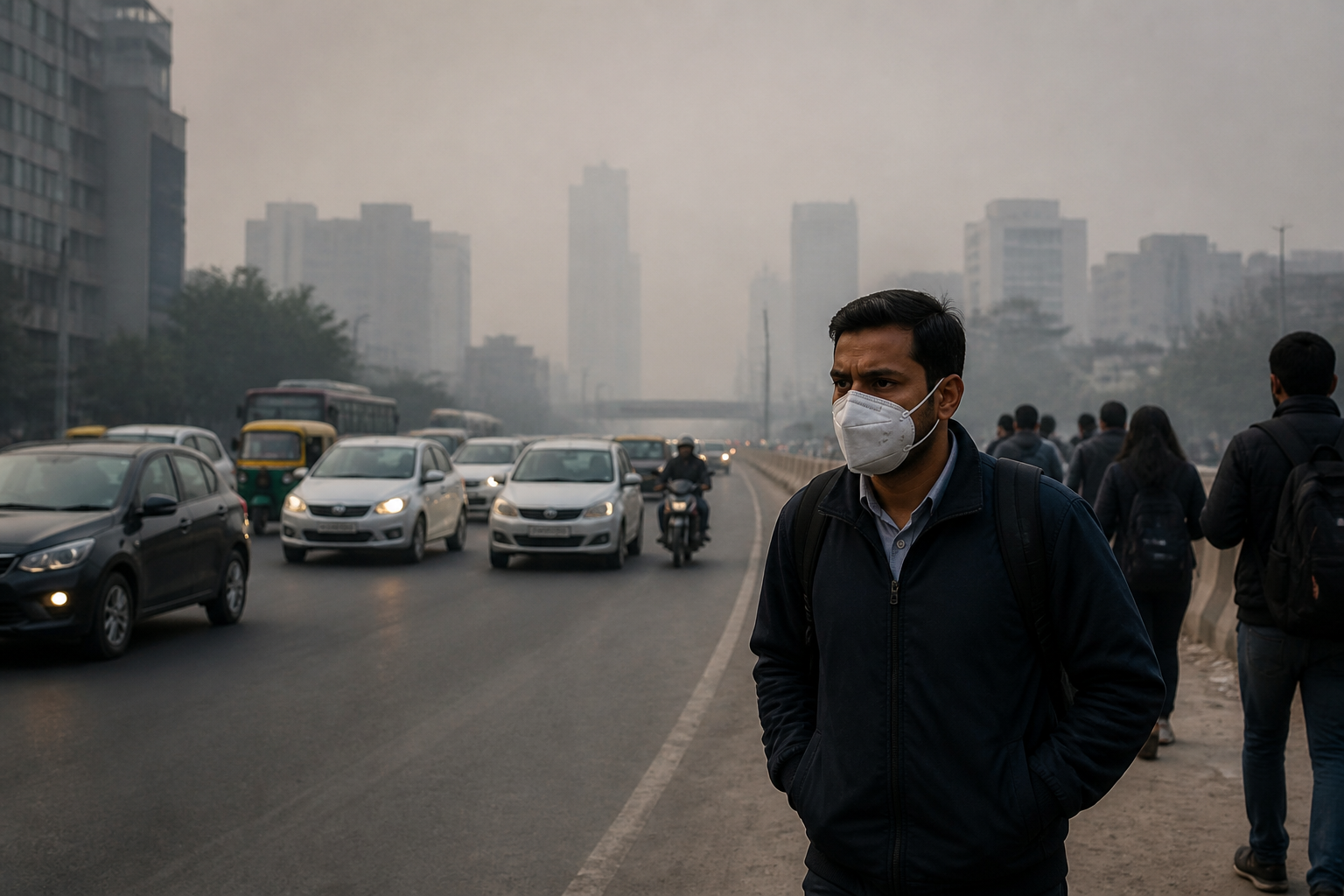
A review of 29 studies has found statistically significant associations between exposure to several air pollutants and death by suicide, attempted suicide and suicidal thoughts, opening a difficult question for cities: how should environmental risk be understood when it intersects with mental health and other social pressures?
The review, published in the Journal of Epidemiology and Community Health, identified particulate matter PM2.5 and PM10 and nitrogen dioxide as the pollutants most strongly linked with the outcomes examined. The researchers from Queen’s University Belfast said the findings underline the importance of considering environmental exposures as potentially modifiable risk factors in suicide prevention.
The study does not establish that air pollution directly causes suicide. Instead, it brings together evidence from studies examining associations between pollution exposure and suicide-related outcomes. That distinction is important because suicide is shaped by multiple individual, biological and contextual factors. The researchers themselves described suicide prevention as a public health issue rather than a question that can be explained by a single exposure.
For urban areas, the findings are significant because the pollutants identified in the review are closely tied to everyday city systems. PM2.5 and PM10 are associated with combustion and other sources of particulate pollution, while nitrogen dioxide is commonly linked to traffic and fuel burning. This means that exposure is not simply an individual choice. It can be shaped by where people live, how they travel, the quality of local air and the performance of wider transport and energy systems.
The urban environment also brings other potential stressors into the same field of inquiry. The researchers said positive links might exist for sulphur dioxide, ozone and noise pollution. They also referred to evidence that traffic and other environmental noise, as well as light pollution, may increase stress by disrupting the body clock. These factors can overlap in dense neighbourhoods, near busy roads, around transport infrastructure and in areas with intense activity through the night.
The review’s explanation of possible biological pathways focuses on neurological effects. The researchers said pollutants and water contaminated with substances such as arsenic, lead, lithium or nitrate have been linked to chronic inflammation and nerve damage, which may impair brain function and influence mood and stress resilience. These observations describe possible mechanisms, but they do not by themselves prove that a particular exposure caused an individual suicide or suicidal thought.
That limitation was emphasised by Ben Mullins, professor at Curtin University’s School of Population Health in Australia, who was not involved in the study. Mullins said the meta-analysis was among the first to explore the link between air pollution and suicide. He also noted that many pollutants, particularly some metals, can have wide-ranging neurological effects, including depression and anxiety, making a relationship with mental health disorders biologically plausible.
At the same time, Mullins cautioned that the effect sizes in the studies included in the review were relatively small and that the authors had not adequately addressed confounding factors or other explanatory variables. In practical terms, this means the observed association could partly reflect other conditions that affect both pollution exposure and suicide risk. Those conditions may include weather, climate extremes, socio-economic circumstances or local patterns of urban exposure.
Weather and climate are particularly important to the interpretation of pollution data. Mullins said other studies had found stronger links between weather and climate extremes and suicide, while noting that such extremes can also be associated with air pollution events. Separating these overlapping influences is therefore necessary before researchers can determine how much risk is attributable to pollution itself and how much is related to wider environmental or social conditions.
This is the central policy challenge raised by the review. Air-quality policy already operates through monitoring, emissions control and transport or industrial regulation, while suicide prevention is usually organised through health services, mental-health support and public-health programmes. The findings suggest that the two policy areas may need to communicate more closely, but the supplied evidence does not establish a specific administrative model or intervention.
The researchers’ description of environmental exposures as modifiable risk factors gives the argument a practical direction without reducing suicide prevention to pollution control. Cleaner air could potentially remove one contributor to health risk, but the review does not claim that improving air quality alone would prevent suicide. Its significance lies in broadening the range of conditions considered in public-health planning.
For city governments, this also raises questions about how exposure is measured. People do not experience citywide pollution averages uniformly. Concentrations may vary between roads, industrial areas, construction zones and residential neighbourhoods, while noise and light exposure can differ by building, street and time of day. However, the review as presented does not provide a city-level comparison or identify specific Indian locations where the reported associations are strongest.
The numerical evidence available in the report is concentrated in the review itself: 29 studies were analysed, and statistically significant positive associations were reported for short-term exposure to PM2.5 and PM10 and long-term exposure to PM2.5 and nitrogen dioxide. The report does not provide pooled effect sizes, a breakdown of the studies by country or a measure of how much risk could be attributed to each pollutant. Those details matter for translating a research finding into local policy.
The distinction between short-term and long-term exposure is also important. Short-term exposure may capture acute pollution episodes, while long-term exposure reflects sustained conditions in the places where people live or work. A city response based only on emergency pollution alerts would not address chronic exposure, just as long-term emissions policy would not by itself explain the immediate effects of a severe pollution episode.
The evidence therefore points to a layered urban-health problem. Pollution control, transport planning, noise management, water safety and mental-health services are often handled through different institutions, even though residents encounter them as part of one environment. The study does not show that these systems are currently integrated, but it makes the case for examining environmental exposure alongside established social and clinical risk factors.
The review’s wider importance lies in what it confirms and what it leaves unresolved. It confirms that the available research contains statistically significant associations between specified pollutants and suicide-related outcomes. It does not confirm a simple causal chain, establish that pollution is the dominant risk factor, or show that the same relationship applies equally across all cities and populations.
Further work, as Mullins said, is needed to separate pollution effects from climate, weather, socio-economic and other confounding influences, while also examining the mechanisms involved and possible mitigation. Until that evidence becomes stronger, the responsible urban-policy conclusion is neither to dismiss the association nor to treat it as settled causation. Air-quality management and suicide prevention remain distinct responsibilities, but the review shows why public health may need to consider where they overlap.
