


India’s data centre capacity is entering a new phase of expansion, but the most important part of the forecast is not the headline number alone. A Cushman & Wakefield report expects 3,860 MW of additional capacity to come up by 2030, requiring USD 29.9 billion in development capital. The projection places data centres at the intersection of technology investment and urban infrastructure planning, with implications for electricity, land, construction, connectivity and resource use.
The proposed addition includes 509 MW already under construction and 3,351 MW in the planning stage. India’s operational data centre capacity stood at 1,789 MW in the first half of 2026, according to the report, compared with around 400 MW in 2019. That growth indicates that data centres have moved from being a specialised technology asset to a significant component of the built environment in major Indian cities.
The sector’s expansion is being driven by several overlapping changes. The report identifies relatively low data centre penetration, growing enterprise use of artificial intelligence and increasing activity by hyperscale cloud companies as factors leaving room for further growth. AI workloads are also creating demand for facilities with higher rack densities, changing the technical requirements of buildings that were earlier designed primarily around conventional cloud and enterprise computing needs.
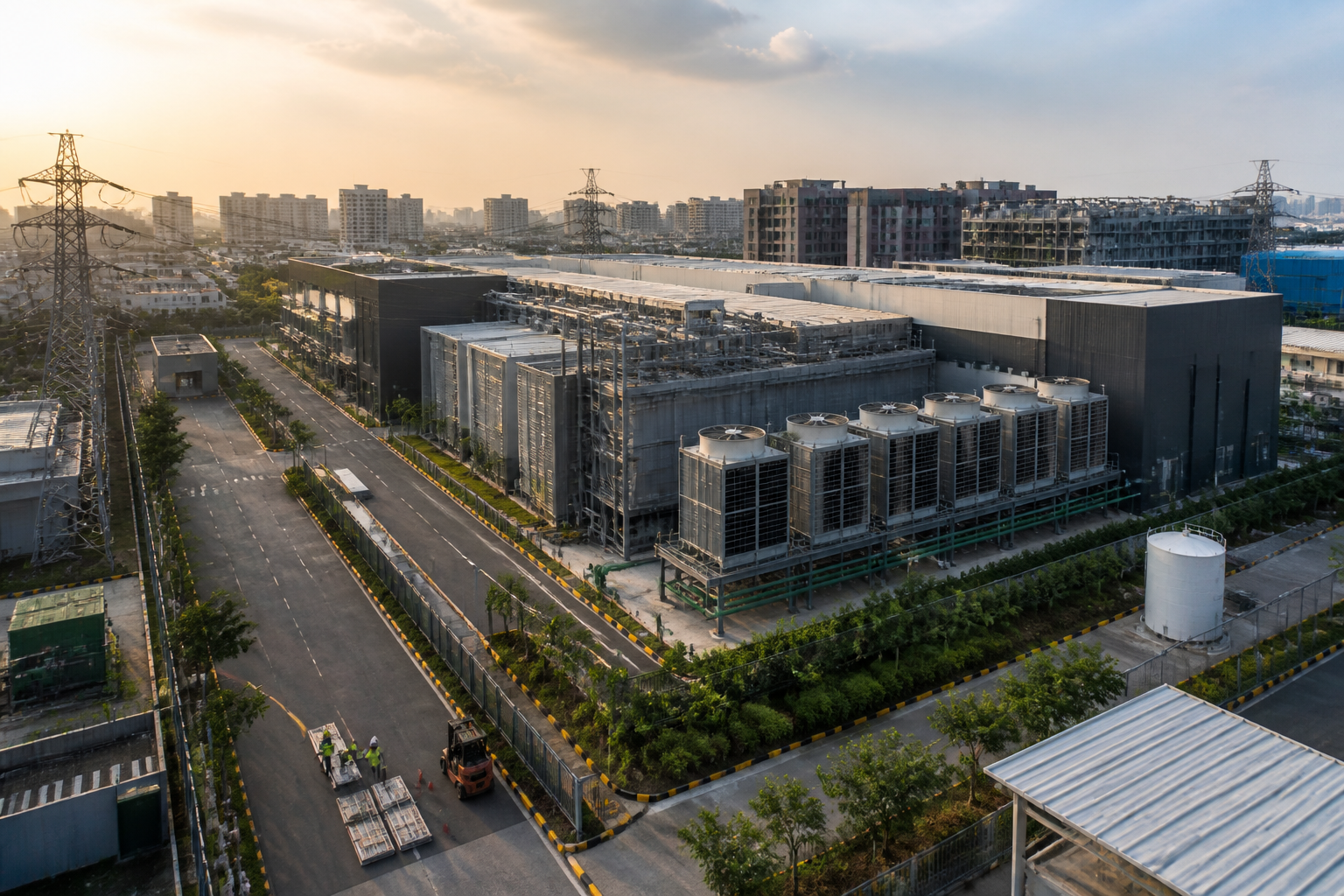
This matters to cities because a data centre is not an isolated warehouse containing servers. It is a high-value, power-intensive facility that requires reliable electricity, redundant connectivity, cooling systems, secure sites and a construction ecosystem capable of delivering specialised buildings. Its urban footprint may be less visible than a metro line or a housing project, but its dependence on public and private infrastructure is substantial.
Mumbai remains the centre of India’s data centre market. The city accounted for 890 MW, or half of the country’s operational capacity, in the first half of 2026. It also had the largest upcoming pipeline, at around 1.7 GW, with operational capacity expected to cross 1 GW by the end of 2026, the report said.
That concentration reflects Mumbai’s established role as a connectivity and business hub. It also raises a planning question: how much additional digital infrastructure can be accommodated in a market that already faces pressure on land, electricity, water, transport and environmental systems? The supplied report does not quantify the local resource requirements of Mumbai’s pipeline, but the scale of the proposed addition makes those requirements central to future planning.
The expansion is nevertheless spreading to other major markets. Hyderabad had 151 MW of operational capacity and 710 MW of upcoming supply. Chennai had 214 MW operational and 368 MW upcoming, while Delhi NCR had 183 MW operational and 387 MW of future supply. These figures show that the next stage of growth is not limited to one city, even though Mumbai continues to dominate the national market.
The distribution of upcoming capacity is significant for urban development. A wider market can reduce dependence on a single location and allow operators to use different combinations of land, power supply, connectivity and planning conditions. At the same time, each new hub will need institutions capable of coordinating approvals, electricity infrastructure, construction activity and resource management. The report establishes the scale of the pipeline, but does not set out how these requirements will be administered across the different urban regions.
The market is also being shaped by the distinction between operational capacity and future supply. India’s operational capacity of 1,789 MW represents facilities already functioning, while the additional 3,860 MW includes projects at different stages of construction and planning. This distinction is important because a planned facility is not equivalent to commissioned capacity. The transition from pipeline to operation depends on land, financing, power availability, construction and technical commissioning.
The report recorded colocation vacancy at 14.9 per cent. Colocation facilities allow multiple customers to use shared data centre infrastructure rather than building and operating every facility independently. Vacancy therefore provides an indication of available space within this segment, although the supplied material does not explain how the figure varies between cities, facility types or customer categories. It should not be read as a complete measure of demand across the entire data centre market.
The investment requirement is equally notable. Cushman & Wakefield estimates that India will require USD 29.9 billion in development capital through 2030. At the Asia-Pacific level, data centre capacity is projected to increase 2.7 times by 2030 and require more than USD 280 billion in capital expenditure. India’s projected share of development investment places it among the region’s major markets.
This investment connects digital growth to the physical construction economy. New facilities require land acquisition or assembly, building works, mechanical and electrical systems, backup power, cooling equipment, security infrastructure and network connections. The capital figure therefore represents more than spending on servers. It signals a pipeline of specialised construction and infrastructure projects whose delivery will depend on the availability of industrial land, contractors, equipment and utility connections.
Power is likely to remain one of the most important planning considerations. The report specifically flags sustainability as an increasing priority and says that the rapid expansion of AI workloads is expected to raise data centre energy demand and resource requirements. It does not provide a national energy-consumption estimate for the projected 3,860 MW, nor does it specify the energy mix that future facilities will use. Those omissions matter because capacity expansion alone does not establish whether growth will be supported by renewable power, grid supply, captive generation or a combination of sources.
Cooling adds another layer to the urban resource question. Data centres must remove heat generated by densely packed computing equipment, and the report notes that AI-focused infrastructure is driving demand for higher rack densities. Higher densities can increase the technical intensity of cooling and power systems. The supplied material does not provide water-use figures or identify the cooling technologies planned for the different markets, so the local resource impact cannot be quantified from the report alone. It does, however, establish that resource requirements are becoming a recognised planning concern.
The institutional challenge is to treat data centres as part of infrastructure policy rather than only as a real estate or technology investment category. Their performance depends on multiple systems operating together: electricity distribution, telecommunications, roads for construction and maintenance access, land-use permissions, building approvals and environmental planning. Responsibility for these systems is distributed among different authorities and private providers, making coordination a key condition for delivery.
The geographic pattern also affects how the benefits and pressures of the sector are distributed. Mumbai’s established lead may support faster ecosystem development, while Hyderabad, Chennai and Delhi NCR are building their own capacity and investment pipelines. The report does not provide employment figures, local tax data or details on citizen-facing benefits, so the wider economic effects cannot be measured here. What can be established is that the sector is creating a substantial demand for urban sites and infrastructure in several major markets.
The numbers describe a rapid change in scale. India’s operational capacity increased from around 400 MW in 2019 to 1,789 MW in the first half of 2026. The country could add another 3,860 MW by 2030, although the report’s projection includes projects still in planning. Mumbai alone had an upcoming pipeline of around 1.7 GW, while Hyderabad, Chennai and Delhi NCR together had 1.465 GW of upcoming supply based on the figures provided. These figures indicate that future growth will combine continued concentration in established markets with expansion across a broader group of urban centres.
The central urban question is therefore not whether India can attract data centre investment. The report indicates that investment and demand are already moving in that direction. The harder question is how cities will accommodate facilities that consume significant amounts of power, require specialised construction and depend on reliable networks, while also managing land and resource constraints.
Cushman & Wakefield Executive Managing Director Gautam Saraf said that nearly 3.9 GW of additional capacity expected across India’s leading markets would support the next phase of cloud adoption, AI deployment and data-driven growth. The statement captures the sector’s economic rationale, but the report’s sustainability warning adds an important condition: digital expansion will also increase energy and resource requirements.
The evidence currently confirms a large national pipeline, a continuing concentration in Mumbai and the emergence of Hyderabad, Chennai and Delhi NCR as important growth markets. It does not establish the final delivery rate of planned projects, their city-level power and water requirements or the specific sustainability measures that will be adopted. Those will be the key indicators to monitor as the projected capacity moves from planning documents to operating facilities.
