


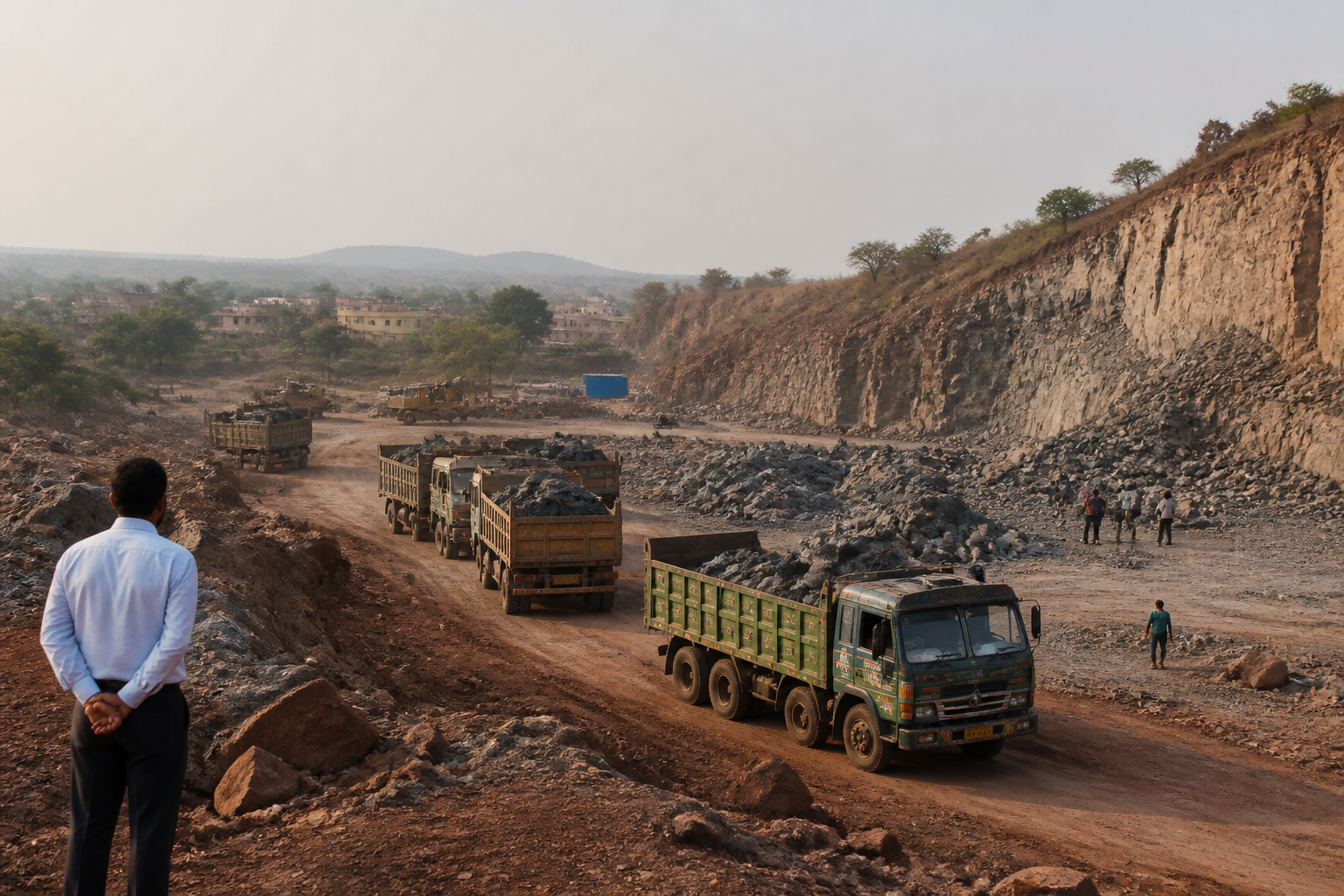
Birbhum’s mineral revenue collection has risen sharply enough to make the district West Bengal’s leading source of revenue from minerals, government land leases and related land transactions during the first four months of the current period. The figure is significant not only because of the money collected, but because it places administrative monitoring of mining activity at the centre of a wider question: how much public revenue can the state actually recover from districts where coal, stone and sand extraction have long generated political and legal controversy?
According to figures cited by Anandabazar and attributed to administrative sources, Birbhum collected ₹235 crore from various mineral resources between 16 April and 15 August. That was the highest collection among districts in the state during the period. Across West Bengal, mineral and related revenue collection reached ₹567.82 crore in those four months, compared with ₹428.20 crore during the corresponding period of the previous year.
The increase was ₹139.62 crore, or approximately 33 per cent. Birbhum accounted for roughly 41 per cent of the current period’s total cited state collection. The gap between Birbhum and the next districts was substantial: Jhargram collected ₹70.29 crore, Purba Bardhaman ₹56.12 crore, Bankura ₹53.06 crore and Paschim Bardhaman ₹48.59 crore, according to the figures reported.
These numbers make Birbhum more than a district-level revenue story. They offer a measurable indication of how enforcement and collection practices can change the fiscal value of extractive activity. At the same time, the figures alone do not establish whether the increase came primarily from higher production, better assessment of dues, action against under-reporting, recovery of earlier arrears, changes in lease administration or a combination of these factors. The supplied report does not provide a category-wise break-up.
That distinction matters because mineral revenue is not the same as the value of minerals extracted. A rise in receipts may reflect more accurate recording of existing activity rather than a sudden expansion in mining. It may also represent a temporary recovery of payments that had previously escaped the formal system. Without details on volumes, rates, permits, leases, penalties and arrears, the collection figure can demonstrate a fiscal change but cannot by itself explain the entire operational change behind it.
The reported improvement has emerged in a district that has repeatedly featured in public discussions about coal, stone and alleged illegal extraction. The report says surveillance at sand and stone quarries increased after a change in political administration. It also refers to the discovery of large assets allegedly outside declared accounts belonging to stone traders, including Tulu Mondal. Those references are part of the source report’s account and are not independently established in the material supplied here.
The administrative mechanism described in the report is centred on two factors: closer police monitoring and more active intervention by the district administration. That combination is important because mineral governance is not handled by a single institution. Revenue assessment, land administration, mining permissions, policing and enforcement can involve different offices and layers of government. Higher collections therefore depend not only on the statutory rate but also on whether these agencies share information and act consistently.
The report connects the revenue increase to allegations that the previous administration failed to collect the full public value of Birbhum’s mineral resources. Chief Minister Shubhendu Adhikari is quoted as having claimed that the state may have lost around ₹15,000 crore from Birbhum over 15 years, based on an average annual loss of ₹1,000 crore. The report also says he argued that the money could have supported schools, hospitals and employment. These are political claims cited by the source, not independently verified calculations in the supplied material.
The same report says the chief minister referred to an earlier annual mineral-revenue collection of ₹60 crore from Birbhum and claimed that ₹83 crore was collected in a single month after he took oath on 9 May. Because the article does not provide the underlying accounts or explain whether the figures use identical accounting periods and revenue categories, these comparisons require caution. A one-month collection figure cannot automatically be compared with a full-year figure without knowing whether it includes arrears, revised assessments or exceptional payments.
Still, the broad direction of the reported data is clear. Birbhum’s ₹235 crore collection was more than three times the amount reported from Jhargram, the second-ranked district. Its collection was also higher than the combined figures cited for Bankura and Paschim Bardhaman. This concentration suggests that the state’s mineral-revenue geography is uneven and that a small number of districts may account for a large share of receipts.
That concentration has an administrative consequence. When revenue depends heavily on a few mineral-producing districts, weaknesses in local monitoring can have an outsized impact on the state treasury. Conversely, improved enforcement in one major district can produce a visible change in the statewide total. The figures reported for the four-month period illustrate this effect, although they do not show whether the pattern will continue beyond the current collection window.
The issue also extends beyond government accounts. Mining and quarrying affect land records, transport routes, local employment, water systems and settlements near extraction sites. A stronger revenue collection system may indicate that extraction is being brought more fully into the formal administrative framework. It does not, by itself, establish whether environmental safeguards, worker protections, road conditions or local rehabilitation have improved. The supplied report contains no data on these outcomes.
For citizens, the key institutional question is what happens after revenue is collected. The report invokes possible spending on schools, hospitals and employment, but it does not identify a district-level allocation or a dedicated mechanism linking mineral receipts to such projects. Revenue recovery and public service delivery are separate stages of governance. The first creates fiscal capacity; the second depends on budgeting, expenditure decisions and implementation.
The numbers also raise a transparency requirement. To understand the reported 33 per cent rise, the state would need to publish the components of the ₹567.82 crore total, including mineral-wise receipts, district-wise sources, lease payments, penalties, arrears and the period to which each payment relates. Such a breakdown would help distinguish recurring revenue from one-time recovery and show whether collection gains are being achieved through broader compliance or intensified action against specific operators.
What the available evidence confirms is that West Bengal recorded a substantial increase in mineral and related revenue during the four months from 16 April to 15 August, with Birbhum contributing the largest reported share. What remains unclear is the precise composition of that increase, the extent to which it reflects improved oversight rather than changed extraction levels, and whether higher receipts will translate into visible public investment. Those are the measures that will determine whether the reported collection surge represents a durable reform in mining governance or a short-term fiscal jump.
