


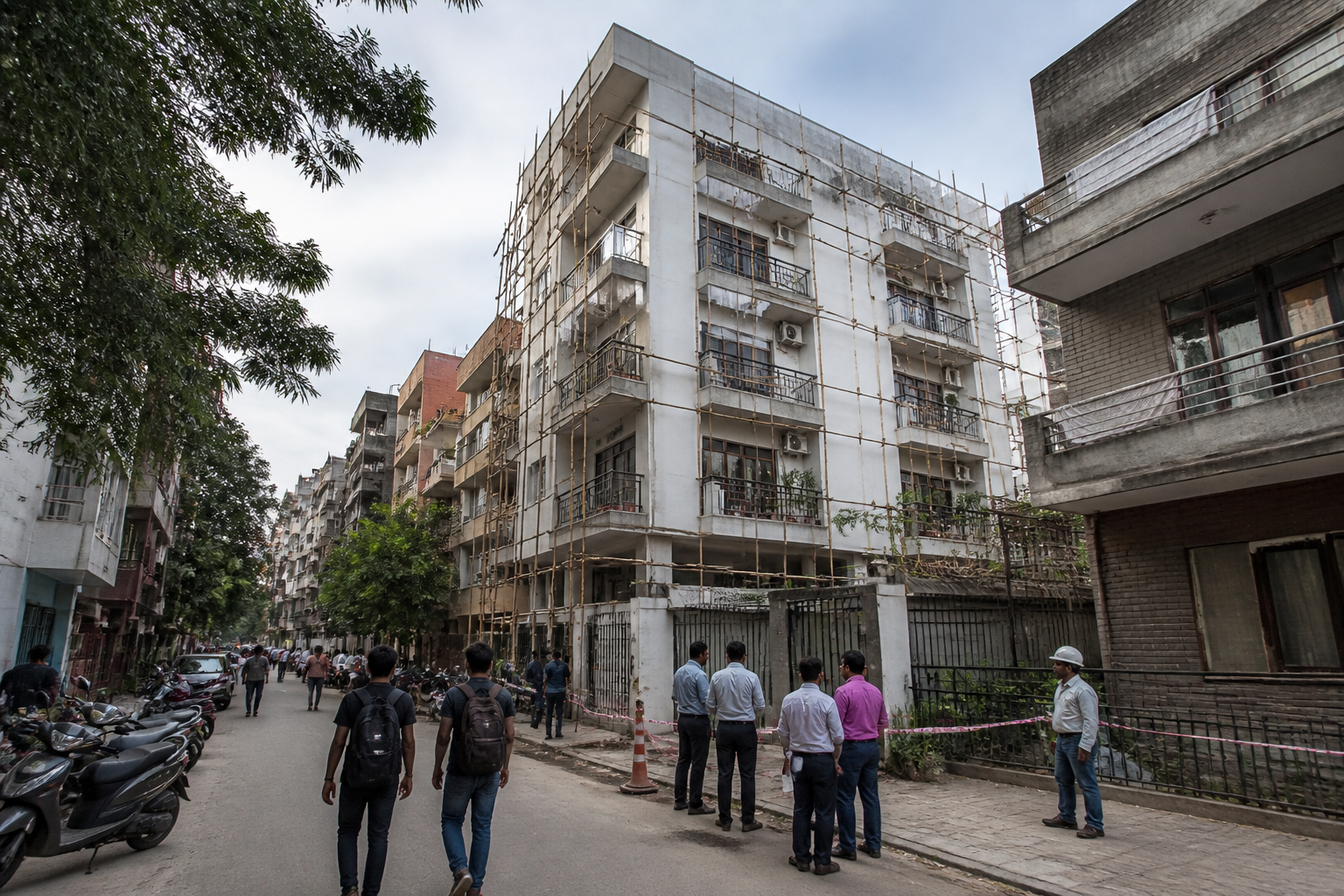
The Delhi High Court’s observations on the Satya Niketan building collapse have shifted attention from a single construction accident to a wider failure in how the capital houses and protects students. The court said the collapse, which killed seven people including four students, was not an ordinary mishap and linked the deaths to what it described as the “callous and criminal conduct” of certain persons.
The building, a multi-storey boys’ paying-guest accommodation near Delhi University’s South Campus, collapsed on September 6 while repair work was under way. Several people were injured. The court’s remarks, reported by Millennium Post, came while hearing a public interest litigation seeking an independent probe, inspections of paying-guest facilities, and compensation and rehabilitation for victims and their families.
The significance of the proceedings lies in the court’s decision to place the collapse within Delhi’s long-running student-housing problem. Students come to the capital from across the country for higher education, but the city’s formal hostel capacity has not kept pace with that demand, according to the observations recorded in the report. As a result, many students depend on private paying-guest accommodation and other forms of rental housing whose safety, construction condition and regulatory status can vary considerably.
The bench of Chief Justice D K Upadhyaya and Justice Tejas Karia noted that the four students who died had come from small towns with hopes of building careers in Delhi. The court said those hopes were “shattered” by the conduct of those responsible. The remarks are significant because they identify the victims not only as occupants of a failed structure but also as young people navigating a housing market shaped by limited institutional accommodation.
The court also rejected the idea that the shortage of student housing was a recent development. It observed that the lack of hostels had persisted for 20 to 25 years, during which students had continued to flock to Delhi for higher education. That long time frame raises a question about the division of responsibility between universities, the government, municipal authorities and private accommodation operators.
The immediate regulatory responsibility for buildings and local construction activity is not held by a single institution. The report refers to the role of the Municipal Corporation of Delhi and other authorities in regulating paying-guest facilities. It also records that the court had earlier ordered a high-level MCD inquiry and said the government could not evade responsibility. The case therefore concerns not only the legality of the repair work under way when the building collapsed, but also whether existing systems were capable of identifying unsafe accommodation before lives were lost.
The distinction matters. A post-collapse inquiry can establish what happened at one building, identify violations and examine individual responsibility. But the court’s concern about paying-guest accommodation points to a wider administrative task: locating such facilities, inspecting them, checking their structural and occupancy conditions, and ensuring that corrective action is actually completed. The PIL specifically seeks inspection of paying-guest properties, indicating that the safety question extends beyond Satya Niketan.
Additional Solicitor General Chetan Sharma told the bench that authorities had taken several steps after the incident. These included proactive mapping and earmarking of land and other facilities for students. The statement suggests that the government response is being framed around both immediate safety measures and the longer-term shortage of student accommodation. The supplied report, however, does not provide details of the mapped properties, the number of facilities involved, the inspection schedule or the funding arrangements.
That absence of detail is important to the policy discussion. Mapping can help authorities identify where students are living and which accommodation providers fall within the regulatory system. It does not, by itself, establish that buildings are safe or that violations have been corrected. Similarly, earmarking land for student facilities may address supply over time, but it does not resolve the condition of existing paying-guest buildings where students currently live.
The court’s comments also expose the relationship between housing supply and safety. When formal hostels are inadequate, students are pushed towards private rooms, paying-guest arrangements and other accommodation close to educational institutions. The report does not quantify Delhi’s hostel deficit or the number of students living in private facilities. It does, however, record the court’s view that the shortage has been known for decades. This makes student accommodation a governance issue rather than simply a matter of individual housing choice.
The Satya Niketan collapse further shows how repair work can become a critical safety point. The building came down while repairs were under way, but the supplied report does not establish what work was being carried out, whether approvals had been obtained, whether a structural assessment had been conducted, or whether any authority had issued warnings before the collapse. Those questions are central to the investigation and cannot be settled by the court’s observations alone.
They also illustrate the limits of routine building regulation when applied to dense urban rental accommodation. A paying-guest facility may function as a commercial housing operation even when it is not perceived by residents as a conventional hostel. Its occupants may be students and young workers, while its management, ownership and regulatory classification may involve different agencies. The report does not specify the legal classification of the Satya Niketan premises, but the litigation’s demand for inspections indicates that the status and oversight of such properties are part of the dispute.
The institutional response now has several strands. The MCD inquiry ordered after the collapse is expected to examine the incident. The Delhi High Court is hearing the PIL alongside another pending petition on September 25. The proceedings also involve demands for an independent probe, compensation and rehabilitation for victims and their families. The court’s earlier warning that the government could not evade responsibility places the administrative response under scrutiny beyond any action against private individuals.
For students and families, compensation and rehabilitation address the consequences of the collapse, while inspections and safer accommodation address the conditions that allowed the risk to exist. The report does not state whether a compensation framework has been finalised or whether rehabilitation measures have been implemented. It also does not identify the number of paying-guest facilities already inspected since the incident. These remain material questions for the next stage of the proceedings.
The case therefore brings together three connected failures: inadequate formal hostel capacity, uncertain oversight of private student accommodation and potentially unsafe construction or repair practices. Treating them separately could produce a narrow response. A building inquiry may determine responsibility for the collapse without resolving the shortage that continues to send students into privately managed facilities. Conversely, new hostel sites may be announced without addressing the safety of the rooms students occupy today.
The court has not concluded the proceedings, and its oral observations are not a final finding on liability. They nevertheless establish the central public-interest question: whether Delhi’s institutions have treated student housing as essential urban infrastructure or as a private market problem. The next indicators will be the findings of the MCD inquiry, the details of the authorities’ mapping and earmarking measures, the inspection of paying-guest facilities, and the court’s consideration of the petitions on September 25.
