


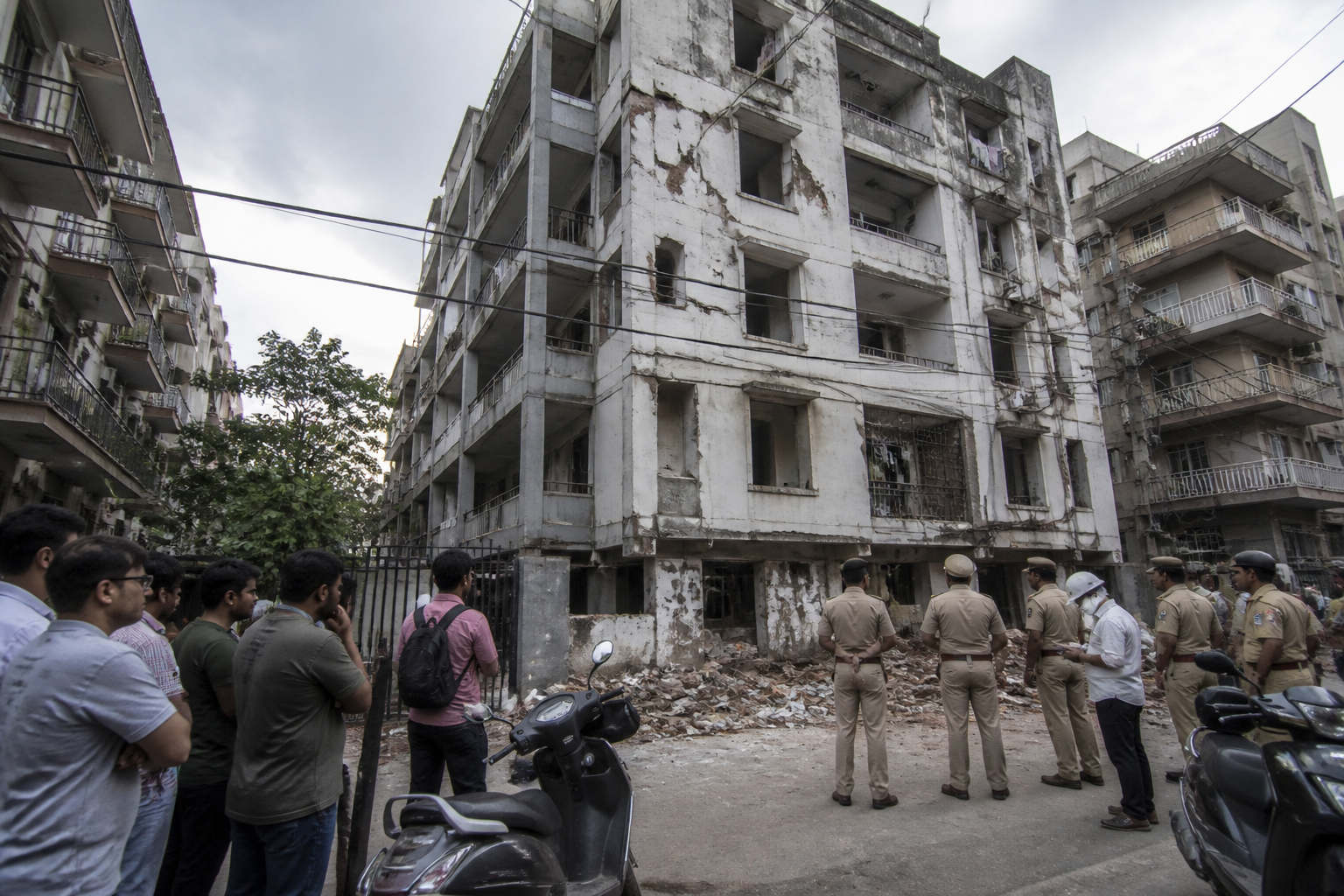
The Delhi High Court’s description of the Satya Niketan building collapse as the result of “criminal conduct” has shifted attention from one fatal incident to a larger failure in how the capital houses students. The collapse on Sept 6 killed seven people, including students, and the court’s observations linked the tragedy to inadequate hostel capacity, unsafe paying guest facilities and weak regulation by civic authorities.
The remarks were made while a bench of Chief Justice DK Upadhyaya and Justice Tejas Karia heard a fresh plea seeking an online platform showing the availability of hostels for students in Delhi. The petition may appear administrative in nature, but the hearing connected accommodation information to a more fundamental urban problem: students arriving in the capital for higher education often have limited access to housing that is both affordable and demonstrably safe.
The court said the deaths were not an “ordinary mishap”. It described the students as people who had come from small towns with “a lot of hopes and dreams” of building a life in Delhi, which were shattered by what it called the “callous and criminal conduct” of certain persons. The language was unusually direct, but it also identified the central institutional question raised by the collapse: whether authorities have treated student accommodation as a peripheral private-market issue rather than as part of the city’s essential housing infrastructure.
That distinction matters because students do not enter Delhi’s housing market as a single, organised group. They arrive at different times, search under pressure and often depend on hostels, paying guest arrangements or other forms of shared accommodation. The court noted that the shortage of hostel facilities was not a new phenomenon. Students have been coming to Delhi for higher education for the last 20 to 25 years, it said, yet the city’s formal accommodation systems have not kept pace with that continuing demand.
The hearing therefore placed two apparently separate issues on the same plane. One is information: students and families need to know where hostel beds are available. The other is institutional capacity: the city needs enough housing facilities, and those facilities must meet basic standards of safety and security. An online platform can address uncertainty about availability, but it cannot by itself create additional beds, certify building conditions or replace inspection and enforcement.
The Delhi High Court’s intervention followed its earlier direction for a high-level inquiry by the Municipal Corporation of Delhi into the Satya Niketan incident. The court had also said that the government could not evade responsibility. Its concern extended beyond the immediate cause of the collapse to inadequate housing facilities, including hostels run by Delhi University or the government, and the measures used by the MCD and other authorities to regulate paying guest facilities.
This is the administrative chain that the case brings into view. Student housing is not controlled by one institution alone. Universities and government bodies may operate or provide hostel facilities. Private owners and operators provide paying guest accommodation. The MCD and other authorities are responsible for aspects of regulation, inspection and enforcement. When responsibility is divided in this way, a gap between ownership, licensing, occupancy and structural safety can become difficult for residents to navigate.
The court’s comments do not establish, on the basis of the supplied report alone, every proximate cause of the Satya Niketan collapse or the responsibility of particular individuals. They do establish that the court sees the incident as connected to failures that extend beyond one building. The remarks also show that the legal process is examining whether the city’s systems were adequate to protect students living in accommodation that authorities knew, or should have known, formed part of Delhi’s education and housing ecosystem.
The proposed hostel availability platform is significant because it could make a fragmented market more visible. At present, the court hearing indicates that students face a problem in identifying available hostel accommodation. A central platform could provide a common point of information about facilities, subject to the details that authorities ultimately decide to include. But its effectiveness would depend on whether the information is current and whether the listed facilities have been checked for compliance with applicable safety requirements.
The court did not treat the platform as a standalone solution. The plea will be heard along with another pending petition on the issue on Sept 25, while the additional solicitor general, Chetan Sharma, told the bench that authorities had taken several steps. These included proactive mapping and earmarking of land and other facilities for students in Delhi. That response suggests that the administration is considering both immediate information gaps and the longer-term question of where student accommodation should be planned and located.
Proactive mapping can help authorities identify the scale and geography of the problem, but the supplied material does not specify the number of hostels, beds, paying guest establishments or unsafe buildings involved. Nor does it set out the standards that will govern the proposed platform or explain how frequently facilities will be inspected. Those missing details are important because an accommodation database can be useful only if it reflects actual availability and distinguishes between facilities that are merely present and those that are legally and physically fit for occupation.
The case also shows why student housing belongs within urban planning discussions. Students are not temporary visitors in any meaningful administrative sense. They stay in the city for extended periods, use transport and public services, and depend on neighbourhood-level infrastructure. If institutional hostels are insufficient, demand moves into private paying guest and rental markets. That movement can expand housing access, but it can also expose residents to buildings and arrangements that are not regulated with the same clarity as formal institutional accommodation.
The High Court’s reference to facilities run by Delhi University or the government is important in this context. It indicates that responsibility cannot be reduced to monitoring private operators alone. Public institutions are also part of the city’s student housing supply. Their capacity, location and safety arrangements influence how many students are pushed into informal or lightly regulated accommodation. The supplied report does not provide capacity figures, but the court’s observations make clear that the shortage has persisted over decades.
The structural question is therefore not simply whether Delhi needs an online hostel platform. It is whether the city has an integrated system for planning, supplying, regulating and monitoring housing for students. Such a system would require coordination between education institutions, civic authorities and the government. It would also require clear responsibility when buildings are used to accommodate students but fall outside effective inspection or enforcement.
The Satya Niketan collapse has made that question urgent because the consequences of administrative gaps are not limited to inconvenience or higher rents. The deaths have connected the availability of housing to the safety of housing. The court’s emphasis on the hopes of students who come to Delhi from small towns also places the issue in a wider social context: access to higher education depends partly on whether a city can provide secure places to live for those who do not have family housing in the capital.
What the proceedings currently confirm is that Delhi’s student accommodation problem is longstanding, that authorities have been asked to examine the Satya Niketan collapse at a high level, and that the court is considering an online platform alongside broader measures such as mapping and earmarking facilities. What remains unclear is how many students lack safe accommodation, how existing facilities are regulated and what enforcement action will follow the inquiry. The next significant development is the court’s hearing on Sept 25, when these institutional and safety questions are expected to return to the record.
