


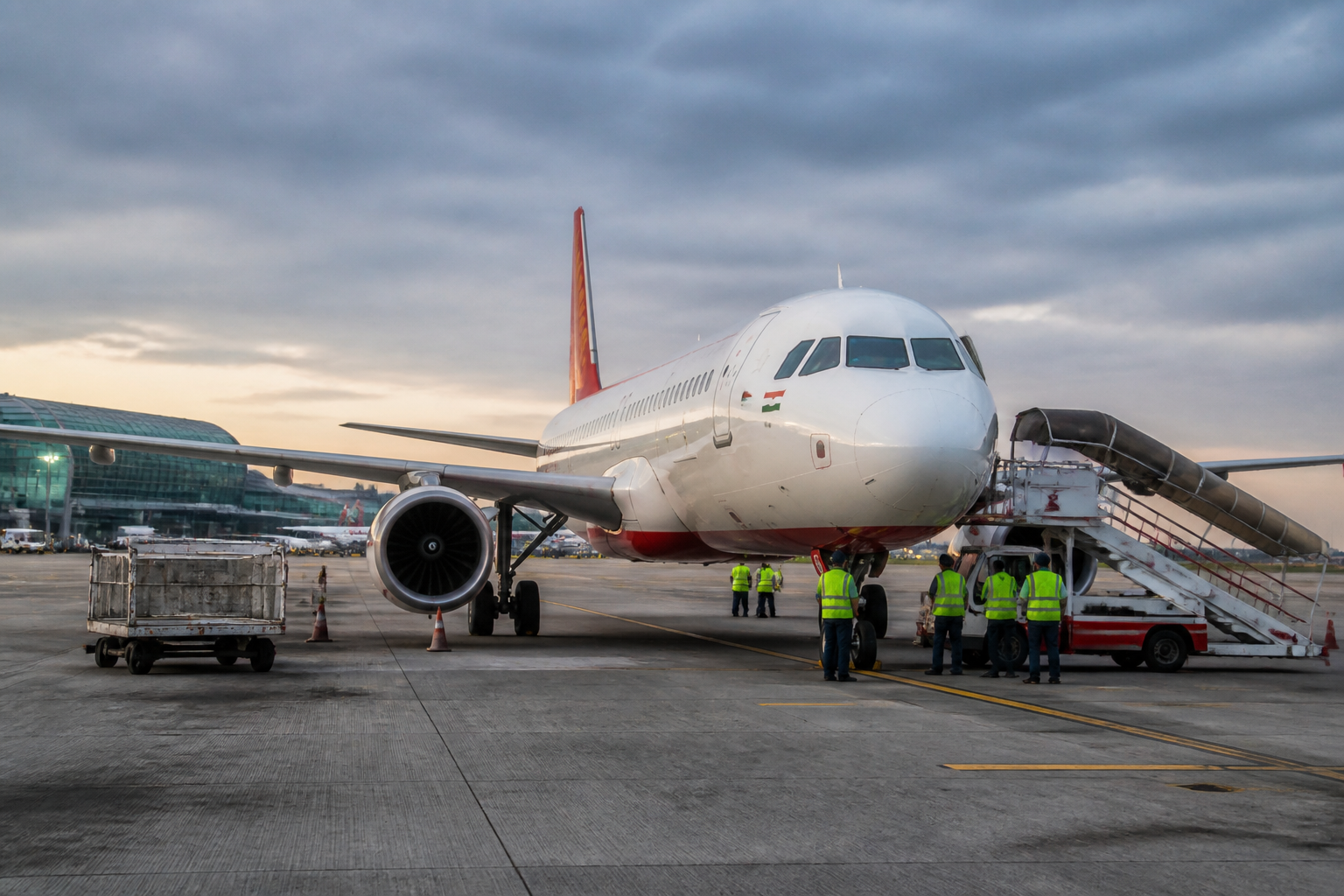
Air India’s consolidated loss of Rs 22,238.23 crore in the financial year ended March 2026 is more than a poor annual result. It is a measure of the cost and complexity of rebuilding an airline whose ownership, systems, fleet, workforce and operating environment are all undergoing change at the same time. The loss more than doubled from Rs 10,858.83 crore a year earlier, while consolidated total income fell from Rs 78,635.61 crore to Rs 71,869.94 crore.
The figures, reported by Moneycontrol citing PTI and regulatory filings, cover Air India and Air India Express. They show that the Tata Group-led turnaround is taking place under pressure from several directions: the fatal AI171 accident in June 2025, geopolitical disruptions, airspace closures, fuel-price volatility, operational difficulties and the continuing effort to replace legacy systems and processes.
The central urban question is not limited to whether Air India can return to profitability. Large airlines are part of the infrastructure that connects cities to one another and to international markets. Their financial health affects the reliability of air links, the functioning of airports, the movement of workers and businesses, and the ability of an aviation network to absorb shocks. Air India’s accounts therefore offer a view of the institutional strain behind the passenger experience.
The reported numbers show a company whose costs remained high even as income weakened. Consolidated total expenses rose to Rs 93,733.31 crore in 2025-26 from Rs 89,317.12 crore in the previous fiscal year. Aircraft repair and maintenance costs increased to Rs 14,976.45 crore from Rs 13,901.82 crore. Fuel expenses, by contrast, declined to Rs 26,871.80 crore from Rs 29,023.37 crore.
That combination matters because it indicates that the year’s pressure did not come from fuel alone. A lower fuel bill did not prevent a larger loss when repair and maintenance costs increased, income declined and foreign-exchange losses rose sharply. The foreign-exchange loss reached Rs 7,388.23 crore, compared with Rs 1,545.01 crore a year earlier. The filings do not establish that any single factor caused the overall deterioration, but they show how multiple operating and financial pressures accumulated in the same period.
The accident involving AI171 also appears in the company’s financial statements through exceptional items. Exceptional items stood at Rs 429.05 crore in 2025-26, including an amount related to the crash. Air India said the parent company had received the agreed amount from its insurer for the loss of the aircraft and related incidental costs under its hull insurance policy. The net impact after derecognition of the aircraft was presented as an exceptional item.
The company’s filing also said that, based on the information available at the time, management expected any financial liability arising from claims to be substantially covered by insurance. It stated that no material financial impact on the company’s reserves and losses was presently expected. That disclosure is important because it distinguishes the accounting treatment of the aircraft loss and related costs from the airline’s wider operating performance. Insurance coverage may address specified liabilities, but it does not remove the broader cost of disrupted operations, weaker revenue or the work required to rebuild systems and confidence.
The standalone figures reinforce the scale of the challenge inside the parent airline. Air India’s standalone loss widened to Rs 15,367.75 crore in 2025-26 from Rs 3,975.75 crore a year earlier. Standalone total income declined to Rs 53,662.15 crore from Rs 64,343.09 crore. The consolidated result is therefore not simply the outcome of combining two businesses with different performance profiles; the parent company itself reported a substantially weaker year.
The ownership structure adds another layer to the story. Air India is jointly owned by the Tatas and Singapore Airlines. Singapore Airlines Group reported a 57 per cent decline in net profit to SGD 1.184 billion, or nearly Rs 8,900 crore, for the same financial year. Its annual report attributed the decline mainly to the absence of a previous one-off accounting gain linked to the Vistara merger, as well as Air India’s losses. The group’s disclosures put Air India’s loss at more than SGD 3.56 billion, or over Rs 26,700 crore, based on the exchange rate used in the report.
These figures should not be read as a complete assessment of the turnaround’s eventual outcome. They describe one difficult financial year, not the full life cycle of the transformation. Tata Sons Chairman N Chandrasekaran wrote in the Tata Sons Annual Report for 2025-26 that Air India’s transformation should be viewed as a five- to ten-year journey. He cited years-long supply-chain disruptions in key components, the need to overhaul legacy systems, culture and fleet, and the creation of a large cadre of airline professionals.
That timeline changes how the latest loss should be understood. A short-term financial result can capture the cost of transition, but it cannot by itself establish whether the underlying restructuring is succeeding. At the same time, a long transformation horizon cannot make the financial deterioration irrelevant. The airline must fund the transition while continuing to operate a large network, maintain aircraft, manage disruptions and serve passengers. The tension between immediate operating demands and long-term rebuilding is visible in the accounts.
For cities, the institutional issue is significant. Air connectivity depends not only on runways, terminals and aircraft, but also on the organisational systems that make schedules, maintenance, safety, crew management and passenger handling work at scale. When an airline is attempting to change its systems and culture while dealing with fleet and supply-chain constraints, the pressure can surface through higher maintenance costs, operational disruption and weaker revenue. The supplied filings document the financial effects, while Chandrasekaran’s statement describes the internal transformation burden.
The arrival of a new chief executive is the next formal milestone in that process. Former Ethiopian Airlines Group chief Tewolde Gebremariam is scheduled to take charge as Air India’s managing director and chief executive later in September 2026. His appointment comes as the company confronts a widened loss, a decline in income, higher expenses and the stated need for a multi-year overhaul.
The evidence currently confirms three things. Air India’s losses increased sharply in FY26; the deterioration reflected a combination of lower income, higher total expenses, increased repair and maintenance costs, foreign-exchange losses and exceptional items; and the owners view the restructuring as a five- to ten-year project rather than a quick financial fix. What remains unresolved is how quickly the transformation can convert investment in systems, fleet, culture and people into improved operating performance. The next accounts and the actions taken under the incoming management will show whether the airline can reduce that gap.
