


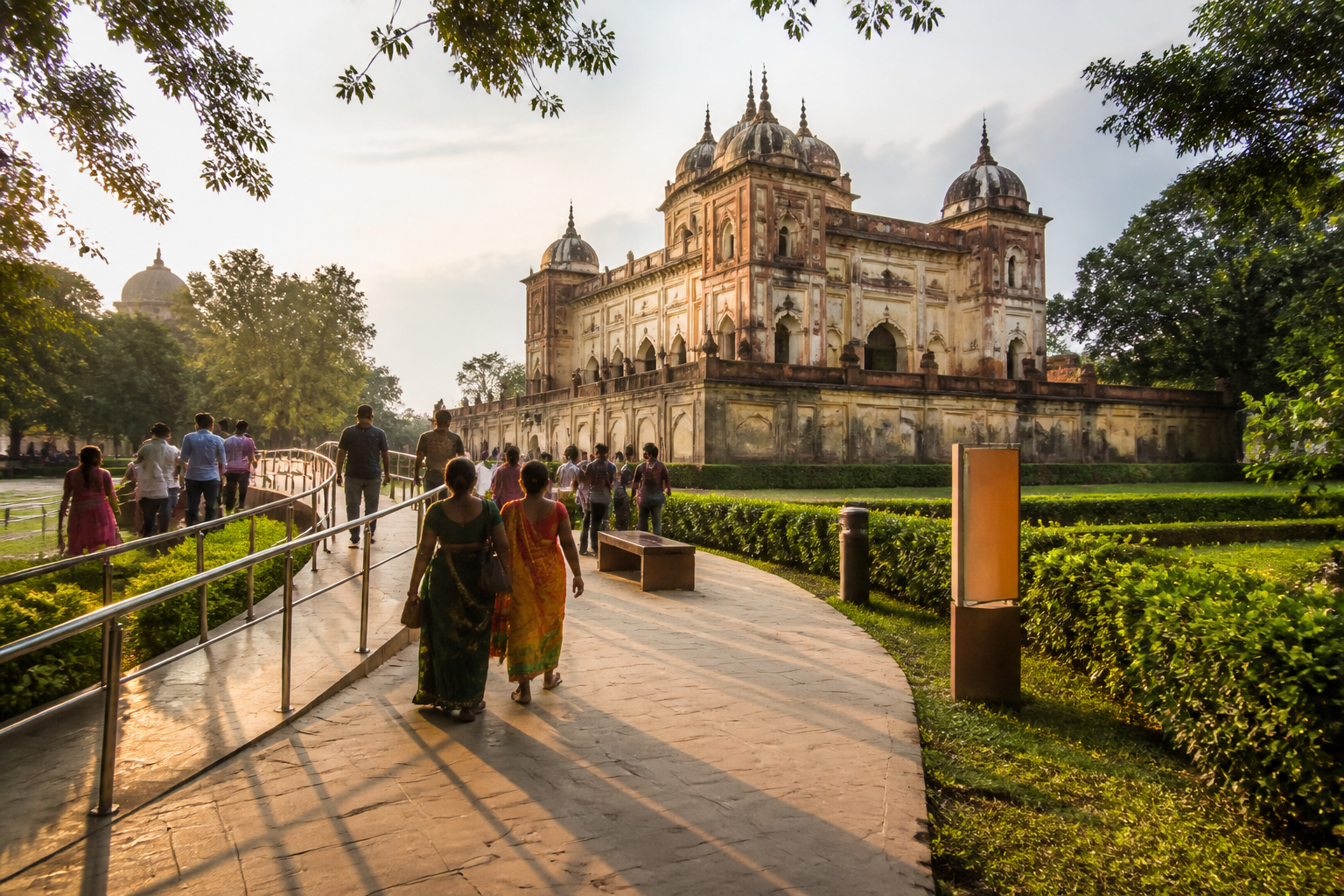
West Bengal’s proposal to bring 135 centrally protected monuments and historic sites into tourism circuits is more than a visitor-infrastructure plan. It is an attempt to solve a recurring urban and regional governance problem: how to make heritage sites accessible, economically useful and inclusive without allowing tourism infrastructure to damage the very architecture it is meant to showcase.
The tourism department announced its intention to sign a memorandum of understanding with the Archaeological Survey of India (ASI) at Udayachal Tourism Property, in the presence of Tourism Minister Shankar Ghosh, Minister of State Purnima Chakraborty, Tourism Secretary Barun Kumar Roy, ASI Director General Yaduvir Singh and Additional Director General Anil Tiwari. The proposed partnership would connect centrally protected sites across multiple districts to organised tourism circuits and support visitor-oriented infrastructure.
The sites identified for possible development are spread across Bishnupur, Murshidabad, Malda, Cooch Behar, Hooghly, Kolkata, Nadia, Purba Medinipur and Paschim Medinipur, among other districts. The geographical spread is important. It means the programme is not limited to a single heritage precinct or a city-centre redevelopment project. Its success would depend on coordinating conservation, visitor movement, local administration and tourism services across places with different histories, physical conditions and levels of connectivity.
The proposal includes landscaping, toilets, drinking water, pathways, seating areas, parking, CCTV surveillance, audio guides and souvenir shops at selected tourism destinations. Digital services, information boards and improved interpretation systems are also planned to explain the importance of the sites. These are basic services, but their absence often determines whether a protected monument functions as a public cultural asset or remains difficult to visit and understand.
The central policy challenge is that visitor infrastructure cannot be treated as a conventional construction exercise. The tourism department has said that the architectural character of the historic sites must not be affected. The ASI, meanwhile, would monitor the process to ensure that development complies with the Ancient Monuments and Archaeological Sites and Remains Act, 1958, and that the heritage features remain intact.
That division of responsibility places conservation controls at the heart of the proposed arrangement. The state government is expected to prepare development proposals, while the ASI would oversee whether the proposed works are compatible with the legal framework governing centrally protected monuments. A joint management committee comprising representatives of the state government and the ASI has also been proposed to supervise planning, development, maintenance and operations at selected sites.
The proposed committee matters because heritage tourism involves several functions that are usually divided between institutions. Conservation is primarily a specialist and regulatory responsibility. Visitor facilities involve public works and tourism administration. Parking, access routes, sanitation and surveillance require local coordination. Events and commercial activity require additional permissions. Without a shared management structure, these functions can develop separately, creating conflict between visitor demand and conservation requirements.
The financial model is similarly mixed. The proposal allows for central financial assistance, state government funding, corporate social responsibility contributions and public-private partnerships. Revenue-sharing from approved tourism and visitor-related activities has also been proposed, with the state’s share set at 70 per cent under the revised framework.
This arrangement indicates that the programme is being conceived not only as a conservation initiative but also as a revenue-generating tourism system. That can help create resources for maintenance and local services, but the supplied announcement does not specify the selection criteria for projects, the expected capital expenditure, the revenue-sharing obligations of private participants or the mechanism for ensuring that commercial activity remains compatible with protected-site rules. Those details will be important when the proposed partnership and individual project plans are formalised.
The use of public-private partnerships and CSR funding also raises an institutional question: who will remain responsible for long-term maintenance when the initial visitor facilities are built? Toilets, pathways, parking areas, digital systems and surveillance equipment require recurring expenditure. A heritage destination can deteriorate even when its main monument remains protected if supporting infrastructure is poorly maintained. The proposed joint management committee may provide an administrative platform, but its authority, staffing and funding arrangements have not been detailed in the announcement.
The planned tourism circuits could also redistribute visitor attention beyond the most established destinations. Bishnupur, Murshidabad, Malda, Cooch Behar, Hooghly, Kolkata, Nadia and the two Medinipur districts contain sites with different architectural traditions and historical associations. Connecting them through circuits may make it easier to present heritage as a network rather than as isolated monuments. However, the source material does not establish which sites will be selected first, how circuits will be designed or whether transport links between sites are already adequate.
That uncertainty is significant because a tourism circuit is not created simply by listing monuments together. It requires reliable movement between locations, information in usable formats, safe and accessible entry points, accommodation and food services, and coordination between local authorities. The proposal mentions pathways, parking, drinking water, toilets and digital interpretation at selected sites, but it does not provide a timetable for construction or identify the agencies responsible for wider transport and public-realm improvements.
Inclusion is one of the stronger elements of the proposed framework. The government plans to introduce ramps, tactile pathways and Braille-based systems to make tourism destinations more accessible. These measures shift the idea of heritage access away from simply opening a monument to visitors. They recognise that public access includes the ability to approach, move through and understand a site, including for visitors with disabilities.
The proposal to organise heritage festivals and cultural events outside the core protected area at suitable ASI-approved sites also reflects an attempt to separate cultural programming from the most sensitive conservation zones. The announcement says such events may be held outside the original protected area where appropriate approval is obtained. The precise operating conditions, capacity limits and approval procedures have not yet been provided, so the practical balance between public programming and site protection remains to be established.
The programme therefore combines four objectives: conserving protected heritage, improving basic visitor infrastructure, expanding tourism activity and supporting local economies and cultural work. These objectives can reinforce one another, but they can also compete. More visitors may increase revenue and local business opportunities while placing pressure on fragile structures, access routes and surrounding settlements. Better facilities can improve the visitor experience while altering the visual or physical character of a historic setting if they are poorly designed.
The proposed West Bengal heritage tourism framework will ultimately be judged less by the number of sites placed on a tourism map than by the quality of its institutional execution. The announcement establishes an intended partnership, a possible joint management structure, a mixed funding approach and a broad list of visitor facilities. It does not yet establish the final list of sites, project costs, implementation schedule, technical designs or operating responsibilities.
The next significant milestones will be the formalisation of the state–ASI memorandum, preparation of development proposals and decisions on which sites receive priority. Those steps will show whether the initiative becomes a coordinated conservation-led tourism programme or remains a collection of infrastructure proposals. Until then, the central urban and regional question is clear: can West Bengal improve access to its historic places while ensuring that tourism growth remains subordinate to the legal and physical requirements of heritage conservation?
