


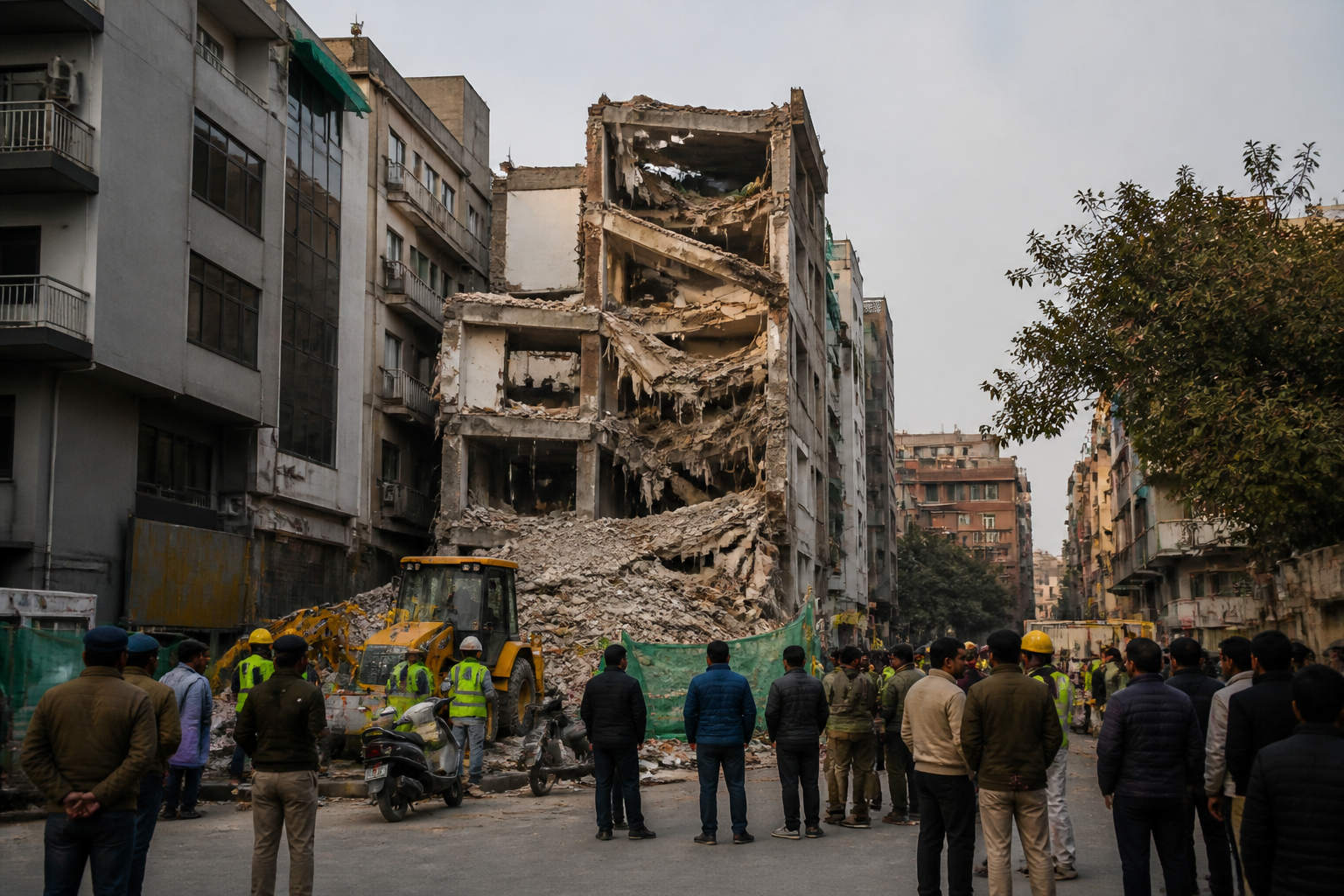
The Delhi High Court’s remarks on the Satya Niketan collapse have shifted attention from a single building failure to a wider urban problem: Delhi’s dependence on privately operated paying-guest accommodation for students without a sufficiently secure and regulated housing system. The court has linked the deaths not only to the conduct surrounding the collapse but also to the long-standing shortage of hostel facilities for students arriving in the capital from smaller towns.
Seven people, including four students, died when a multi-storey boys’ paying-guest building near Delhi University’s South Campus collapsed on September 6 while repair work was under way. Several others were injured. The Delhi High Court is now hearing a public interest litigation seeking an independent probe, inspections of paying-guest facilities, and compensation and rehabilitation for victims and their families.
The court’s oral observations are significant because they place the incident within a chain of institutional responsibilities. A bench of Chief Justice D K Upadhyaya and Justice Tejas Karia described the collapse as more than an ordinary mishap and attributed the deaths, in its remarks, to the “callous and criminal conduct” of certain persons. The bench also noted that the four students who died had come to Delhi from small towns with hopes of building careers.
That framing matters. A building collapse can be treated as an isolated failure of construction, maintenance or supervision. The High Court’s comments instead connect the immediate incident to the conditions that push students into informal or lightly regulated accommodation. The court observed that the shortage of hostels was not a new phenomenon and that students had been coming to Delhi for higher education for the last 20 to 25 years. The implication is not that every private accommodation facility is unsafe, but that the city’s housing arrangements for students have developed without an adequate institutional response to sustained demand.
This distinction is central to understanding the Satya Niketan collapse. The incident occurred in a building used as a paying-guest accommodation, while repair work was in progress. The supplied account does not establish the precise technical cause of the collapse, identify the alleged acts or omissions of individual persons, or record the findings of a completed investigation. Those questions remain subject to the high-level inquiry ordered by the court and to the proceedings before it.
What the case does establish is a governance gap that has been visible to the court for some time: students are arriving in Delhi in large numbers, but the availability and safety of formal hostel accommodation have not kept pace with that reality. The Additional Solicitor General, Chetan Sharma, told the court that authorities had taken several steps after the incident, including proactive mapping and earmarking of land and other facilities for students. The statement indicates that the government is responding through planning and identification measures, but it does not yet show how many facilities will be created, who will operate them, or when they will become available.
The court’s earlier intervention also points to the administrative complexity of the problem. On September 7, it ordered a high-level inquiry by the Municipal Corporation of Delhi and said the government could not evade responsibility. It also expressed concern over inadequate housing facilities, including hostels run by Delhi University or the government, student safety and security, and the measures used by the MCD and other authorities to regulate paying-guest facilities.
That list brings several institutions into the same frame. The MCD has a role in the regulation and inspection of buildings within the city, while universities and government agencies are responsible for providing or enabling student accommodation. The court proceedings also refer to private paying-guest facilities, which occupy the space between ordinary rental housing, hostel accommodation and commercial use. When responsibility is divided across these categories, an unsafe facility can remain part of a city’s housing supply without a clear, visible chain of accountability for residents.
The public interest litigation filed by Aakarshak Danveer Rathi seeks an independent investigation, inspection of all paying-guest facilities, and a compensation and rehabilitation scheme for affected families. These demands go beyond the individual building. A building-specific inquiry can establish what happened at Satya Niketan. A broader inspection programme would address whether similar risks exist in other paying-guest properties used by students. The source material does not indicate how many such facilities are operating in Delhi or how many have been inspected, so the scale of the regulatory challenge remains unquantified.
The absence of those numbers is itself relevant to the policy discussion. Authorities may announce mapping and earmarking of land, but mapping is not the same as housing capacity. A student housing response requires information on the number of students seeking accommodation, the capacity of existing university and government hostels, the location of private paying-guest facilities, and the safety status of those buildings. None of these figures is provided in the current account. Without them, it is difficult to assess whether official measures address the shortage or merely improve the visibility of a problem already known to administrators.
The court’s reference to a 20- to 25-year pattern makes clear that the issue is not confined to one admission cycle or one neighbourhood. Delhi’s higher-education system has long drawn students from across the country. When formal hostels do not provide enough beds, students turn to nearby private accommodation because proximity to campuses and transport is essential to their daily lives. The Satya Niketan location, near Delhi University’s South Campus, illustrates how student housing becomes embedded in the wider urban rental market.
That market can offer speed and proximity, but the court’s concerns show the limits of relying on it without effective regulation. Students and families may be able to assess rent, distance and basic amenities, but they may not be able to verify structural safety, the legality of alterations, the status of repair work or the adequacy of emergency arrangements. The supplied material does not establish that any particular safeguard failed at Satya Niketan. It does, however, show that the High Court considers the regulation of such facilities sufficiently inadequate to warrant inspections and continued judicial scrutiny.
The case also raises a question about how cities assign responsibility after an urban disaster. The High Court has criticised the inadequacy of measures employed by the MCD and other authorities to regulate paying-guest facilities, while the government has pointed to steps involving land and facilities for students. These are different parts of the same problem. One concerns the safety of existing accommodation; the other concerns the supply of alternatives. Improving one without the other may leave students dependent on private facilities while those facilities remain difficult to monitor.
The court’s decision to hear the Satya Niketan PIL along with another pending petition on September 25 may bring these questions into a common legal and administrative record. The next stage will be important because the outcome may clarify whether the response remains focused on the collapsed building or expands to cover inspections, hostel capacity, compensation and rehabilitation. It may also establish what information authorities must provide about the safety and regulation of student accommodation.
The evidence currently confirms three connected facts. Seven people died in a collapse at a student-oriented paying-guest building during repair work. The Delhi High Court considers the incident serious enough to reject the description of an ordinary mishap and has ordered scrutiny of institutional responsibility. And the court has connected the immediate tragedy to a long-standing shortage of hostel accommodation and inadequate regulation of paying-guest facilities in Delhi.
What remains uncertain is equally important: the technical cause of the collapse, the specific responsibility of individuals or agencies, the number and condition of comparable facilities, and the measurable capacity of the proposed housing response. The high-level MCD inquiry, the inspection process sought through the PIL, and the hearing scheduled for September 25 will determine whether the city’s response addresses those gaps or remains limited to the aftermath of one building failure.
