


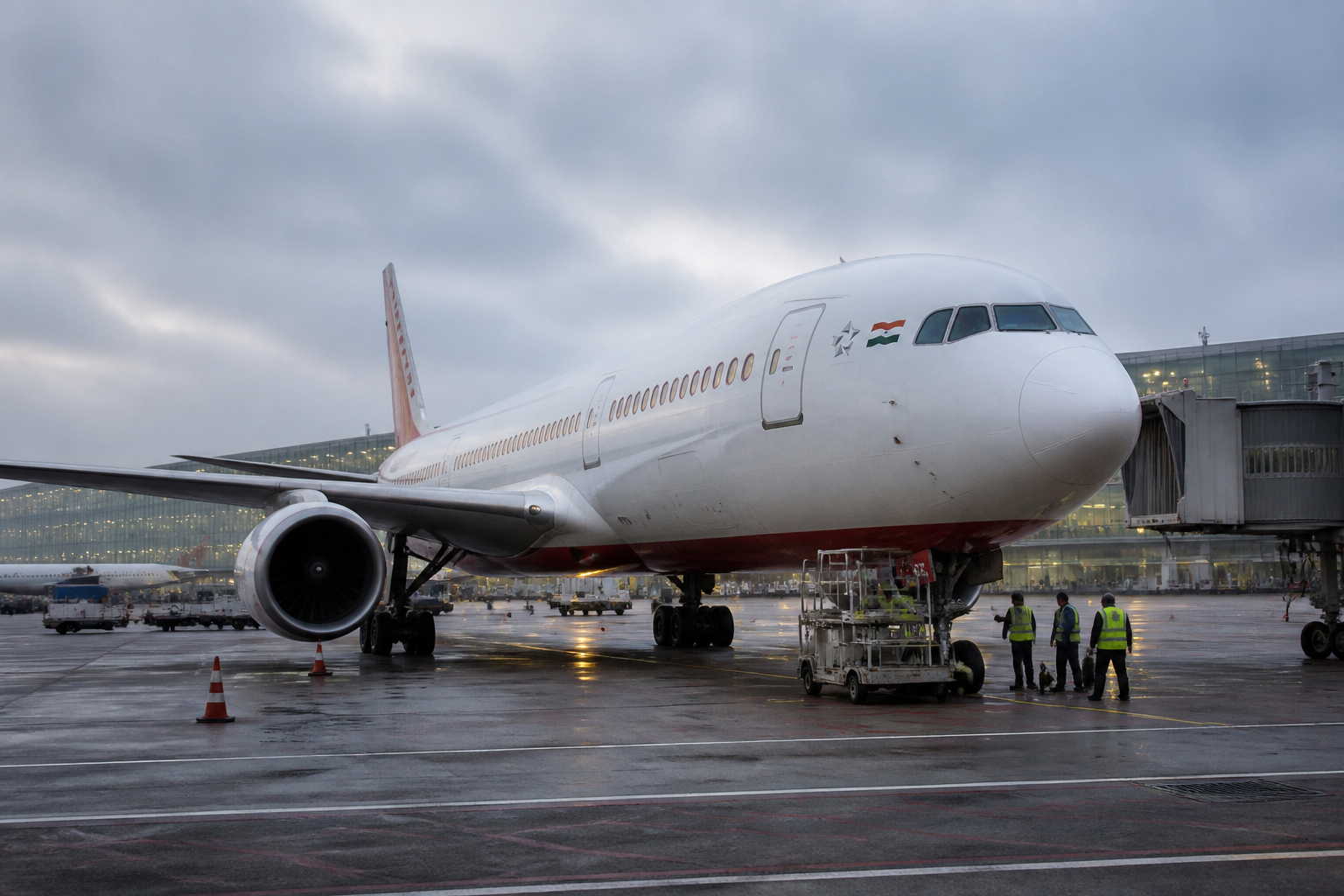
Air India’s consolidated loss widened to Rs 22,238.23 crore in the financial year ended March 2026, more than double the previous year’s Rs 10,858.83 crore. The figures, disclosed in regulatory filings accessed by PTI and reported by Economic Times, expose the financial strain behind the Tata Group-owned airline’s attempt to rebuild its fleet, systems, operating culture and professional capacity while managing a series of external disruptions.
The result is not simply a corporate earnings story. Air India occupies a central position in India’s international aviation network, and its financial condition affects the pace at which the country’s largest airline group can expand connectivity, renew aircraft, improve service reliability and absorb operational shocks. The filings show that the airline’s transformation is taking place alongside weaker income, higher expenses, a substantial increase in foreign exchange losses and the continuing financial consequences of a fatal accident.
The consolidated figures include Air India Express, making them a measure of the wider operating group rather than only the legacy Air India carrier. Consolidated total income fell to Rs 71,869.94 crore in FY26 from Rs 78,635.61 crore in FY25. At the same time, total expenses rose to Rs 93,733.31 crore from Rs 89,317.12 crore.
That combination is significant because it shows pressure on both sides of the airline’s financial structure. Revenue declined while costs increased, producing a wider operating gap. On a standalone basis, Air India’s loss rose to Rs 15,367.75 crore from Rs 3,975.75 crore. Standalone total income declined to Rs 53,662.15 crore from Rs 64,343.09 crore in the previous year.
The numbers also indicate that the deterioration was not driven by one cost category alone. Aircraft repair and maintenance expenses increased to Rs 14,976.45 crore from Rs 13,901.82 crore. Fuel expenses, by contrast, fell to Rs 26,871.80 crore from Rs 29,023.37 crore. The reduction in fuel costs was therefore not sufficient to offset the larger expense base and the fall in income.
The sharpest movement came in foreign exchange losses. These rose to Rs 7,388.23 crore in FY26 from Rs 1,545.01 crore a year earlier. For an airline with major aircraft, leasing, maintenance and other internationally linked obligations, currency exposure can materially affect reported performance. The filings establish the scale of the loss, but the supplied material does not provide a detailed breakdown of which individual foreign currency liabilities or transactions caused the increase.
This matters for the economics of aviation infrastructure because an airline’s ability to use airports, sustain routes and add capacity depends not only on passenger demand but also on the financial resilience of the carrier operating those routes. Aircraft are long-term assets, maintenance requirements are unavoidable, and international operations expose airlines to costs that are not entirely controlled by domestic revenue. A weak balance sheet can make a network expansion programme more difficult to execute even when the strategic case for more connectivity remains strong.
Air India’s current position is also shaped by a series of disruptions identified in the filings. The carrier has been dealing with the fatal Boeing AI171 accident in June 2025, which the source says killed 260 people, as well as geopolitical disruptions, airspace closures, fuel price volatility and other operational challenges. These events have placed pressure on an airline that was already pursuing a major institutional transformation after its acquisition by the Tata Group.
The accident has a financial dimension beyond the immediate operational and human consequences. According to the filings, the parent company is adequately covered under aviation hull and liability insurance policies. Air India has received the agreed amount from its insurer for the loss of the aircraft and related incidental costs under hull insurance. The net effect after derecognising the aircraft has been presented as an exceptional item.
Management stated in the filing that any financial liability arising from related claims is expected to be substantially covered by the parent company’s insurance policies. On that basis, it said no material financial impact on the company’s reserves and losses was presently expected. This is an important qualification to the headline loss: the filing identifies insurance as a mechanism intended to limit the longer-term effect of the aircraft loss and associated claims, although the consolidated result still reflects the broader pressures faced during the year.
The financial disclosures therefore point to two different timelines. The first is the immediate performance cycle, in which income, expenses, currency movements and maintenance costs determine the annual loss. The second is the longer transformation cycle, in which the airline is attempting to change legacy systems, fleet, organisational culture and managerial capabilities.
In a letter in the Tata Sons Annual Report for 2025-26, chairman N Chandrasekaran described Air India’s transformation as a five-to-10-year journey. He cited years-long supply chain disruptions affecting key components, the need to overhaul legacy systems and culture, fleet changes, and the creation of a large cadre of airline professionals. That framing places the FY26 loss within a longer corporate rebuilding process, but it does not remove the need to understand how much financial pressure the airline can absorb while that process continues.
The institutional challenge is especially large because the airline is managing several forms of change simultaneously. Fleet renewal requires capital and technical support. Legacy systems require replacement without disrupting daily operations. A larger professional workforce must be created while existing operations continue. Maintenance spending may rise during the period when aircraft and systems are being standardised or brought up to required operating conditions. The source material does not establish how much of FY26’s maintenance increase is directly attributable to any one transformation initiative, so that connection cannot be treated as proven.
The available data does, however, show that Air India’s cost structure remains exposed to factors beyond fuel prices. Fuel expenses declined by more than Rs 2,151 crore year on year, but maintenance costs increased by more than Rs 1,074 crore and foreign exchange losses rose by more than Rs 5,843 crore. Against this, consolidated income dropped by about Rs 6,766 crore while total expenses increased by about Rs 4,416 crore. The figures suggest that lower fuel expenditure alone cannot determine the airline’s financial trajectory.
For passengers and cities, the consequences of this financial position are indirect but important. Air connectivity is delivered through a network of aircraft, airports, maintenance systems, crews, schedules and route economics. When a carrier is trying to expand or rebuild that network, financial stress can affect the speed of fleet deployment, the flexibility available during disruptions and the resources available for service improvement. The supplied filings do not specify route cancellations, passenger effects or changes to airport operations, so those outcomes cannot be inferred from the loss figures alone.
The central question is therefore not whether one difficult year defines Air India’s transformation. It is whether the airline can convert a long-term rebuilding plan into a financially sustainable operating model while facing high maintenance requirements, currency exposure, supply chain constraints and disruption-related costs. FY26 provides evidence of the scale of the challenge, but not yet a complete measure of whether the transformation is succeeding.
What the filings confirm is that Air India’s consolidated loss widened sharply, income declined and expenses increased, even as fuel costs fell. They also show that management expects insurance policies to substantially cover liabilities connected with the AI171 accident. The next indicators will be the airline’s ability to improve income, manage foreign exchange exposure, control maintenance costs and progress with the multi-year overhaul of its fleet, systems and workforce.
