


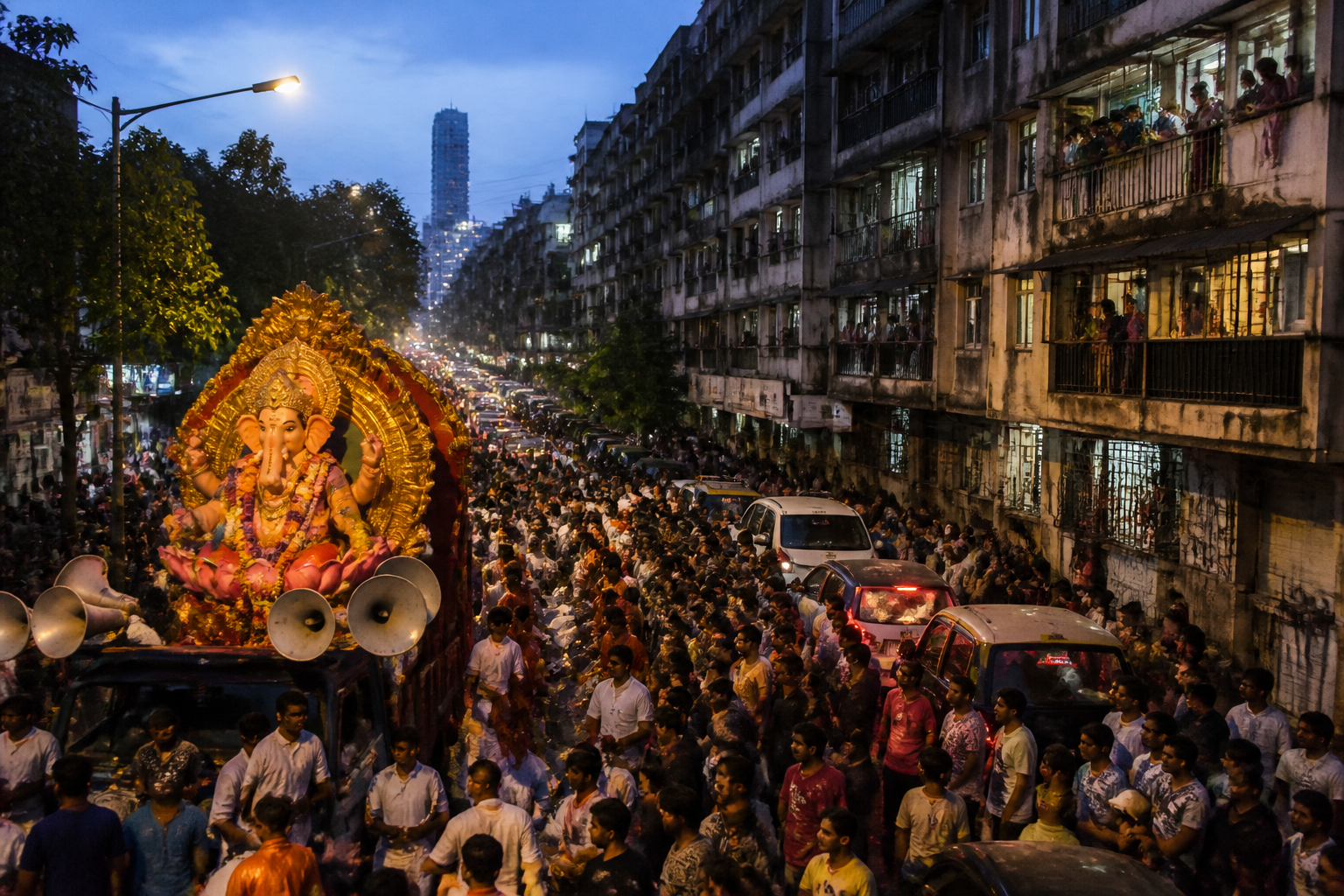
Mumbai’s Ganeshotsav noise debate is often framed as a contest between DJs and traditional dhol-tasha groups. The evidence presented by residents, activists, police and sound-system operators points to a more difficult urban problem: the law regulates the level, timing and location of sound, while public arguments continue to focus on the identity of the instrument producing it.
That distinction matters in a city where religious processions, residential neighbourhoods, traffic, commercial activity and public celebrations occupy the same streets. For residents living along procession routes, the issue is not simply whether a DJ is present. It is whether amplified sound or percussion remains within the limits prescribed for the area, whether it continues late into the night, and whether there is a credible system for responding when those limits are crossed.
The reported experience of Kandivli resident Sonu Gupta illustrates the problem at household level. Gupta, 48, said that Ganeshotsav had come to mean wearing noise-cancelling headphones and waiting for the sound to end. She reported ear pain and sound sensitivity over the past few years, while an audiography showed some deterioration in her hearing. She also said that even industry-grade noise-cancelling headphones provided little relief when dhols and DJs began playing.
Her account does not establish that festival sound caused the hearing deterioration. It does, however, show how a city-wide celebration can be experienced very differently by residents who live near venues or procession routes. For one group, amplified music and percussion are part of a public festival. For another, the same sound can enter homes, disrupt daily life and create a sense that private space is no longer protected during the celebration period.
Noise activist Sumaira Abdulali, who has campaigned on the issue for more than two decades, argues that the debate should move away from banning or defending particular instruments. Her position is that amplification and decibel levels are the relevant questions. She said the issue was not whether a DJ or traditional instruments were being used, but the level of sound reaching residents. She also called for loudspeakers to be restricted rather than treating individual musical forms as the problem.
The numbers included in the report explain why the distinction is important. The maximum permissible noise level in residential areas is 55 decibels during the day and 45 decibels at night. The reported levels for unamplified instruments are already high: a single dhol is listed at 98 to 104.5 decibels, a single tasha at 102 to 105.7 decibels, and a dhol-tasha troupe at 105 to 113.7 decibels. A brass band is listed at 90 to 100 decibels, while amplified DJs can reach 105 to more than 128 decibels.
These figures do not mean that every reading is taken at the same distance or under identical conditions. They do show why a simple cultural distinction between traditional and modern sound is inadequate for enforcement. A dhol-tasha group can generate substantial sound without electronic amplification, while a DJ system can push levels considerably higher through speakers. The relevant exposure for a resident depends on the sound reaching the location, the duration of the event and the time of day.
Abdulali also emphasises duration and intensity rather than treating a decibel reading as an isolated number. That is significant for neighbourhoods exposed to repeated processions or several venues operating at once. A resident may not be dealing with one short burst of sound, but with overlapping celebrations, traffic, honking, crowds and amplified music over several hours. The urban impact is therefore shaped by the pattern of activity around a home, not only by the equipment at one venue.
The police procedure described in the report is built around comparison. Officers assess complaints by comparing readings taken at the same location under normal conditions with readings recorded after a complaint. Teams maintain baseline readings for daytime and nighttime, as well as periods of heavier traffic, and compare them with the level measured when a complaint is received. The permissible limit also changes according to the time of day and the zone, including residential, commercial, industrial and silent areas.
That method recognises an important administrative reality: noise is not produced in a vacuum. Traffic, crowds and honking can raise the ambient level before a loudspeaker or procession is added. Establishing whether a violation has occurred requires personnel, equipment, a suitable comparison point and a record of the conditions at the time. It also requires enforcement teams to reach the location while the alleged excess sound is occurring, rather than relying only on later complaints.
The challenge becomes larger during Ganeshotsav because the number of sites is substantial. Nikhil Morye, joint secretary of the Brihanmumbai Sarvajanik Ganeshotsav Samanvay Samiti, said mandals must keep sound systems within legal limits but that monitoring more than 12,000 celebrations across the city is difficult. He also pointed to traffic, honking and crowds as factors that raise ambient noise.
This is the central enforcement gap exposed by the debate. Rules can specify different limits for different zones and times, but compliance depends on city-level capacity to monitor thousands of temporary events in changing street conditions. A legal limit is only as effective as the system that can measure it, identify the responsible operator, respond to a complaint and require a reduction or stoppage when necessary.
The problem is also one of coordination. Festival mandals, sound-system operators, procession organisers, residents and police operate within the same public space but do not experience the costs in the same way. Milind, who has run Om Sound & Lights since 2003, said excessive sound causes discomfort even to people working in the sound industry. He said his own shows stop at 10pm and argued that the difficulty lies less in the existence of rules than in making them clear and enforcing them consistently.
That response suggests that enforcement need not be understood only as a conflict between celebration and restriction. Sound-system operators have an operational interest in knowing what is permitted, when an event must end and how compliance will be assessed. Organisers also require clarity if they are expected to control equipment, coordinate with performers and respond to complaints. Without predictable enforcement, residents can see rules as ineffective while organisers can see complaints as inconsistent or difficult to interpret.
Dhol-tasha performers have resisted being singled out. Vaibhav Sahasrabuddhe, who has been part of a dhol-tasha group for 14 years, acknowledged that the instruments are loud but said their sound is softer than amplified DJ music. This defence is understandable within a debate that can quickly become a judgement on cultural authenticity. But it does not resolve the administrative question. If an unamplified troupe exceeds the applicable limit at a particular location, its traditional status cannot by itself determine whether the sound is permissible.
The reported accounts of Kiran Martis and other residents show the consequences when the issue is treated only as a seasonal disagreement. Martis, 69, said competing speakers and late-night DJs and drums during processions made her former neighbourhood unlivable, contributing to her decision to leave Mumbai. Abdulali also recalled cases involving an elderly man who threatened suicide because of procession noise affecting him and his mother, and a woman who experienced a severe psychological episode that she attributed to procession noise. These accounts are individual testimonies, not a city-wide measure of harm, but they illustrate the intensity of the conflict for vulnerable residents.
The reluctance of residents to complain adds another layer. Abdulali said some people fear confrontation with organisers or neighbours. Her suggestion that citizens document the time and location of excessive noise, use decibel-meter applications and approach the police creates a possible route for collective reporting. However, app readings may be disputed, and she acknowledged that residents can ask authorities to take an official measurement. The gap between citizen documentation and legally actionable measurement remains important.
Mumbai’s noise debate therefore raises a broader question about how the city manages temporary, high-intensity uses of public space. Ganeshotsav celebrations are not confined to isolated venues; they interact with streets, homes, traffic corridors and neighbourhood sound environments. The same city must accommodate public expression while protecting residents from exposure that exceeds applicable limits. That requires enforcement to focus on measurable conditions rather than on whether a sound is labelled traditional or commercial.
The evidence in the report confirms three points. Residential noise limits are defined by time and zone, not by whether the source is a DJ, dhol-tasha group or another instrument. Sound levels can vary greatly across instruments and amplified systems. And implementation is difficult when thousands of celebrations operate amid traffic, crowds and overlapping sources of noise.
What remains unresolved is whether the city’s monitoring and complaint-response capacity is sufficient for that scale. The next test will not be the outcome of the argument over DJs alone, but whether mandals, sound operators, police and residents can operate within a system that measures sound consistently and acts when the prescribed limits are exceeded.
