


The resolution of an alleged land dispute in Bhayander after a single meeting at Maharashtra’s Mantralaya has brought an uncomfortable feature of urban governance into view: the difference between having a formal administrative route and being able to make that route work. According to a Times of India report, 81-year-old Asgar Ali Vora pursued the matter through government offices for nearly 15 years before a meeting convened after he raised it with Prime Minister Narendra Modi produced a settlement involving the disputed plot, construction permission and a police complaint.
Vora had purchased around 2,810 square metres of land at Navghar in Bhayander East in 1989. He said that the plot was taken over in 2011 by Swayam Builders and Seven Eleven Constructions, a firm owned by BJP MLA Narendra Mehta. The report does not independently establish the underlying title or possession claims. It records Vora’s account, the subsequent administrative meeting and written actions by Mehta that the parties treated as a settlement.
That distinction matters. A settlement reached in an administrative meeting is not the same as a judicial determination of ownership. Nor does the reported surrender of construction permission, by itself, establish the history of the land title. What the episode does establish, on the evidence supplied, is that a dispute involving private land, a construction firm, town planning authorities, a municipal corporation and the police remained unresolved through ordinary official channels for a prolonged period before senior-level intervention brought the relevant actors into the same room.
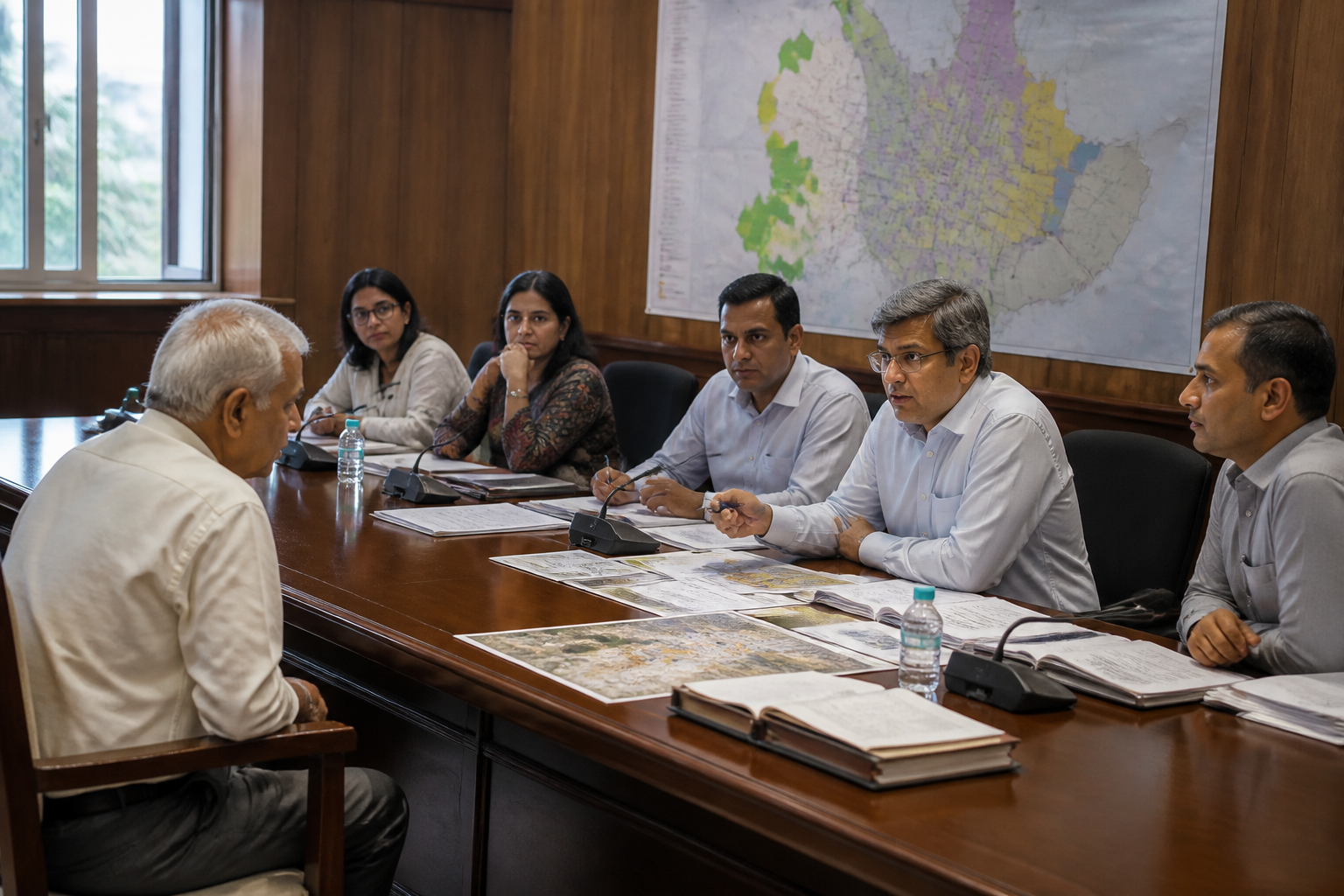
The sequence is unusually revealing. Vora met Modi on September 8 and raised the dispute with him, seeking intervention. The Times of India had earlier reported on Vora’s complaint and that meeting on September 13. Days later, a meeting was convened at Mantralaya by Shrikar Pardeshi, principal secretary to the chief minister. Vora, Mehta, Mira-Bhayander municipal commissioner Radha Binod Sharma and town planner Purushottam Shinde attended the sitting.
The participants matter because the dispute crossed several administrative boundaries. The municipal commissioner represented the local urban administration, while the town planner was connected to the planning and construction-permission side of the matter. The presence of the principal secretary brought the issue to the state secretariat. Mehta’s participation represented the private party identified in the report. Bringing these actors together allowed the question to be addressed as a single administrative problem rather than as a series of separate applications moving between offices.
The reported outcome was specific. Mehta submitted a letter to the town planning department stating that he was giving up possession of the disputed land and surrendering the construction permission granted to him. In a separate letter to the police commissioner, he said he was withdrawing an earlier complaint against Vora and that the two sides had reached a settlement. The report says the entire dispute was resolved in that one sitting, after almost 15 years of attempts by Vora to pursue it through government authorities.
This is where the episode becomes relevant to the wider built environment. Urban land disputes are rarely confined to a private disagreement between two parties. Once construction permission, development activity, municipal records and police complaints enter the picture, the dispute can affect the use of land, the legality of construction, the responsibilities of public authorities and the security of people claiming an interest in the property. A prolonged unresolved dispute can also leave planning decisions and enforcement actions suspended between institutions.
The case, as reported, shows the administrative cost of fragmentation. Vora moved through “various government authorities” for years, but the supplied account does not identify every office he approached, the precise orders or applications that were filed, or the reason those efforts did not resolve the matter. That missing detail prevents a definitive conclusion about whether the delay resulted from conflicting records, procedural gaps, disputed title, lack of coordination, political influence or another factor. It does, however, leave a clear question about how a matter that had remained pending for so long could be addressed only after escalation to the highest political level.
The contrast between the two phases is central. Before the Mantralaya meeting, the process was dispersed across offices and had produced no resolution for nearly 15 years. After the meeting, the parties recorded consequential decisions in writing: possession was to be given up, construction permission was to be surrendered and an earlier police complaint was to be withdrawn. The available report does not say that a new legal order was issued, nor does it describe a formal adjudication by a court or a land-record authority. The resolution therefore appears, on the supplied evidence, to have been driven by a negotiated settlement supported by administrative coordination.
That distinction also identifies the limits of the episode as a model for public administration. A meeting can coordinate agencies and parties when the participants are present and willing to settle. It cannot automatically resolve questions that require title verification, statutory orders, record correction or judicial determination. The report does not specify whether those further steps remain necessary in this case. It also does not state whether the land records have been changed, whether any construction had taken place, or how the surrendered permission will be formally cancelled in the planning system.
For citizens, the most consequential feature may be the apparent relationship between access and speed. The report says that Vora’s case moved rapidly after he met an old schoolmate who was now the Prime Minister. That does not establish that the intervention was legally required or that officials had acted improperly earlier. It does show how a citizen’s ability to reach a powerful intermediary can alter the administrative attention given to a long-pending matter. The resulting perception problem is straightforward: if a dispute can be convened and settled in one sitting after direct access to political authority, people may reasonably ask why the existing grievance channels did not produce a comparable response.
The supplied material does not provide enough evidence to compare Vora’s case with other land disputes in Maharashtra or to establish whether this was an isolated failure or part of a wider pattern. It contains no statistics on pending land complaints, average resolution times, construction-permission disputes or municipal grievance performance. Any broader claim about the state’s land administration would therefore go beyond the evidence available here. The defensible conclusion is narrower but still important: this individual case exposes a gap between the formal existence of government offices and the practical ability of a citizen to obtain coordinated action from them.
The urban planning dimension is equally significant. Construction permission is not merely a private document; it is an administrative decision connected to land use and development control. When a party surrenders such permission following a settlement, the responsible planning authority must have a clear record of what has been withdrawn, what remains valid and what actions, if any, are required on the land. The report identifies the town planning department as the recipient of Mehta’s letter but does not describe the department’s subsequent order. That is an important unresolved administrative detail.
The police component raises a parallel issue. Mehta’s separate letter to the police commissioner reportedly withdrew an earlier complaint against Vora because the two sides had settled. The report does not provide the complaint number, the nature of the allegations or the police commissioner’s response. A withdrawal request and the formal closure of a police matter are not necessarily identical processes. The available account establishes the reported request, but not the final procedural status of the complaint.
The episode therefore contains two stories. The first is a personal account of an elderly landowner who says he spent nearly 15 years seeking action and eventually secured a settlement. The second is an institutional account of how a land dispute travelled across local government, town planning, police and state-secretariat channels before being resolved through a single coordinated meeting. The first explains the human stakes. The second explains why the case matters to cities.
What the evidence confirms is that Vora purchased the plot in 1989, pursued a dispute connected to it for nearly 15 years, met Modi on September 8, and participated in a Mantralaya meeting attended by senior officials and the other party. It also confirms, according to the report, that Mehta wrote to the town planning department about surrendering possession and construction permission and separately wrote to the police commissioner about withdrawing his complaint. What remains unclear is the documentary history of the title, the precise administrative failures during the preceding years and the formal implementation of each part of the settlement.
Those next steps are more important than the symbolism of the meeting. The final position of the land in municipal and planning records, the status of the construction permission, and the formal action on the police complaint will determine whether the settlement has been fully implemented or has only created an agreement between the parties. Until those details are documented, the Bhayander case remains both a reported resolution and a warning about how uneven access to administrative attention can shape the experience of urban governance.
