


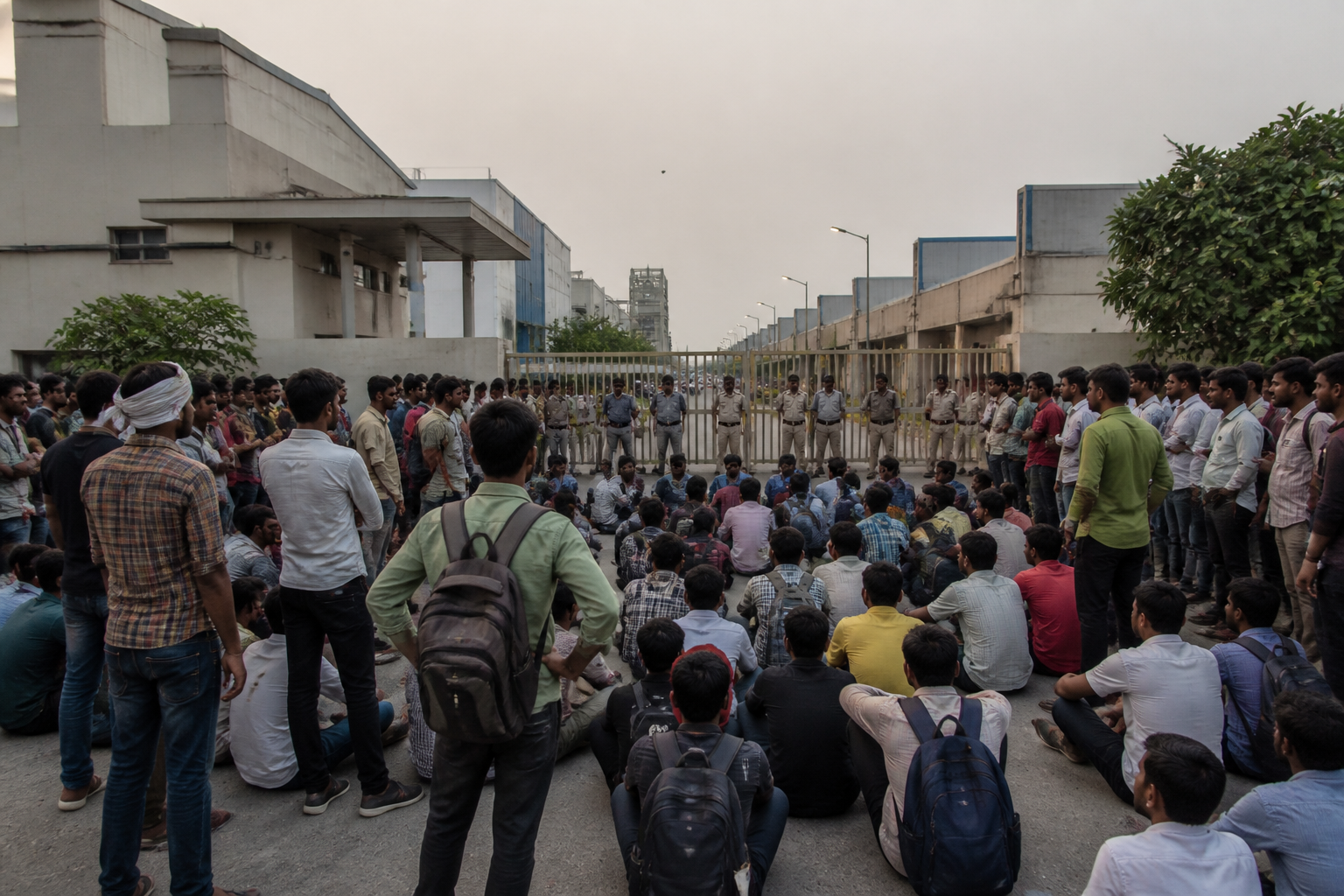
A Gurugram sessions court’s decision to grant bail to engineer Aditya Anand in the Manesar labour protest case has brought a central question in industrial-city governance into focus: when does organising workers around wages remain protected democratic activity, and when can investigators treat it as participation in criminal violence?
The court’s order, as reported by The Indian Express, did not decide the full case against Anand. It held that keeping him in custody would serve no useful purpose when the prosecution material placed before the court did not, prima facie, establish his complicity. The judge noted that there was no CCTV footage or photograph showing Anand at the protest site, that he was not part of the protesting workers’ WhatsApp group, that no incriminating messages linking him to co-accused had been found, and that his mobile phone had not been seized during the investigation.
The ruling is significant because it separates two issues that often become merged during industrial unrest. The first is whether a protest or wage campaign is legally permissible. The second is whether particular individuals can be connected, through admissible and corroborated evidence, to violence or conspiracy alleged to have occurred during that protest. The court’s observations address the first issue in broad constitutional terms while applying the second to the evidence against Anand.
The Manesar case stems from violence during a workers’ protest at Richa Global Exports in IMT Manesar on April 9. FIRs registered at the Industrial Sector 7 Manesar police station invoked multiple provisions of the Bharatiya Nyaya Sanhita, including attempt to murder, rioting, assault and criminal conspiracy, along with Section 3 of the Prevention of Damage to Public Property Act. The seriousness of those charges explains why the evidentiary question is central: the allegations involve major offences, but the court must still assess the specific material connecting each accused person to them.
The court recorded that police relied partly on mobile-phone tower location data, which allegedly placed Anand near the protest site between April 7 and 9. But the judge observed that tower location data, without independent corroboration, could not establish complicity. The prosecution, according to the report, also conceded that there was no visual evidence placing Anand at the site. The order therefore illustrates the limits of treating technical proximity as proof of participation in a criminal act.
That distinction has particular importance in industrial areas such as Manesar, where workplaces, worker settlements, transport routes and labour networks exist in close proximity. A person may be geographically near a protest without being part of the alleged violence. In this case, the court’s reasoning indicates that proximity had to be supported by other evidence before it could justify continued detention.
The court also addressed the nature of the underlying labour demand. It observed that raising demands for higher wages and democratically mobilising workers to seek salary increases because of rising living costs were not offences in themselves. The order referred to the constitutional right to freedom of speech and expression and questioned how informing workers of their rights and encouraging them to raise their voices for higher wages through a democratic demonstration could itself constitute an offence.
This does not mean the court treated every action connected to the protest as lawful. The order expressly left open the question of whether the April 9 incident resulted from an alleged conspiracy or from other forces, stating that this would be decided at trial. The distinction is important: a lawful objective does not automatically legalise violence, but an unlawful incident does not automatically prove that every person associated with the broader labour campaign participated in it.
The case also shows how the timing and sequence of arrests can shape the legal process. Anand, a 28-year-old NIT Jamshedpur engineering graduate who worked as a Java developer at Genpact, was already in judicial custody in Uttar Pradesh in connection with a separate case concerning labour agitation in Noida. Gurugram Police arrested him in the Manesar case on June 5 on a production warrant while he was lodged in Luksar Jail in Gautam Buddha Nagar.
The production-warrant procedure allowed police to formally arrest him in the Manesar case even though he was already in custody in another matter. That sequence does not determine guilt, but it means that the question of continued detention can span multiple cases and jurisdictions. The court’s bail order therefore has to be read alongside the separate Noida proceedings rather than as a final resolution of all allegations against Anand.
The order was also part of a wider sequence of bail decisions arising from the Manesar labour unrest. The Indian Express reported that Additional Sessions Judge Dr Gagan Geet Kaur had similarly observed in an order dated May 18, while granting bail to accused Ajit Singh, that demanding higher wages was not an offence. The repeated appearance of this issue suggests that the courts are being asked to distinguish the legitimacy of wage advocacy from allegations about specific acts during the protest.
The prosecution position, as reported, was materially different. Police had earlier submitted an affidavit before the Supreme Court through Assistant Commissioner of Police (Crime) Lalit Dalal, alleging that Anand had played an active role and conspired to incite workers to attack company management and police with an intention to kill. Anand strongly denied those allegations in a statement annexed to the status report and alleged that investigating agencies had framed him because of his association with the labour advocacy group Mazdoor Bigul.
These competing accounts show why the court’s focus on corroboration matters. Police allegations and an accused person’s denial establish the positions of the parties, not the final facts. The bail court’s task, as reflected in the order, was narrower: to determine whether the material presented justified keeping Anand behind bars pending trial. Its conclusion was that the available evidence did not show a prima facie incriminating case strong enough to make further custody useful.
The institutional issue extends beyond one accused or one factory. Industrial disputes are managed through several overlapping systems: company-level negotiations, labour mobilisation, police intervention, criminal investigation and judicial review. When a wage protest becomes associated with violence, the criminal-law response can quickly become the dominant institutional action. The court’s observations serve as a reminder that this response must still identify individual conduct rather than rely only on association, ideology or location.
The facts recorded in the order also raise questions about the evidentiary balance between digital investigation and physical proof. Call-detail records and tower-location data can establish that a phone was in a particular broad area, but the court found that such data alone did not show that Anand took part in violence or conspiracy. In the absence of CCTV footage, photographs, messages or a seized device, the prosecution case against him faced a specific evidentiary gap at the bail stage.
That does not make digital evidence irrelevant. It establishes a threshold for how it may be used. Location data can become more probative when combined with messages, witness accounts, images, financial records or other material. The order, as reported, indicates that the court was unwilling to treat one category of circumstantial evidence as a substitute for independent corroboration.
For workers, employers and police in Manesar, the case also highlights the legal importance of separating collective demands from alleged criminal acts. Wage negotiations and demonstrations may be contentious, particularly when workers cite rising prices and living costs. But the court’s reasoning suggests that the existence of a contentious demand cannot, by itself, supply the missing evidence required to prosecute an individual for attempt to murder, rioting, assault or conspiracy.
At the same time, the court did not establish that the violence alleged in the Manesar case did not occur. Nor did it determine whether other accused persons were responsible. It stated that the question of conspiracy and the forces behind the April 9 incident would be a matter for trial. The bail order is therefore an assessment of custody and prima facie material, not an acquittal or a final finding on the incident.
The immediate next stage is the continuation of the underlying criminal proceedings and the separate legal process connected to the Noida workers’ protest case. The allegations made in police filings, Anand’s denials and the evidence relied upon by both sides will ultimately have to be tested through the trial process. For now, the Gurugram order establishes a narrower but consequential principle: lawful wage advocacy cannot be treated as criminal conduct without evidence of the specific unlawful acts alleged against an individual.
