


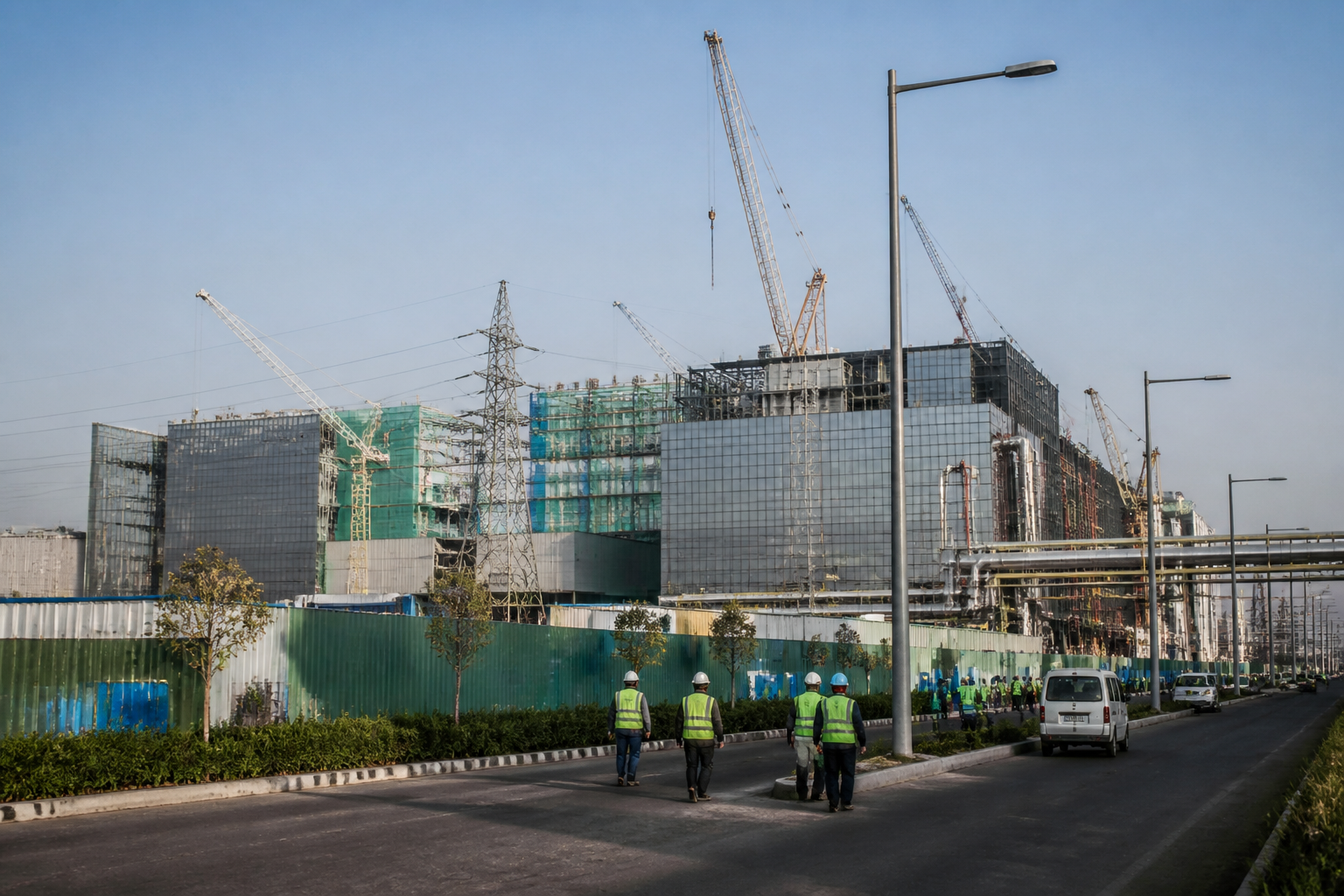
The approval of Uttar Pradesh’s Semiconductor Policy-2024 implementation proposal for Noida marks an attempt to turn Gautam Buddh Nagar from an established electronics and technology district into a larger manufacturing ecosystem. The policy identifies the district as Uttar Pradesh’s first semiconductor-focused district and offers incentives that could reshape how land, water, power, skills and industrial infrastructure are planned across Noida and the emerging Dadri-Noida-Ghaziabad Investment Region, or DNGIR.
The immediate policy promise is substantial. Companies investing in semiconductor-related manufacturing can receive financial incentives of up to 75 per cent for land parcels of up to 200 acres, according to the report. The policy also provides for support on land allocation, adequate water supply, uninterrupted electricity, patent assistance and workforce development. These provisions show that the proposal is not limited to attracting individual factories. It is designed around the wider infrastructure requirements of a capital-intensive industry.
That distinction matters because semiconductor manufacturing is not simply another category of industrial activity. It requires large, reliable and closely coordinated systems. Land must be available at a scale that is increasingly difficult to assemble within established Noida. Power supply must be continuous. Water availability must be planned in advance. Industrial authorities must also coordinate approvals, training and supporting services. The policy’s success will therefore depend not only on the size of the subsidy but on whether these urban systems can work together.
The reported approval by the infrastructure and industrial development commissioner of the proposal submitted by the Noida Authority creates an administrative basis for that coordination. It places the authority’s role within a broader state policy framework rather than treating semiconductor investment as an isolated land-allotment exercise. However, the supplied report does not establish how many companies have received final approvals, how much land has been allotted, or when production will begin. Those details will be important in assessing whether the policy has moved from an investment attraction measure to an operating industrial programme.
## Why the land question is moving towards New Noida
Noida’s limited land availability is already shaping the geography of the semiconductor plan. The report identifies New Noida, being developed under the DNGIR, as a potential location for semiconductor industries because large industrial parcels may be difficult to assemble within the existing authority area. This could make semiconductor policy one of the early forces influencing the economic purpose and infrastructure priorities of the new investment region.
The choice carries an important planning implication. If major manufacturing units are located beyond the established urban core, the success of the policy will depend on more than the availability of plots. Workers, suppliers, service providers and logistics operators will need access to the new industrial areas. The report does not provide a mobility plan, housing strategy or details of supporting urban services for the proposed expansion. That absence does not invalidate the policy, but it indicates that industrial investment and urban development will need to be planned together.
The semiconductor incentive is linked to land of up to 200 acres, a scale that can influence the shape of industrial districts. Large parcels can support integrated production and ancillary facilities, but they also create demands for roads, utility corridors, drainage, water networks and power infrastructure. In New Noida, the sequencing of these systems will determine whether the area develops as a connected industrial region or as a collection of projects dependent on infrastructure that arrives later.
## The policy is attempting to build an ecosystem, not only attract factories
Uttar Pradesh approved its Semiconductor Policy-2024 in January 2024, according to the report. The state became the fourth in India, after Gujarat, Odisha and Tamil Nadu, to introduce a dedicated semiconductor policy. Gautam Buddh Nagar was subsequently identified as the state’s first semiconductor-focused district.
The policy’s components indicate an effort to address several parts of the investment chain. Land and financial incentives are intended to reduce the initial cost of establishing industrial units. Water and power provisions address basic operational continuity. Patent assistance is meant to support research and innovation, while internships and specialised training at technical institutions are intended to create a workforce aligned with industry requirements.
The patent support is specified at up to ₹10 lakh for national patents and up to ₹20 lakh for international patents. These measures are significant because the semiconductor sector involves both manufacturing capacity and technological capability. Yet the available information does not indicate how many firms are expected to use the patent incentive, what institutions will deliver the training, or how the policy will measure the results of the internship programme. The implementation architecture will determine whether these incentives operate as a connected programme or as separate benefits.
The proposal also illustrates the number of public institutions involved. The Noida Authority is responsible for the local implementation proposal and industrial-area coordination. The state’s infrastructure and industrial development administration has approved that proposal. Technical institutions and the proposed chief minister’s internship programme are expected to contribute to workforce preparation. The policy will therefore require coordination between industrial land administration, utilities, education and economic development agencies.
## India’s demand story creates the pressure for local production
The report cites an estimate that India’s semiconductor market could reach approximately $110 billion by 2030. It also identifies Taiwan, China and the United States as major global semiconductor exporters. The policy is being advanced against this backdrop of rising domestic demand and the stated objective of reducing dependence on imports.
The $110-billion estimate is a market projection, not a measure of production already secured in Noida or Uttar Pradesh. It indicates the scale of the opportunity described by the policy, but it does not establish how much of that future demand can be met by facilities in Gautam Buddh Nagar. The difference between market growth and local manufacturing capacity is central to evaluating the plan.
For Noida, the more immediate question is how semiconductor investment will connect with its existing industrial base. The report says new chip-related industrial units are being encouraged in and around Noida, while the Noida Entrepreneurs Association expects investment to extend from the existing city towards New Noida. The report does not identify confirmed investors or quantify expected employment. It does, however, place the proposed expansion within a wider industrial geography rather than limiting it to the current Noida Authority area.
That geography could create both economic opportunities and administrative pressures. New manufacturing may generate direct jobs within factories and indirect work through suppliers and services, as the report notes. It may also increase demand for worker housing, commuting infrastructure, logistics facilities and civic services. Whether those effects are concentrated within Gautam Buddh Nagar or spread across the wider DNGIR will depend on the eventual location and scale of projects.
## Utilities will be the test of implementation
The policy’s reference to adequate water and uninterrupted electricity is one of its most important urban provisions. These are not supplementary conveniences for industrial investors; they are the basic conditions on which high-value manufacturing depends. A subsidy can reduce the cost of land, but it cannot by itself guarantee the reliability of the networks that keep a production unit operating.
The supplied report does not specify the source of the additional water, the planned power capacity, the responsible utility agencies or the financing arrangements for these systems. It also does not state whether the required infrastructure has already been planned for New Noida or will be created after companies commit to specific sites. These questions will become more important as land parcels are identified and investment proposals move through approval stages.
The same issue applies to industrial standards and compliance. The report says the Noida Authority and related organisations will provide necessary facilities and support operations, while industrial areas will be expected to follow the policy’s guidelines. The implementation details of those guidelines are not provided. For a sector that depends on consistent utilities and specialised facilities, the quality of execution will be as important as the headline subsidy.
The semiconductor plan therefore offers a larger test for New Noida’s development model. The region is being considered not merely as a land bank but as a location for industries requiring coordinated infrastructure and skilled labour. Its performance will depend on whether public agencies can align land allocation, utilities, training and industrial approvals before individual projects begin operating.
The evidence currently confirms a policy direction, an administrative approval and a set of incentives. It does not yet confirm the number of investors, final land allotments, construction schedules, production capacity or employment outcomes. The next meaningful milestones will be the identification of approved projects, the allocation of industrial land, the publication of utility and implementation plans, and evidence that training and patent support are reaching participating companies. Until then, Noida’s semiconductor push remains a significant planning commitment whose success will be measured by the infrastructure and institutions built around it.
