


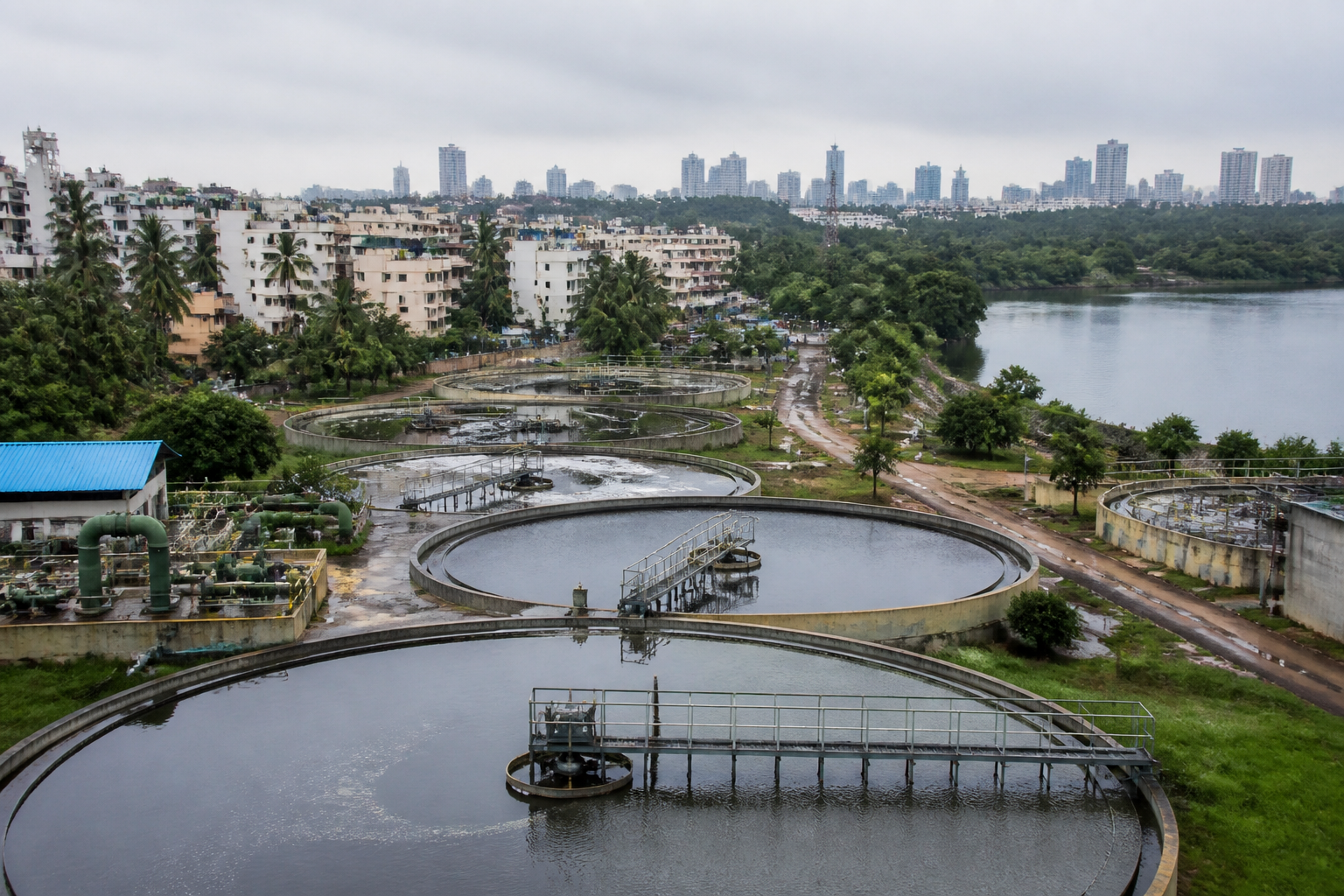
Bengaluru’s next major water challenge is moving from supply to treatment. The Bengaluru Water Supply and Sewerage Board (BWSSB) plans to establish nine new sewage treatment plants (STPs) with a combined capacity of 475 million litres per day (MLD), at a total estimated cost of Rs 2,071.21 crore. The proposal comes as the city generates far more wastewater than its existing treatment infrastructure can handle.
The scale of the gap is visible in the figures cited by the board. Bengaluru currently receives about 2,825 MLD of water, including Cauvery and borewell supplies, and generates approximately 2,580 MLD of wastewater every day. Its 37 existing STPs have a combined treatment capacity of only 1,364.5 MLD. On these figures, 1,215.5 MLD of wastewater is outside the capacity of the existing treatment network.
That mismatch places wastewater management at the centre of Bengaluru’s water and environmental infrastructure problem. Untreated or inadequately treated sewage can enter water bodies, while the city continues to face pressure on freshwater sources. The board’s new plan therefore has two linked objectives: increase treatment capacity and create a larger supply of treated water for non-potable uses.
The nine proposed plants will be developed in three packages. The first package covers six locations—Madiwala, Kadubeesanahalli, Kadugodi, Koramangala, Bellandur and Basapura—with a combined capacity of 175 MLD. The package has an estimated capital cost of Rs 836.75 crore and an operations and maintenance cost of Rs 119.92 crore, taking its total projected cost to Rs 956.67 crore.
The second package includes two plants at Doddanekkundi and Mylasandra, with a combined capacity of 200 MLD. Their capital cost is estimated at Rs 629.81 crore, while operations and maintenance are projected to cost Rs 92.91 crore. The total cost for the package is Rs 722.72 crore.
The third package consists of a 100 MLD plant at Byramangala. It carries an estimated capital cost of Rs 344.44 crore and an operations and maintenance cost of Rs 47.38 crore, bringing the package total to Rs 391.82 crore.
Across the nine plants, capital expenditure is estimated at Rs 1,811 crore. A further Rs 260.21 crore is earmarked for operations and maintenance. Capital expenditure therefore accounts for about 87.4% of the total project cost, while operations and maintenance account for about 12.6%.
The proposal is significant because wastewater treatment is not only a construction question. It is also an operating and financing challenge. A treatment plant can add capacity on paper, but its urban value depends on whether sewage reaches it through functioning networks, whether the plant operates consistently, and whether the treated output has a dependable market or reuse system. The material supplied by the board does not establish the implementation schedule for the nine new plants or explain how their performance will be monitored after commissioning.
The BWSSB already has another large expansion programme under way. According to the report, the board is constructing 42 STPs with an additional capacity of about 1,147 MLD. The proposed nine plants would add another 475 MLD. Together, these projects indicate an attempt to close the gap between wastewater generation and treatment capacity while accounting for further growth in water use.
The board is also linking the programme to the approved sixth phase of the Cauvery water project. As the city’s water supply expands, wastewater generation is expected to remain an integral part of the same urban water cycle. This makes treatment capacity a necessary complement to water-supply infrastructure rather than a separate environmental intervention.
Technology is another stated component of the plan. BWSSB sources cited in the report said the new plants would use advanced treatment systems designed to reduce pollutants including nitrogen and phosphorus. Existing plants are also expected to be upgraded in phases. These nutrients are particularly relevant to the health of urban lakes and other water bodies, although the supplied material does not provide plant-wise treatment standards, discharge targets or independent performance data.
The reuse plan is equally important. The board intends to use treated wastewater for filling lakes and for supply to industries, parks and construction activity. This would shift part of Bengaluru’s demand for such uses away from freshwater. However, the proposal’s success will depend on distribution infrastructure, quality standards, user agreements and the ability to move treated water from plants to areas of demand. The report does not specify the reuse volumes or the network proposed for this purpose.
The financing structure shows how expensive the transition will be. The board expects the state government to fund 25% of the capital cost and plans to contribute another 25% from its own resources. The remaining 50%—about Rs 905 crore—is expected to come through loans from eligible financial institutions at favourable interest rates, according to a BWSSB official quoted in the report.
That structure reduces the immediate burden on public funds but creates a long-term obligation for the utility. The capital cost is only one part of the financial commitment; the nine plants also carry more than Rs 260 crore in projected operations and maintenance expenditure. The ability to recover costs, maintain equipment and sustain treatment quality will influence whether the infrastructure delivers its intended environmental benefits over time. No tariff or cost-recovery plan is identified in the supplied material.
Bengaluru’s wastewater expansion also highlights an institutional issue: the city’s water infrastructure is being built in overlapping layers. The existing 37 plants, the 42 plants under construction, the nine newly proposed plants and the planned upgrades will need to function as one network. Their effectiveness will depend on trunk sewers, local connections, pumping systems, land availability and coordination with lake and urban development authorities. The announcement provides capacity and cost figures, but not a consolidated citywide map of how these components will connect.
The immediate urban question is whether Bengaluru can convert wastewater from a disposal problem into a managed resource. The numbers show the pressure clearly: 2,580 MLD of daily wastewater generation against 1,364.5 MLD of existing treatment capacity. The proposed 475 MLD expansion is substantial, but it is not the entire gap, and the city is simultaneously adding capacity through the 42 plants under construction.
What the proposal establishes is a clear direction of travel: more treatment capacity, tighter pollutant control, phased upgrades and greater reuse of treated water. What remains to be established is the delivery timetable, plant-level performance, the supporting sewerage network and the arrangements that will ensure treated water is actually reused. Those details will determine whether the Rs 2,071.21-crore programme becomes a functioning part of Bengaluru’s water system or remains primarily a capacity-creation exercise.
