


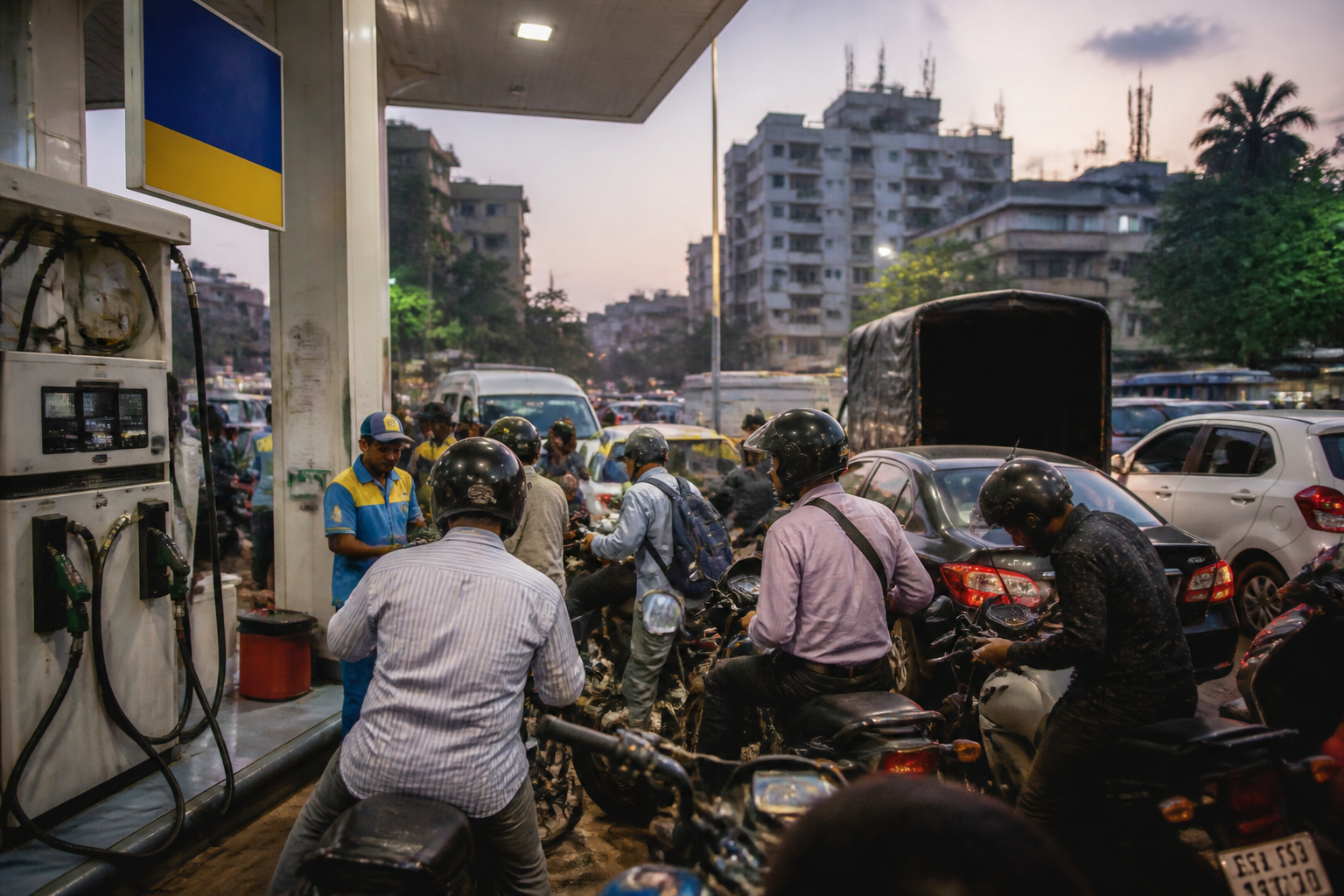
India’s petrol pricing benchmark has reached a 50-month high, but the larger concern is not only the number displayed in international oil data. It is the growing strain being placed on the country’s fuel-retailing system, where state-run oil marketing companies are reportedly losing money on every litre sold while geopolitical disruptions threaten to push crude prices higher.
The average daily benchmark price for petrol between September 1 and 18 was $133.05 a barrel, 20% above the August average of $110.87, according to official data cited by Hindustan Times. The benchmark has also moved above the recent peak of $129.63 recorded in May, when public-sector oil marketing companies raised petrol and diesel prices four times in one month.
That movement matters because India’s fuel market operates through a combination of international crude exposure, domestic retail pricing decisions and the financial capacity of state-run oil companies to absorb losses. When retail prices do not rise as quickly as international costs, the gap does not disappear. It becomes an under-recovery for fuel retailers, a pressure on public-sector balance sheets or a future pricing decision for consumers.
According to industry experts cited in the report, oil marketing companies are currently losing about ₹5 a litre on petrol and ₹20 a litre on diesel. Some private oil companies have also begun restricting bulk diesel sales, the report said. The figures indicate that the present pressure is not confined to crude markets; it is already affecting the commercial conditions under which fuel is supplied and sold.
The diesel benchmark has reached a four-month high of $167.08 a barrel, although it remains below the April 2026 peak of $187.92 during the recent energy crisis. Diesel is particularly important to the wider urban economy because it is used in commercial transport and other fuel-intensive operations. The supplied report does not quantify the effect on freight, public transport or municipal services, but losses of ₹20 a litre on diesel illustrate the scale of the exposure for retailers.
The current episode follows a sharp pricing adjustment in May 2026. State-run oil marketing companies raised petrol prices by ₹7.35 per litre and diesel prices by ₹7.53 per litre after their daily losses had mounted to ₹1,000 crore. That sequence shows how fuel pricing pressure can accumulate before being reflected at retail outlets. It also demonstrates the institutional role of public-sector companies in absorbing short-term volatility.
## India petrol prices and the cost of absorbing volatility
The central issue is the distance between the international cost of fuel and the price consumers pay at the pump. The report indicates that public-sector oil marketing companies may absorb under-recoveries during the July-September quarter. One industry expert quoted in the report said a price increase would become imminent if countries such as India and China succumbed to United States pressure to reduce purchases of Russian crude.
The statement is an industry assessment, not an announced government decision. Its significance lies in the supply mechanism it describes. India and China are the world’s second- and third-largest consumers of crude oil after the United States, according to the report. If their purchases of Russian crude decline significantly, they could compete more intensely for supplies from other producers, potentially increasing pressure on international prices.
That exposure limits the ability of domestic fuel retailers to treat the current price rise as a short-lived market fluctuation. The underlying risks include the price of crude, the origin of supplies, shipping routes and the degree to which retail prices are adjusted when costs rise. Each factor sits partly outside the control of Indian fuel retailers, while the consequences are felt inside the domestic distribution system.
The reported losses also raise a governance question about fuel pricing. Public-sector oil companies are commercial entities, but they have historically carried part of the burden of price stability. When they absorb losses, the immediate effect on consumers is delayed. However, prolonged under-recoveries can create pressure for later price increases or weaken the financial position of the companies involved. The supplied material does not establish how the losses will ultimately be accounted for or whether any government compensation mechanism is being used.
## Geopolitical disruption is becoming a fuel-supply problem
The pressure on international prices is linked in the report to several disruptions and risks around major energy routes. Industry experts cited concerns over energy flows through the Strait of Hormuz, less predictable Saudi Arabian supplies following attacks on oil infrastructure and export supply lines, and the possibility of further disruption through the Bab al-Mandeb Strait.
They also referred to drone attacks on Saudi Arabia’s East-West pipeline and new United States measures aimed at countries buying Russian crude. These developments affect more than the physical availability of oil. They also influence shipping security, alternative transport routes and the risk premium attached to international crude prices.
The movement in Brent crude during the reported week illustrates that volatility can run in both directions. Brent rose to $108.75 a barrel on September 15 after a Houthi drone hit the Saudi East-West pipeline, according to the report. It then fell to $105.83 on Wednesday and $103.87 by Friday’s close after Saudi Arabia worked to create alternative channels for moving crude.
This pattern is important for interpreting the petrol benchmark. A decline in Brent after a supply disruption does not remove the structural risk. It may instead show how quickly prices respond to new information about supply routes and contingency arrangements. The experts quoted by Hindustan Times warned that crude prices could rise again if geopolitical disruptions intensify. That remains a conditional assessment rather than a confirmed price trajectory.
For Indian cities, the immediate institutional question is how much of this volatility can be absorbed before retail prices change. Fuel is embedded in urban mobility and the movement of goods, but the supplied report does not provide city-level petrol prices, transport-fare data or household expenditure estimates. What it does establish is the financial pressure at the point where international energy markets meet India’s retail fuel network.
## The unresolved policy balance
The present situation exposes a recurring policy balance: protect consumers from sudden price increases, or allow retail prices to track international costs more closely. The first approach can reduce immediate disruption but transfers pressure to fuel companies. The second can protect company margins but pass the full shock to households and businesses.
The May price increases show that delayed adjustment does not eliminate the cost of higher crude. It can produce a larger correction after losses accumulate. At the same time, the report does not establish whether future changes will be automatic, politically directed or linked to a specific government policy. That uncertainty is central to understanding the operating environment for both public and private fuel retailers.
The report also points to a distinction between petrol and diesel. Petrol’s benchmark has reached a 50-month high, while diesel’s benchmark is at a four-month high but remains below its April peak. Yet the reported per-litre loss is substantially higher for diesel. This suggests that the significance of a fuel-price episode cannot be assessed by headline benchmark levels alone; the retail economics of each product also matter.
The next stage will depend on three observable developments: whether international crude prices remain above recent averages, whether disruptions affect the Strait of Hormuz, Bab al-Mandeb or Saudi export infrastructure, and whether public-sector oil marketing companies continue absorbing under-recoveries. The supplied material does not confirm a new domestic price increase. It confirms that the financial pressure behind such a decision has intensified.
India’s petrol-price challenge is therefore not simply a question of what consumers pay on a particular day. It is a test of how the country’s fuel-retailing institutions manage imported energy exposure, geopolitical risk and the political pressure for price stability. The data currently show rising benchmarks and mounting retailer losses; the remaining uncertainty is how long that gap can be sustained and who will ultimately bear its cost.
